
Twice a vehicle has driven into the façade of this building. Not in a high-speed accident, but the way it happens on many residential streets: the house stands close to the road, its own parking spaces lie in front of it, and anyone who loses control while manoeuvring, on ice or in a moment of inattention has only a few metres to the wall of the house. After the second time, it was clear to the owner that signs and hope were not enough. He wanted a barrier that actually stops a vehicle – and at the same time protects his cars from thieves.

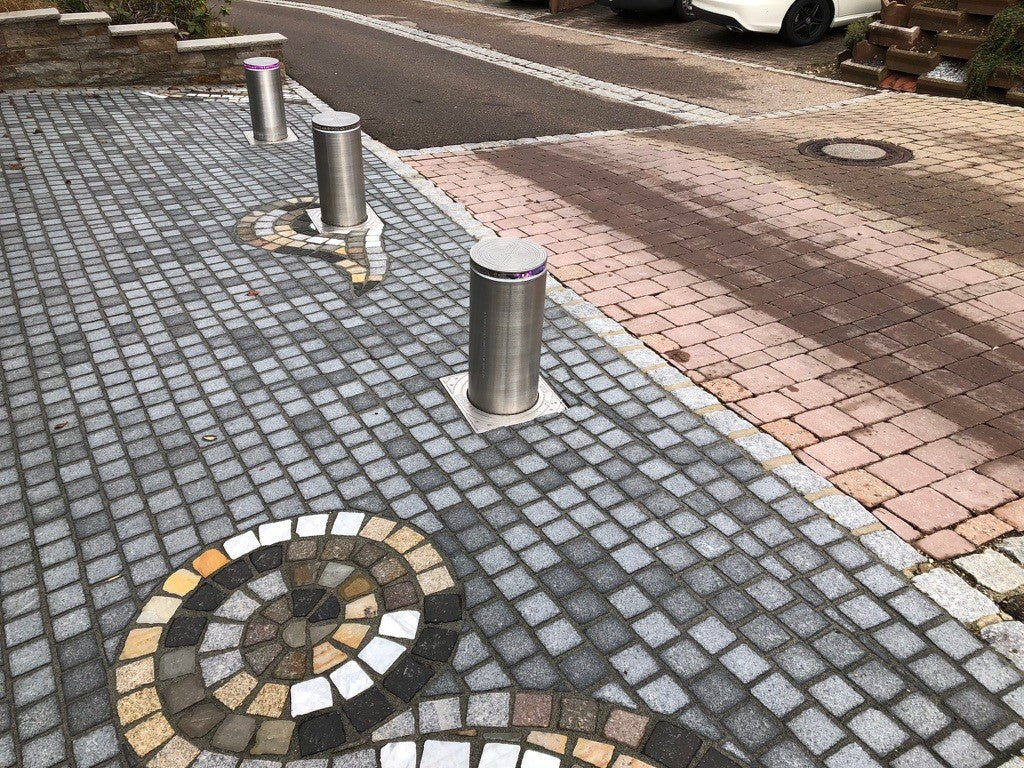
Seven retractable bollards made of stainless steel V4A (316) in the 160 kg standard version now stand between the pavement and the parking spaces. The façade behind them is exactly the one that was hit twice before.
Why not a fence or a wall
The obvious solution would have been a wall or a fence in front of the parking spaces. The only thing is: the spaces are to remain in use, several times a day, by several vehicles. A gate across the full width would have closed off the open front of the building, and nobody keeps getting out, unlocking and locking up again in the long run. On top of that came a second nuisance: unauthorised parkers who regarded the free spaces in front of the house as a public car park.
Retractable bollards solve both at once. When raised, they form a row of stainless steel that no vehicle breaks through and no stranger drives around. When lowered, only the lids lie flush in the paving, and the parking spaces can be reached in seconds – those who are allowed to park here lower the bollards without getting out.
Seven bollards along the street side
The row of bollards follows the edge of the property along the pavement. The spacing is chosen so that no car fits between two bollards, while pedestrians and bicycles pass unhindered. In front of the façade there is now a barrier of seven stainless steel cylinders, each anchored in its own sleeve deep in the ground. A vehicle that leaves the road no longer hits the wall of the house, but the bollard.

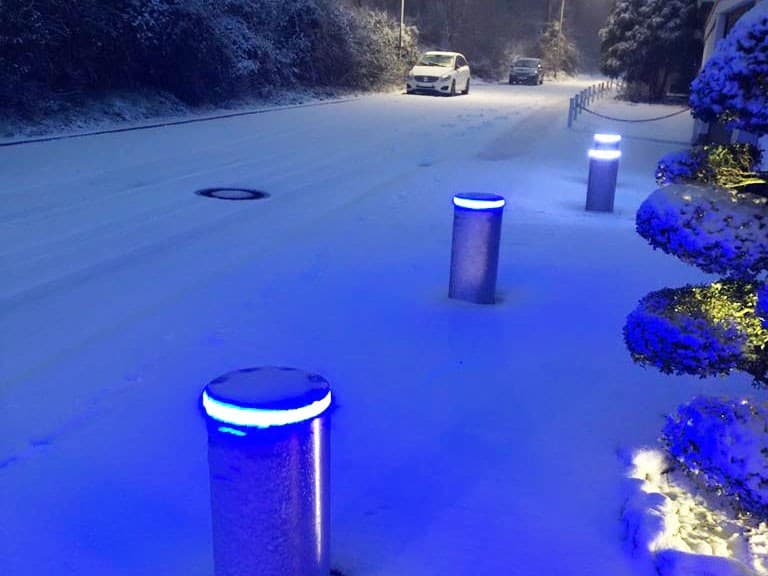
Fresh snow, dusk, blue LED rings: the bollards cannot be missed even when the road and pavement disappear under a blanket of snow.
Impact protection: what a V4A bollard can withstand
Installed here is our barrier bollard stainless steel V4A pneumatic in the standard version: around 160 kg, Ø 273 mm, 600 mm stroke, made of stainless steel 1.4571 with 6 mm wall thickness and an installation sleeve set deep in the ground. It is the bollard we install in the vast majority of driveways and in front of buildings – designed to stop a car of the kind found on a residential street. For sites where lorries or deliberate ramming must be expected, there are our security bollards with a steel core, which we tested in a crash test with a 12-tonne lorry. Here, the standard version was sufficient: it stops a car before it reaches the façade, and that was exactly the task.
What matters for impact protection is what is inside the bollard – or rather, what is not. With our pneumatic bollards, the only thing in the ground is a stainless steel cylinder with a mechanical lock. No motor, no circuit board, no limit switches that could be damaged in an impact. The compressor and valves stand dry in the building.
Theft protection: the bollard stays up, the car stays put
The second reason for the system was the vehicles themselves. Most cars are stolen where they stand at night: in front of their own house. Electronic immobilisers can be outwitted with the well-known methods; a row of stainless steel bollards cannot. Anyone who wants to drive the car away must first lower the bollards, and that is only possible with the owner's authorisation.
What counts here is a detail we build into every one of our bollards: the mechanical height lock. When the bollard rises, it engages at the top via a locking bolt. After that it can no longer be pushed down – not even if someone cuts the compressed air hoses. The air escapes, the bolt holds, the barrier stays closed. And the system can be set so that the bollards stay up during a power failure instead of sinking. For theft protection, this is exactly the right setting: cutting the power opens nothing.

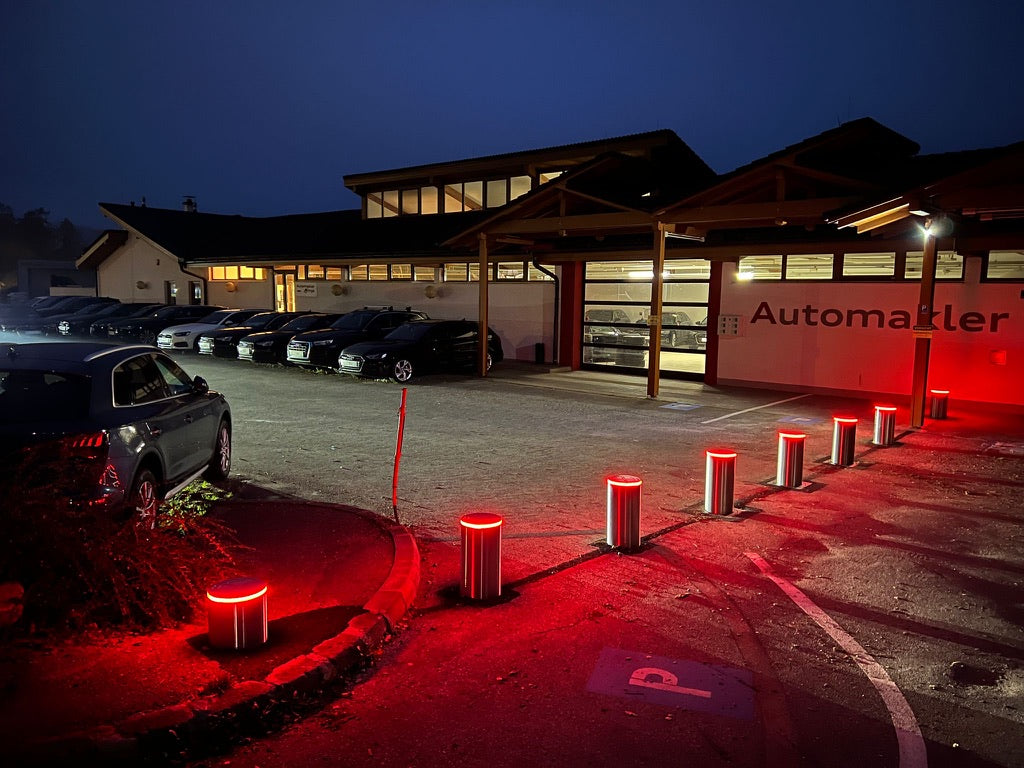
Raised and locked at night: without authorisation, the vehicles behind the row of bollards cannot get onto the street.
Snow, road salt, frost – and the system keeps running
The photos were taken in the first winter after installation, and they show the conditions under which a bollard on a street has to work: snow on the lids, meltwater in the sleeves, road salt from the pavement, frost for weeks. Our bollards are sealed to IP69, the piston rod seals are designed for temperatures down to −35 °C, and because there are no electronics in the ground, the system needs neither a heater nor a drain. Condensation, which becomes a problem in frost for bollards with a built-in motor, does not occur here. Overall, the system is very low-maintenance; should a valve or the compressor need replacing after years, this is done in the house, on quick-release couplings, without opening the paving.

The row at night: seven bollards, seven blue rings, and no vehicle gets through in between.
Blue LED rings as a guide line
Each bollard carries an LED ring under the lid, here in blue. It has two tasks. Drivers on the street can see from a distance in darkness and driving snow where the property boundary runs, and the residents can see immediately on returning home whether the bollards are up or down. The colour can be chosen freely; with our RGB bollard light it can even be changed via an app.

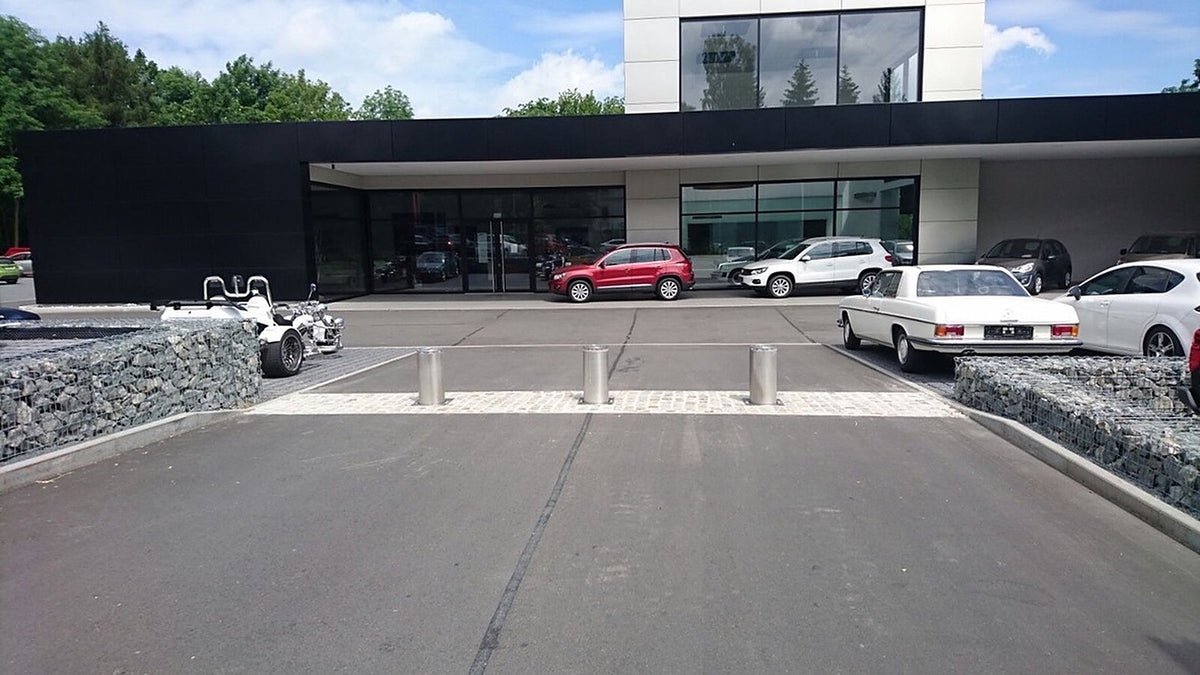
View along the façade towards the street: between the house wall and the roadway there are only the parking spaces – and, since the installation, the row of bollards.
The result
Since the installation, no vehicle has reached the façade, the unauthorised parkers have disappeared, and at night the cars stand behind a locked stainless steel barrier. The owner put it to us like this: he now sleeps soundly. At his request, we do not give his name or the location.
Is your building also right next to the street?
If there are only a few metres between the roadway and the house wall, the question is not whether something will happen, but when. How to protect your driveway and façade is summarised in our topic page Driveway and vehicle protection; what bollards can do against car theft is explained on the page Vehicle theft protection, and for the topic of unauthorised parking there is the page Unauthorised parking.
Send us a photo of your situation via WhatsApp to +49 172 4544485 or call us on +49 40 226390411. We will tell you how many bollards you need, where they should stand and which version suits your protection requirements. You will find all models and prices in the overview retractable bollards made of stainless steel V4A. Everything is manufactured at our site in Seevetal near Hamburg.