

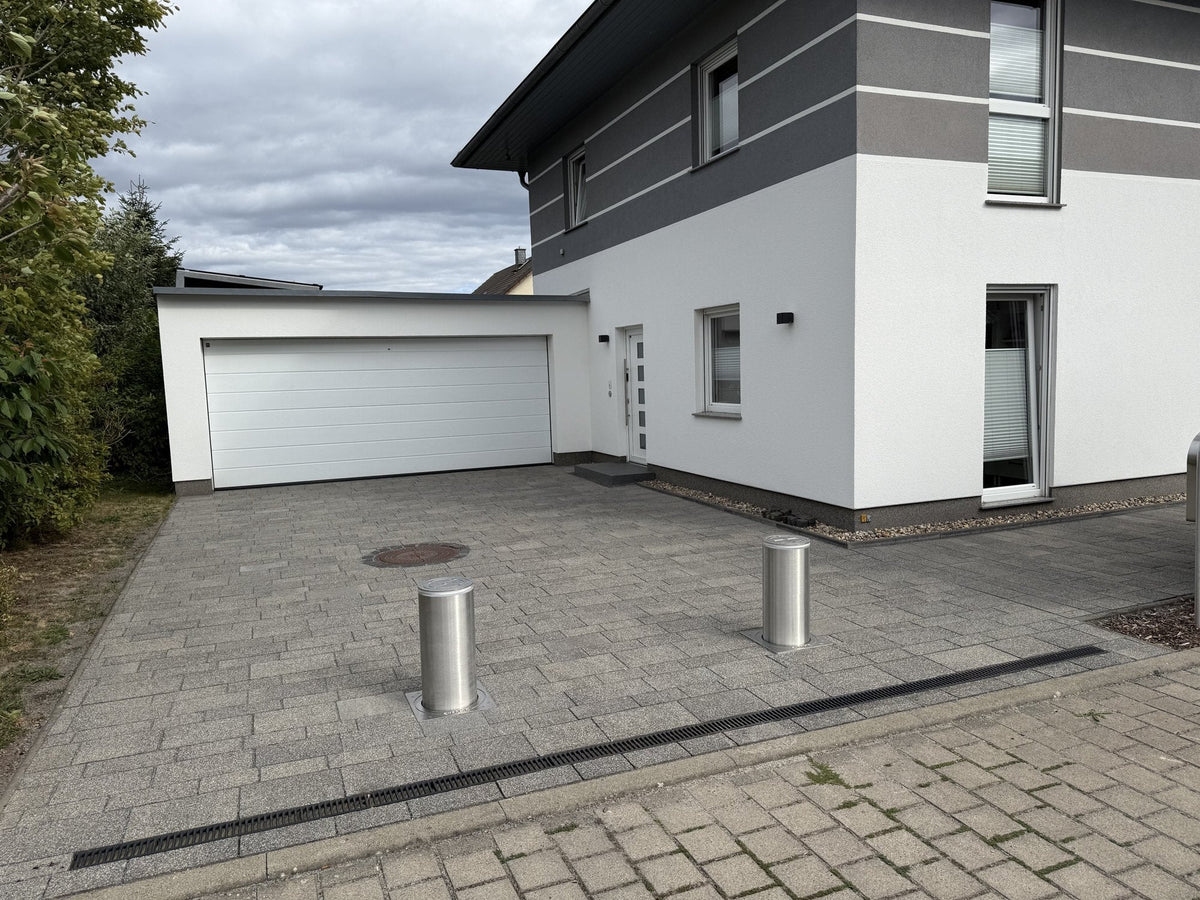
An open driveway is convenient, but it can also mean that strangers park, turn or use freely accessible parking spaces on your property. Anyone who parks a high-value vehicle in front of the house or under a carport may want to secure the property exit as well.
Besides gates, barriers and fixed blocks, retractable bollards are also an option. They physically restrict access and can be fully cleared again when needed. On this page you will learn which options are available for private properties, when a bollard can make sense and which questions should be clarified before choosing and installing one.
How can a private driveway be secured effectively?
A private driveway can be controlled with a gate, a barrier, or fixed, manual or retractable bollards, among other things. Which option makes sense depends on the specific goal: do you want to deter unauthorised parkers, prevent unauthorised driving onto the property or give a vehicle additional protection against theft? Retractable bollards are particularly suitable for regularly used driveways when a physical barrier is wanted that conveniently disappears into the ground when required.

Why can it make sense to secure a private driveway?
Keeping unwanted parkers away
A freely accessible parking space can unintentionally look like a public parking spot, especially in busy residential areas or near shops, stations or event venues. A clearly visible physical access barrier can prevent your own parking space from being used without permission.
Unlike a sign, a raised bollard actually prevents the vehicle from driving in.
Preventing unauthorised driving and turning
Open yards and driveways are sometimes used for turning or brief stops. This can be a nuisance and cause additional problems on properties with children, pets or tightly packed buildings.
Controllable access ensures that only authorised vehicles get onto the property, without the driveway having to stay closed permanently.
Making vehicle theft more difficult
If a high-value vehicle stands in the open on a parking space or under a carport, an additional physical barrier between the vehicle and the public road can make sense.
A bollard does not guarantee protection against vehicle theft. However, it can make it harder to drive the vehicle away through the regular exit and thus form an additional element of a multi-layered security concept.
Controlling access to the property
Maximum security is not always the priority. Often it is simply about being able to decide for yourself when the driveway is open.
Retractable systems combine this gain in control with ease of use: with the appropriate control system, the bollard can be operated from the vehicle and raised again after passing through.
What options are there for securing a driveway or parking space?
Not every property needs the same solution. A first comparison:
| Solution | Suitable for | Advantages | Points to consider |
|---|---|---|---|
| Manual bollard | Rarely used parking spaces | Simple, low technical complexity | Has to be moved by hand |
| Retractable bollard | Regularly used driveways | Convenient and space-saving | Requires installation in the ground |
| Fixed bollard | Permanently blocked areas | Permanent physical barrier | No passage possible |
| Barrier | Wider entrances | Quick opening | Needs space at the side and offers a different kind of protection |
| Gate | Closing off the property | Privacy and access protection | More space and construction work required |
For a frequently used private driveway, the retractable bollard is particularly interesting: it needs no lateral swing area and clears the driving surface again once lowered.
When does a retractable bollard make sense for a private driveway?
Regularly used driveway
If you drive in and out every day, you do not want to get out each time and remove a manual barrier. Depending on the system, automatic retractable bollards can be operated conveniently from inside the vehicle.
Limited space
Depending on its design, a gate needs a swing area or room to slide sideways. A retractable bollard, by contrast, moves vertically into the ground and is therefore also suitable for driveways where space is tight.
Visual requirements
When lowered, the driveway remains largely clear. This can be an advantage, especially on modern properties or open courtyards, where a permanently visible barrier is not wanted.
Additional physical barrier
Electronic vehicle or access security and physical property security perform different tasks. A bollard creates a real obstacle in the entrance and can therefore be a useful addition to other measures.
Can bollards protect against vehicle theft?
A bollard should not be seen as a guarantee against car theft. Its job is rather to create an additional physical hurdle between the parked vehicle and the public road.
If the regular property exit is blocked by a bollard, the vehicle cannot easily be moved off the property by that route at least.
Bollards as part of a security concept
Especially with high-value vehicles, it is advisable not to rely on a single protective measure. Depending on the situation, the following may also be useful:
- garage or protected parking space
- the vehicle's own or an additional immobiliser
- alarm system
- adequate lighting
- video surveillance in compliance with legal requirements
- electronic vehicle security
Several independent layers of protection can offer greater security than focusing on a single measure alone.
Which bollard solution suits which private application?
The table is intended as a guide. Before choosing a specific product, the installation situation and the desired level of protection should be checked.
| Situation | Primary goal | Possible solution | Operation |
|---|---|---|---|
| Own driveway | Keep other vehicles out | Retractable bollard | Radio |
| Several family members | Flexible access | Retractable bollard | Several remotes / GSM |
| Parking space in front of the house | Prevent unauthorised use | Bollard | Depending on use |
| High-value vehicle in a carport | Additional physical protection | Reinforced bollard | Radio / GSM |
| Several authorised users | Simple access management | Automatic bollard | GSM / smart control |
| Area must never be driven on | Permanent barrier | Fixed bollard | No control required |
What needs to be clarified before installing a retractable bollard?
Installation location
The bollard should be positioned so that the intended entrance is actually blocked. It should also be checked whether vehicles could drive round the barrier at the side.
Installation depth
A retractable bollard needs sufficient space in the ground. The required depth depends on the particular system.
Utility lines
Before any groundwork, it must be clarified whether water, electricity, gas, telecommunications or other lines run through the intended area.
Drainage
Rainwater and surface water must not collect uncontrolled in the installation area. The planned drainage is therefore part of the planning.
Subsoil and surface
Paving, concrete or asphalt may require different work during installation.
Slope
The gradient of the driveway is also relevant. Slope and surface water must be taken into account when positioning and installing the bollard.
Number of bollards
For narrow entrances, one bollard may be enough. For wider driveways, it must be checked whether several blocking points are required.
How can a retractable bollard be operated?
Which control system fits best depends above all on how many people need access and how flexibly permissions should be assigned.

| Control | Particularly suitable for | Advantage |
|---|---|---|
| Radio remote control | Individual households | Very easy to use |
| GSM control | Several or changing users | Access via mobile phone |
| Smart home integration | Connected homes | Integration into existing systems |
| Push button | Certain fixed applications | Simple local operation |
How much does a bollard system for a private driveway cost?
There is no flat overall price for a bollard system, because the costs are made up of several components:
- bollard or bollard system
- control and operation
- groundwork and installation
- electrical, pneumatic or other lines and technology
- sensors or additional equipment, if required
The structural situation in particular can affect the overall effort. An existing paved driveway with straightforward cable routing has different requirements from an area with extensive groundwork or several bollards.
How does a bollard system work in everyday use?
Do I have to get out of the vehicle to open it?
Not with a suitably equipped automatic system. Radio or other remote controls allow access to be granted from inside the vehicle.
Can several people operate the bollard?
Yes, the specific implementation depends on the control system. For example, several handheld remotes or appropriately set-up users can be used.
How do visitors or family members get access?
This can be organised in different ways depending on the control system. Permanent access can be set up for regularly authorised people, while flexible systems offer additional options.
What happens when the bollard is raised?
The entrance is physically blocked. The operating logic should therefore be chosen so that authorised users can open the bollard at any time in line with the intended operation.
How quickly can the entrance be opened?
The rising and lowering time depends on the model. When choosing, you should therefore consider how often the driveway is used and what level of convenience is wanted.
What happens in the event of a power cut, frost or a fault?
Retractable bollards are permanently outdoors and must therefore be considered together with their installation situation. Rain, dirt, frost and snow can be just as relevant as reliable water drainage.
Failure scenarios should also be clarified before buying: what happens in a power cut? Is there an alternative or manual means of operation? How does the chosen system behave in the event of a fault?
The specific answers depend on the technical design of the respective Braun Antriebe system. That is precisely why these questions should be clarified for the specific model before installation.
How private driveways are secured with bollards
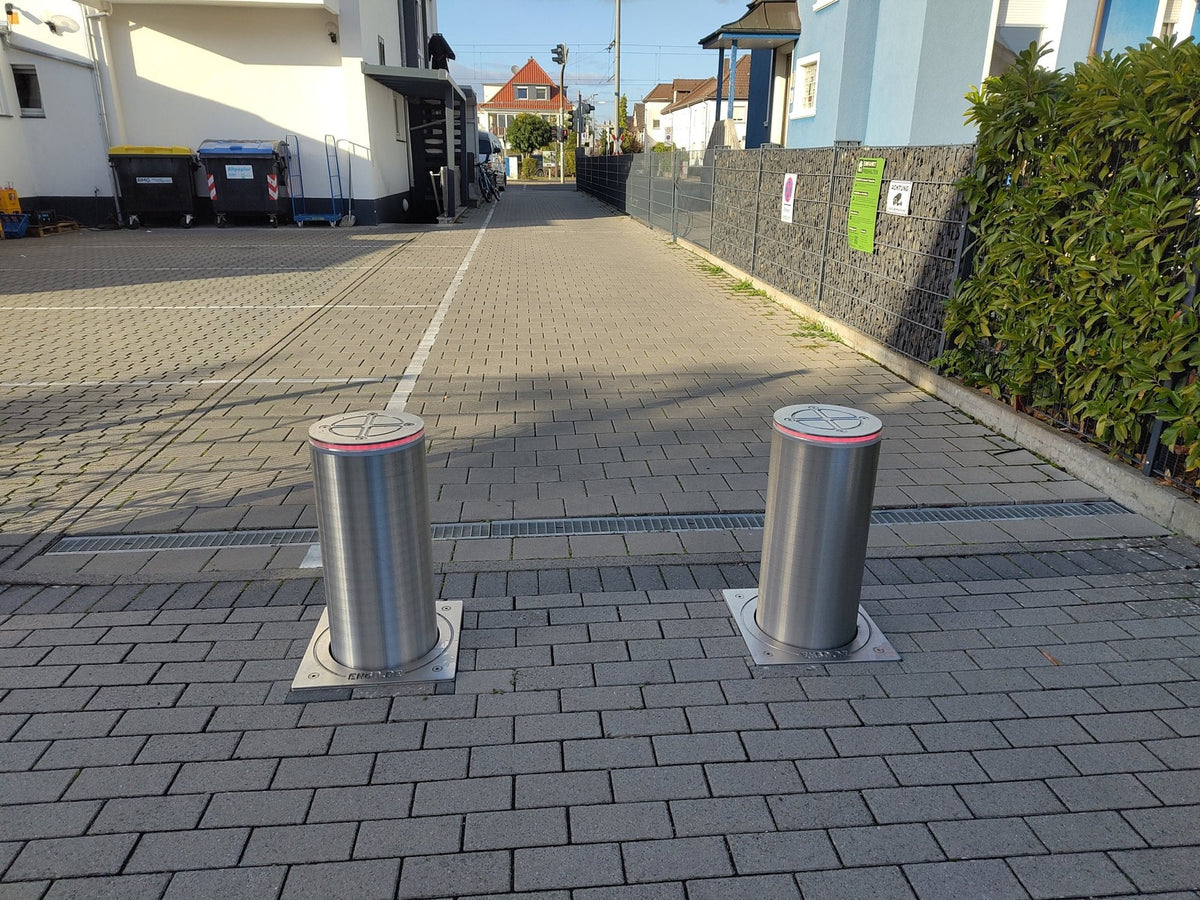
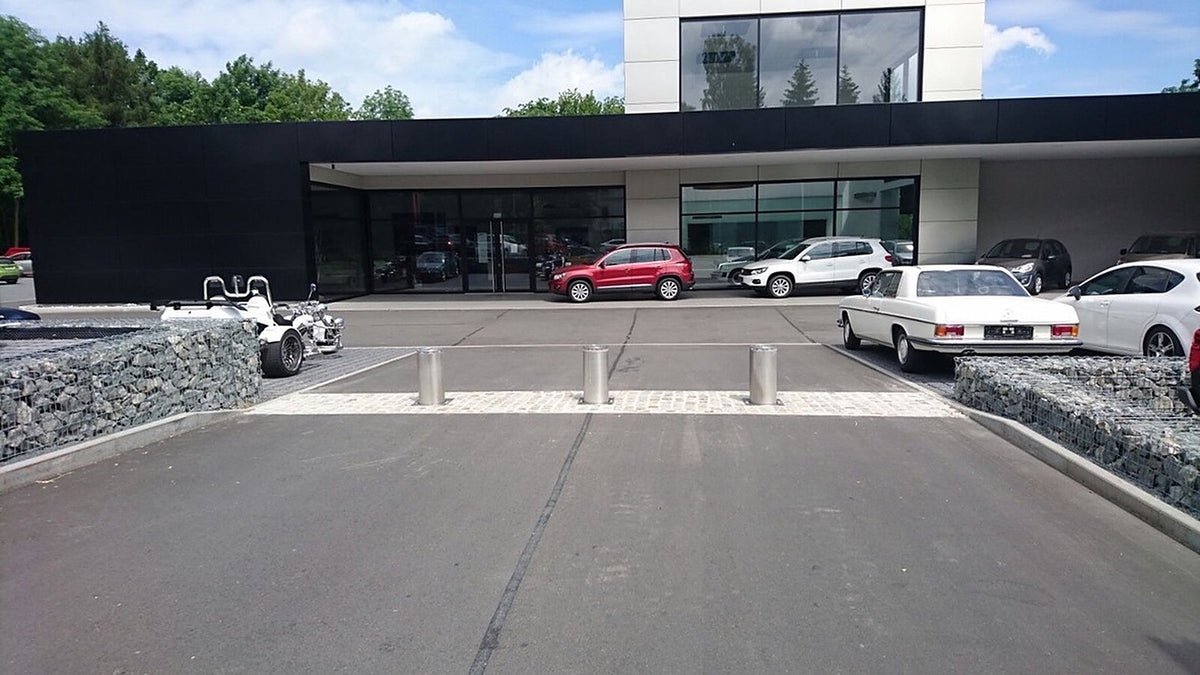
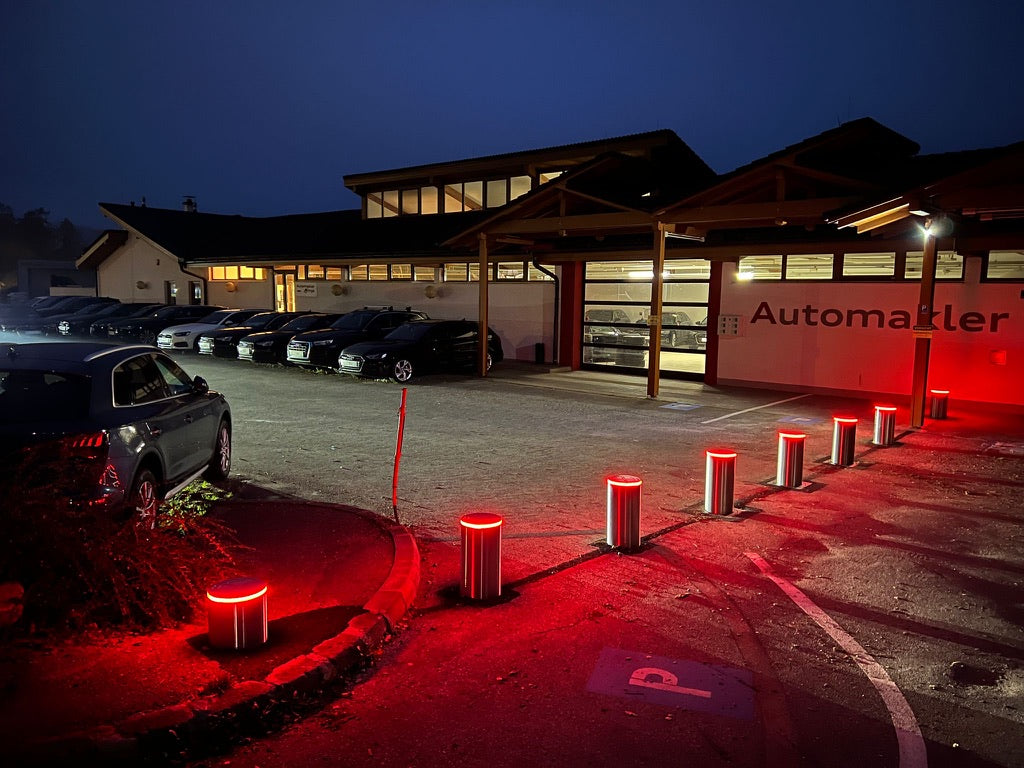
Practical examples show particularly well how different requirements can be. Among other projects, Braun Antriebe has secured entrances to private homes where unauthorised driving onto the property was to be prevented.
Other typical applications are parking spaces or carports, where a bollard forms an additional physical barrier in front of the vehicle, and wider yard entrances, for which several blocking points can be controlled together. You can find practical examples in our references.
Would you like to secure your driveway or parking space with a retractable bollard?
View stainless steel bollardsRequest adviceFrequently asked questions about securing driveways and parking spaces
Can I retrofit a retractable bollard?
Retrofitting is generally possible if the structural conditions allow it. Key factors include sufficient installation depth, the routing of utility lines, drainage, the subsoil and the desired position of the bollard.
How deep does a retractable bollard need to be installed?
That depends on the specific bollard model and its installation unit. The required installation depth should therefore be planned on the basis of the technical data of the chosen system rather than assumed across the board.
Is one bollard enough for a driveway?
That depends in particular on the width and geometry of the entrance. What matters is that vehicles cannot simply pass the intended barrier at the side.
Can I operate a bollard with my smartphone?
Depending on the control system used, operation via the mobile network or suitable connected systems is possible. Which option makes sense depends on the system and the user concept.
Can several people use the same bollard system?
Yes. For example, several radio remotes can be provided or users can be managed via a suitable digital or GSM-based system.
How much does a retractable bollard cost including installation?
A reliable total can only be given after assessing the site. In addition to the bollard, there are costs for the control system, groundwork, technical connections and any further equipment.
Can a bollard prevent car theft?
Not with any guarantee. However, it can create an additional physical hurdle and thus make it harder to remove a vehicle via the normal property exit.
Do retractable bollards work in winter too?
That depends on the system, the installation and the ambient conditions. Drainage, snow, ice and dirt should therefore be taken into account at the planning stage and during operation.
Do I need permission for a bollard on my property?
There is no blanket answer. The property boundary, land dedicated to or used by the public, local regulations and the structural situation can all play a role. If in doubt, the relevant authorities should be involved before installation.
Which bollard solution suits your driveway?
The width and layout of the driveway, the desired level of protection, daily use, the subsoil, the number of users and the preferred method of operation together determine which solution makes sense.
Braun Antriebe supports you in selecting and configuring a bollard solution that suits your property and your requirements. Discover our retractable stainless steel bollards or request a bollard solution for your driveway.
In-depth guide
You will find detailed information on choosing, planning and operating retractable bollards for private driveways in our guide Retractable bollards for your driveway.

Share:
Retrofitting Bollards: Secure Your Driveway & Access Reliably – the Guide
Access Management for Businesses and Properties: Controlling Entrances Safely and Efficiently