

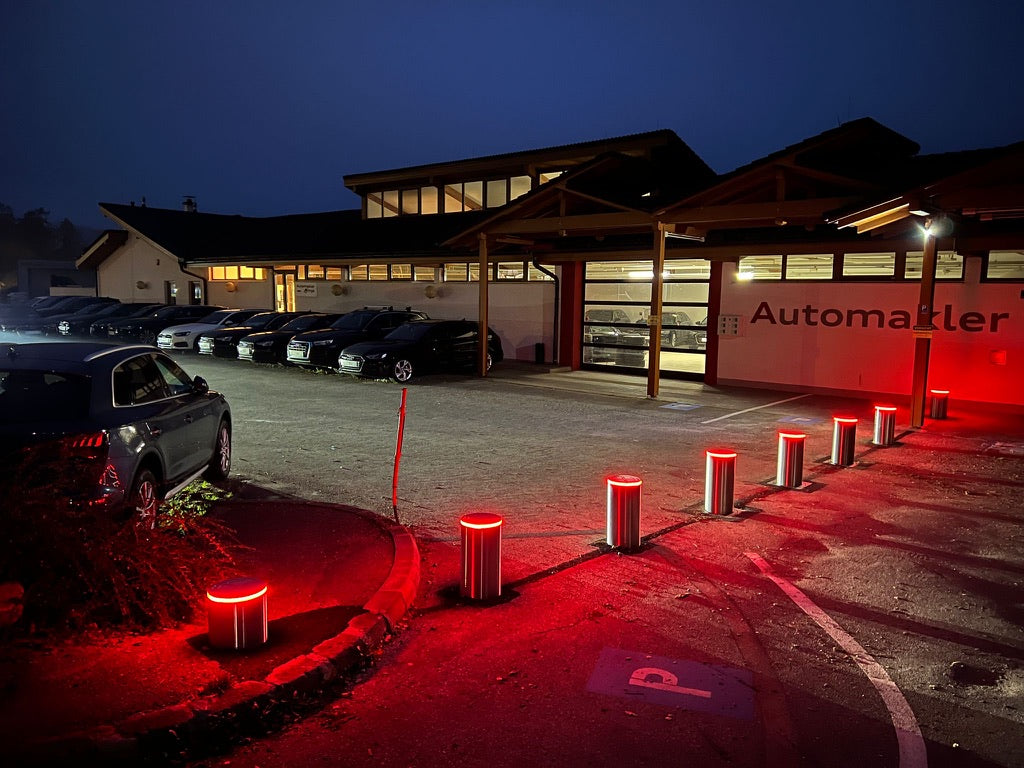
A car dealership depends on its vehicles standing outside: clearly visible, close to the road, still lit up in the evening. That is exactly what makes the display forecourt a target at night. Anyone who wants to steal a car does not need to break into a workshop – all they need is an open access and a few minutes. A car dealership in Austria wanted to close this access without sealing off the forecourt with a fence or roller door. The solution: a row of retractable bollards made of stainless steel V4A – with no hydraulic motor or electric motors in the bollard, powered by compressed air from its own workshop.

In the evening, when the business closes: the bollards stand in an arc between the road and the display forecourt, the LED rings glow red. Anyone wanting to turn in here can see the boundary from a hundred metres away.
The problem: a display forecourt is open – and has to be
The area in front of the building is the sales floor. During the day, customers drive in and out, new cars are moved around, and service customers roll up to reception. A gate opening and closing every time would slow the business down, and a fence would screen the vehicles off from the road – which is exactly why they stand there. At night this is reversed: a fleet worth a six-figure sum then stands behind a boundary consisting of nothing but a kerb.
For car dealerships, this is no theoretical risk. With demonstrators and new cars fitted with keyless systems, a theft often takes only a few minutes, and thieves arrive with a van or drive the vehicle straight off the forecourt. What is needed, then, is a barrier that is insurmountable at night and disappears during the day.
The solution: bollards in an arc, fixed at the ends, retractable in the middle
The bollards do not stand in a straight line but follow the arc of the entrance – from the grass verge by the road to the corner of the building next to the workshop entrance. The two outer bollards, far left and far right, are fixed bollards: set firmly in concrete, with no technology, as a permanent boundary and ram protection. They mark the passage width and never need to be moved. The bollards in between are retractable. During the day they are lowered and the entrance is as wide as before; in the evening they rise and the access is closed.
The mix has a practical reason: every retractable bollard costs more than a fixed one and needs a hose bundle and an installation sleeve. Where a bollard never needs to be lowered anyway, the fixed version is sufficient – same look, same stainless steel, same LED lighting, considerably cheaper. Visually, the bollards are indistinguishable: brushed stainless steel V4A, Ø 273 mm, with an LED ring under the lid.
Compressed air from the workshop: no hydraulic motor, no electric motors in the bollard
Our bollards work pneumatically. The bollard itself contains only a stainless steel cylinder with mechanical locking – no hydraulic power unit, no electric motor, no circuit board, no limit switch, no heater. Nothing that could fail is installed outside in the ground, where rain, frost, road salt and condensation would get to work on it. That is the core of our concept: no technology outdoors that can break.
This car dealership shows how simple that becomes in practice. Every vehicle workshop has compressed air anyway – for impact wrenches, tyre fitting and the paint shop there is a compressor with a ring main. The bollard system was connected to this network; the valves sit in the plant area, and from there the hoses run in armoured hose to the bollards. All the technology is therefore kept dry inside the building, where the mechanics work every day. Should a valve ever need replacing, the workshop does it itself – every component sits on quick-release couplings. An electric or hydraulic bollard would have to be removed for this. Why we rely on compressed air rather than electric spindles or hydraulics for bollards is explained in our comparison of bollard drives.
Radio operation with rolling code
The system is operated by hand-held radio transmitter. For a car dealership, one detail is important that rarely comes up for private users: the radio link uses rolling code. Each press of the button sends a new, one-time code – an intercepted radio signal cannot be replayed to lower the bollards. For a business that has vehicles worth as much as a detached house standing outside at night, this is not a luxury but a prerequisite. On request, the bollards can additionally be controlled by timer, by smartphone or from the showroom; for customer access there are road controls with induction loop or number plate recognition.
Locked at night – even without power
When raised, each bollard locks mechanically at the top via a locking bolt. After that it can no longer be pushed down, not even with a vehicle. Even if someone cuts the compressed air line, only the air escapes – the bolt holds and the bollard stays up. And the system is set so that the bollards remain raised in the event of a power cut. Anyone who unscrews the fuse or cuts the cable opens nothing. This is exactly the setting we recommend to every car dealership; for private driveways, the reverse option is usually chosen, in which the access is free in the event of a power cut. More on this on our page Vehicle theft protection.
Red light as a boundary
All the bollards – fixed and retractable alike – have an RGB LED ring whose colour can be selected via an app. The dealership opted for red at night. This is a deliberate choice: a red-glowing arc of stainless steel posts in front of an illuminated display forecourt is unmistakable from the road. Nobody turns in here “by mistake”, and anyone who tries anyway has seen beforehand what awaits them. During the day, lowered, only the round stainless steel lids remain in the tarmac.
The technology
The bollards installed are our barrier bollards stainless steel V4A pneumatic in the standard version: around 160 kg, Ø 273 mm, 600 mm stroke, 6 mm wall thickness, stainless steel 1.4571. This is the bollard we install in the vast majority of cases – for commercial customers too. The bollards are sealed to IP69 and designed for temperatures down to −35 °C, which is certainly called for in an Austrian winter: snow, road salt and meltwater do not bother them, and they need neither heating nor drainage. The outer bollards are the fixed version with the same diameter and LED ring. Everything is manufactured at our site in Seevetal near Hamburg.
For data protection reasons, we do not disclose the name or exact location of the dealership.
Do you run a car dealership or a commercial yard?
If you have vehicles, machinery or goods standing outdoors at night, a bollard system is usually quicker to install and less of an obstacle in everyday use than any gate. How bollards protect businesses against ram-raids and theft is summarised in our topic section Ram-raid, burglary and theft protection; answers to the most frequent questions about installation, costs and operation can be found in the FAQ on retractable bollards. If you already have a compressed air network, let us know – the system can then be connected directly to it.
Send us a photo of your access via WhatsApp to +49 172 4544485 or call us on +49 40 226390411. We will tell you how many bollards you need, which of them can be fixed and which control system fits. We deliver to Germany, Austria and Switzerland. You will find all models and prices in the overview retractable bollards made of stainless steel V4A.


Share:
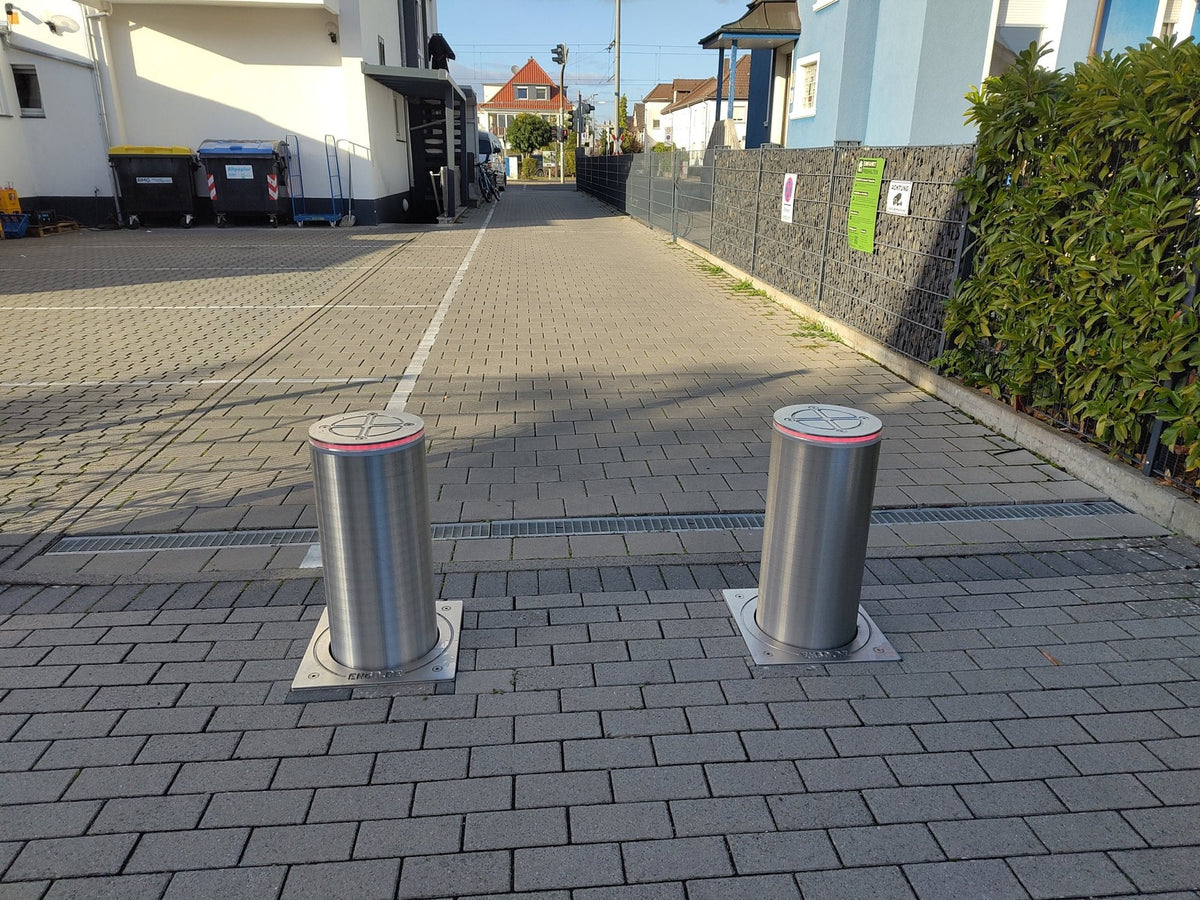
Turning head on the doorstep: three retractable bollards end the turning and manoeuvring over the granite paving
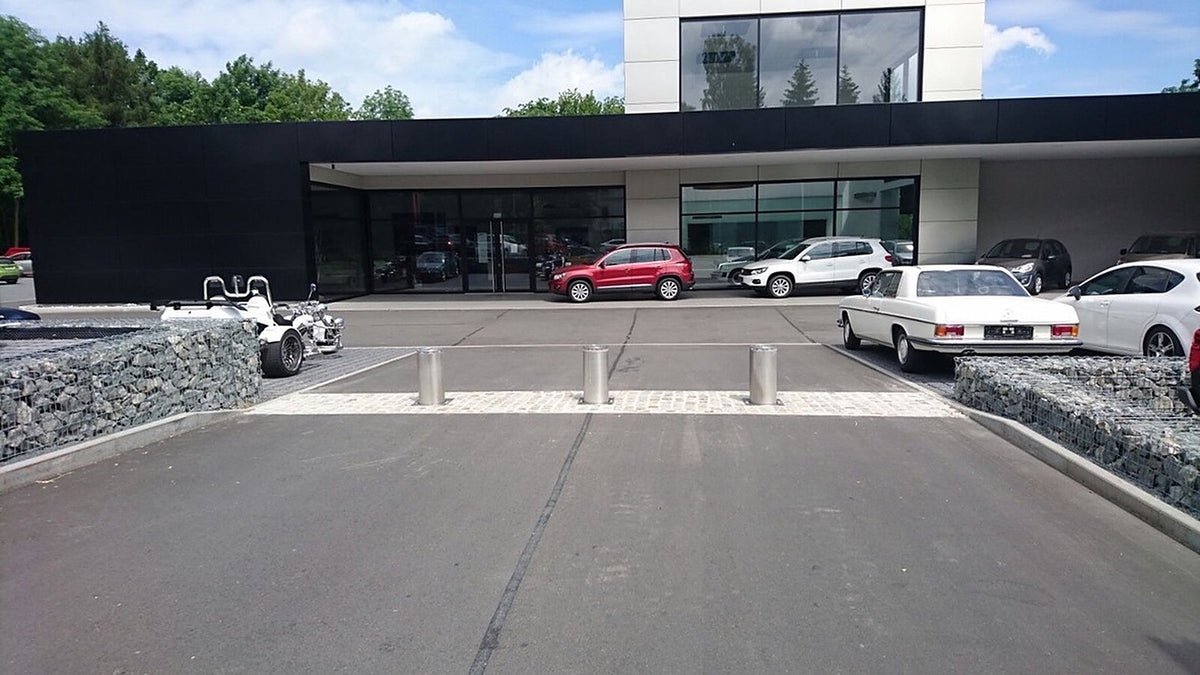
Car dealership protected: retractable bollards controlled by the PLC – with compressed air from the workshop