

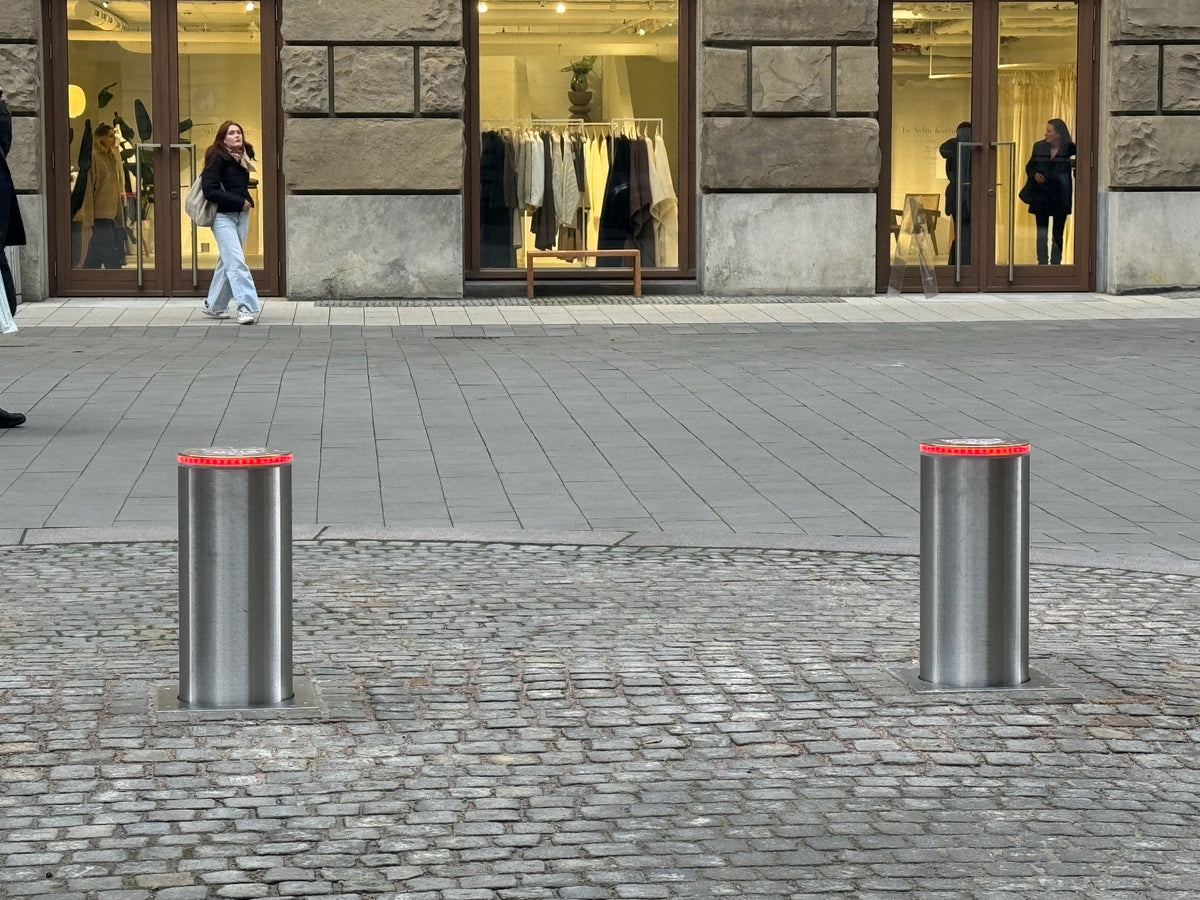
Car dealerships, jewellers and shops with high-value goods can be exposed to very different risks. In addition to conventional burglaries via doors or windows, vehicles can be used to force their way into shop windows or other parts of a building. For car dealerships and vehicle rental companies, there is also the risk of vehicle theft.
An effective security concept should therefore combine several layers of protection. Bollards can complement the outer physical protection of a site by restricting vehicle access or making direct approaches more difficult. However, they replace neither the protection of the building envelope nor alarm, video or organisational measures.
How can car dealerships, jewellers and high-end shops be protected against burglary and vehicle attacks?
Effective burglary, ram-raid and theft protection combines several independent measures. Vehicle barriers can physically hinder direct access to shop windows, showrooms or parked vehicles. At the same time, doors, windows and glazing need suitable mechanical protection. Intruder alarm systems, video surveillance and organisational measures can be used in addition. Which combination makes sense depends on factors such as the location, the objects to be protected, the value of goods or vehicles, possible approach routes and the specific protection objective.

Which risks should particularly vulnerable commercial properties consider?
Conventional burglary: In a conventional burglary, offenders try to gain access to the building via doors, windows, side entrances or other weak points. Mechanical protection of the building envelope is therefore a separate layer of protection. For commercial properties, the German police crime prevention programme puts mechanical security first and recommends alarm and video technology as a supplement.
Ram raid: In a ram raid, a vehicle is used to force its way through an outer boundary, façade, door or glazing. In such cases, protection can start before the building envelope itself. What matters, however, is not simply placing the most massive bollard possible in front of the property. Possible approach routes, the possibility of driving around barriers, positioning and the resistance actually required must be considered together.
Vehicle theft: This risk is particularly relevant for car dealerships, vehicle rental and leasing companies and suppliers of high-value vehicles. The police point out specifically for car dealers that offenders may break into business premises after closing time to obtain original keys and then steal vehicles from the showroom or forecourt. This makes it clear that, with vehicle theft, the vehicle, the property entrance and key management must be considered together.
What is the protection objective at the site?
The starting point should not be the question “Which bollards do we need?”. First, it should be defined what exactly is to be protected.
- People – staff, customers and visitors
- Buildings – façades, entrances, doors and shop windows
- Goods – jewellery, watches, electronics or other high-value products
- Vehicles – display vehicles, customer vehicles and high-value used cars
- Property – entrances, outdoor areas and car parks
- Business continuity – sales areas, workflows and the ability to continue operating after an incident
After all, a break-in does not only cause immediate damage to goods or vehicles. Repairs, closed sales areas, business interruptions and additional organisational effort can also have considerable consequences. The more clearly the protection objective is defined, the more precisely suitable measures can be combined.
Where does effective burglary and theft protection begin?
A security concept can usefully be divided into several successive zones:
- Zone 1 – property boundary and entrance: bollards, gates and clearly defined vehicle entrances
- Zone 2 – outdoor area: lighting, clear sightlines and appropriate positioning of vehicles and goods
- Zone 3 – building envelope: doors, windows and glazing
- Zone 4 – interior: intruder alarm technology, video and protection of valuables
- Zone 5 – organisational security: key management, authorisations and locking procedures
The underlying idea: the earlier unauthorised access is made more difficult, the more independent hurdles there are.
What role can bollards play in burglary and theft protection?
Bollards are not a universal solution against burglary. However, they can perform important tasks in the outer security zone of a site:
- physically restricting vehicle access
- making direct approaches to certain parts of a building more difficult
- providing additional protection for parked vehicles from the public road
- controlling access to the property
- closing certain areas to vehicles permanently or temporarily
The actual protection a bollard offers depends on its design, installation, positioning and any tests carried out. Blanket claims such as “insurmountable” or “absolutely crash-proof” therefore make no sense. Where security requirements are higher, the specifically proven performance of the barrier concerned should always be considered.
Standard bollard or tested vehicle security barrier?
Not every massive bollard performs the same task. If a defined vehicle attack scenario is part of the protection objective, the term “security bollard” alone is not enough. Technical evidence and test conditions must then be examined.
How can shop windows and glass façades be protected against ram raids?
An effective concept does not simply consist of “putting bollards in front of the shop window”. Points to check include:
- possible vehicle approach routes
- distance between the traffic area and the building
- location of entrances
- width of the façade to be protected
- possibilities for driving round at the side
- pedestrian areas
- escape and emergency routes
- necessary through-routes
- possible arrangement of several barriers
- required security level
A vehicle barrier is thus one element between the traffic area and the building. It must be integrated into the actual property and building situation.
What particular requirements apply to jewellers and high-end shops?
Jewellers, watch retailers and other high-end shops often combine several risk factors: high-value goods in a comparatively small space, valuable goods in the immediate vicinity of the sales floor, large shop windows and sometimes a location directly on roads open to traffic. The shop window should therefore not be considered in isolation:
- Outdoor area: Can a vehicle get right up to the façade?
- Building envelope: How are doors, windows and glazing protected?
- Interior: How are particularly valuable goods stored outside opening hours?
- Alarm: How is a burglary or attack detected, and how does the response follow?
- Organisation: Which goods and valuables remain visible or within reach at night?
The German police crime prevention programme explicitly recommends an individual assessment of commercial properties tailored to the local situation.
How can a car dealership be protected against vehicle theft?
Car dealerships are a special case: vehicles have to be displayed visibly and sometimes with free access, but at the same time they are of high value and must remain protected outside opening hours. Several areas should therefore be considered:

- Property entrance: How can a vehicle leave the site? Is there only one defined exit, or are there several ways to leave the property?
- Outdoor display: Which vehicles are freely accessible, and how close are they to public roads?
- Keys: How are original keys, spare keys and test-drive keys stored? Who has access to them?
- Test drives: How are the handover and return of vehicles and keys organised?
- Building: How are doors, side entrances and other relevant access points secured?
- Surveillance: Which areas of the site and building are covered, and how are alarms or suspicious activity handled?
Precisely because, according to police findings, offenders may deliberately steal original keys from business premises, vehicle protection should not end at the property boundary.
Why should burglary protection always be planned in several layers?
A single measure can only ever address a single weak point. A good security concept, however, prevents one weak point from rendering the entire system ineffective. Mechanical protection, electronic surveillance and organisational measures thus perform different tasks and should not be regarded as substitutes for one another.
What role does the mechanical protection of doors and windows play?
A bollard protects an access or approach area. However, it does not automatically prevent offenders from finding another way into a building. The building envelope must therefore be considered separately. For new builds and conversions of commercial properties, the police recommend, among other things, tested burglar-resistant doors and windows to EN 1627 from resistance class RC2.
The two levels complement each other: bollards and vehicle barriers protect the outer vehicle area, while doors, windows and glazing protect the actual building envelope.
How do alarm systems and video surveillance complement physical protection?
Electronic security technology also has its own function. Mechanical measures are intended to make intrusion more difficult or delay it. Intruder alarm systems are intended to detect and report an attack. Depending on the concept, video technology can help with situation assessment, alarm verification and documentation. A camera is not a physical barrier and does not automatically prevent a break-in. For video surveillance, the applicable data protection requirements must also be taken into account.
Why is key management part of theft protection at a car dealership?
Vehicle keys are themselves an object that needs protecting. A security concept should therefore regulate, among other things: storage of original and spare keys, handling of test-drive keys, staff access rights, issue and return, procedures for lost keys and responsibilities outside opening hours. For car dealers, rental companies and leasing firms in particular, key management is therefore directly part of vehicle protection.
How can the outdoor area of a car dealership or shop be sensibly secured?
It is not only the main entrance that matters. The number of entrances, open sides of the property, positioning of vehicles and goods, adjacent public roads, parking areas, lighting, sightlines, fencing and building entrances should all be considered. A layout that is as clear as possible and controllable entrances can support the other security measures. For commercial properties, the police also recommend entrances designed to be controllable and monitorable, and a clear demarcation of areas.
Where should bollards be positioned in front of an at-risk property?
There is no standard distance that applies across the board. Positioning should result from the specific planning. Questions to clarify: Which area is to be protected? Where are the possible vehicle approach routes? Can a row of bollards be bypassed at the side? Do customer vehicles need to pass? Are there entrances in the protected area? Are escape or emergency routes affected? Does delivery traffic need to pass? Which barrier configuration belongs to any required test performance? The number and position of bollards should therefore not be determined by a blanket rule such as “one bollard every X metres”.
Which types of damage should a security concept take into account?
The economic assessment should not stop at the immediate value of the goods. Possible consequences include: stolen vehicles, stolen goods, damage to the building, damaged shop windows, repair costs, business interruptions, closed sales areas, additional organisational effort and possible effects on customers and reputation. It can therefore make economic sense to consider not only the most likely damage but also its possible consequential costs.
How must the security solution work in day-to-day operation?
A particularly high level of security is of little use if normal operations no longer work as a result. At a car dealership, for example, customers must be able to reach the site, test drives must remain possible, suppliers need access, staff must be able to drive in and out in the morning and evening, fire and emergency services must be taken into account, and different rules must be possible during and outside opening hours. The higher the desired protection, the more important a well-thought-out operating and authorisation concept becomes.
Ram-raid and theft protection in practice
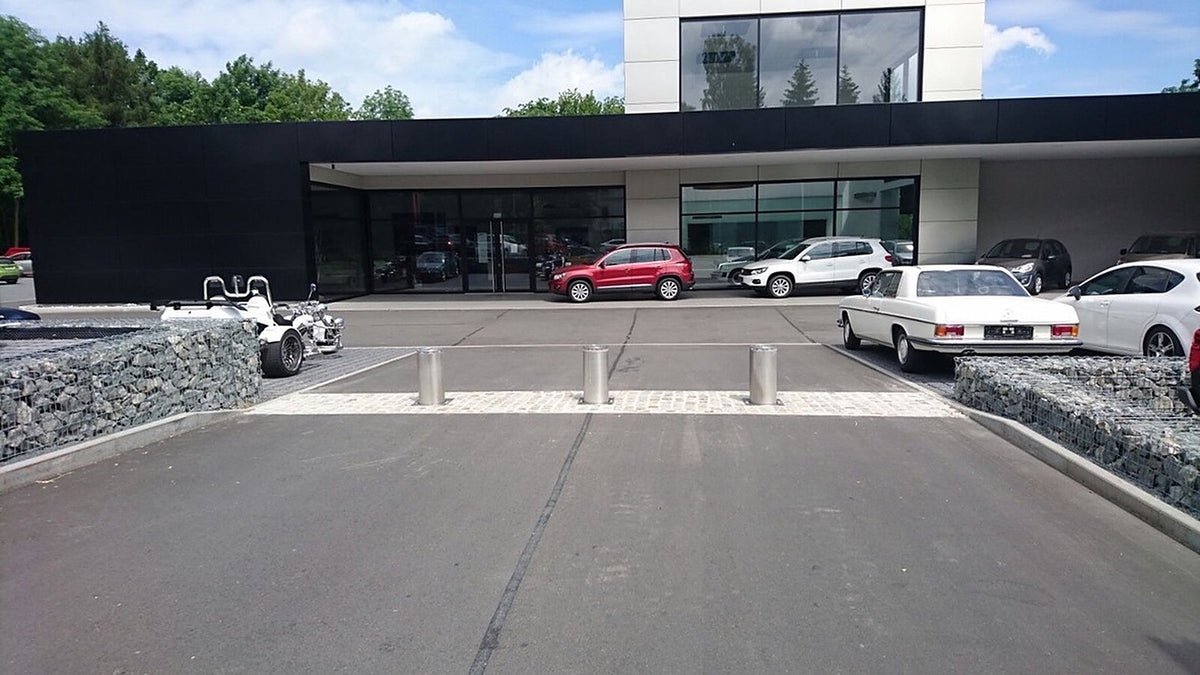
A fitting example from Braun Antriebe is the Mercedes-Benz Center Hamburg. There, 19 retractable bollards were integrated into the access and protection solution. During normal use, the bollards can be lowered so that the areas remain accessible.
Which mistakes should be avoided in ram-raid, burglary and theft protection?
- Considering only the door or shop window – the outdoor area and possible vehicle approach routes are ignored.
- Installing only bollards – the building envelope, interior and organisational layers of protection are missing.
- Calling every massive barrier crash-proof – a defined protective performance requires corresponding technical evidence.
- Forgetting that barriers can be bypassed at the side – a barrier offers little protection if it can be bypassed via adjacent areas.
- Protecting vehicles but forgetting the keys – especially at car dealerships, key management can be a decisive factor.
- Regarding an alarm system as a substitute for mechanical protection
- Regarding video as the sole preventive measure
- Not planning for customer and delivery traffic
- Considering emergency and rescue routes only afterwards
- Not adapting the protection concept despite changes in the value of goods or vehicles
Checklist: security concept for car dealerships, jewellers and retail
- The key objects to be protected are defined
- The value of goods or vehicles has been taken into account
- All possible vehicle approach routes have been analysed
- Shop windows and exposed façades are taken into account
- Possibilities for driving round at the side have been checked
- The desired level of protection has been defined
- The required bollard or barrier performance has been professionally determined
- Test reports are checked for security-relevant barriers
- Doors and windows are part of the protection concept
- Intruder alarm technology has been considered
- Video technology has been considered where appropriate
- Data protection requirements for video have been checked
- Keys and access media are managed securely
- Outdoor areas and lighting have been taken into account
- Customer and delivery traffic remains possible
- Staff procedures are defined
- Fire and emergency access has been clarified
- Fault and emergency operation are planned
- Responsibilities are defined
- The protection concept is reviewed regularly
Would you like to protect your car dealership, jewellery shop or store against ram raids and break-ins?
View stainless steel bollardsRequest adviceFrequently asked questions about ram-raid, burglary and theft protection
Can bollards prevent a ram raid?
There is no blanket answer. The deciding factors are design, installation, positioning, the possibility of driving around them and the protection required. If a defined vehicle impact performance is required, corresponding technical test evidence must also be taken into account.
How do you protect a shop window from a ram raid?
Possible vehicle approach routes, the building envelope and external vehicle barriers must be considered together. Entrances, possibilities for driving round at the side and escape and emergency routes also influence the planning.
How can a car dealership be protected against vehicle theft?
In addition to the entrance, the outdoor area, building access points, display vehicles and, in particular, original, spare and test-drive keys should be included in the concept. The police recommend that car dealers use both security and surveillance technology and security-conscious behaviour.
Is a bollard enough to protect against burglary?
No. A bollard can form an outer vehicle barrier but does not automatically protect doors, windows or other building access points. Effective protection consists of several coordinated layers.
What is more important: an alarm system or mechanical burglary protection?
Both perform different tasks. The German police crime prevention programme regards mechanical protection as the foundation and intruder alarm technology as a complementary protective measure.
Does a jeweller need different security measures from a normal shop?
The protection required depends on the value of the goods, the location, accessibility, the building and possible opportunities for crime. Particularly high or concentrated values of goods may require additional protective measures.
What distinguishes a normal bollard from a tested vehicle security barrier?
For a tested vehicle security barrier, a specific performance under defined test conditions is documented. The mere material thickness or name of a bollard is not sufficient for this.
How many bollards are needed in front of a shop window?
This cannot be answered with a blanket number or a fixed standard spacing. Building geometry, possible approach routes, the possibility of driving around them and the specific barrier configuration determine the planning.
Can a car dealership keep its entrance open during the day and physically close it at night?
With appropriately planned retractable bollard systems, such an operating approach is generally possible. The specific implementation depends on the bollard system, the control system and operational requirements.
Which protection solution suits your site?
Car dealership, jeweller, luxury store or other site with high-value goods: a suitable protection solution results from the object to be protected, possible vehicle approach routes, the building and property situation, operating processes and the desired protective effect.
Braun Antriebe supports you with the technical planning and configuration of a suitable bollard and access solution. Photos, site plans and information on entrances and existing security systems help to assess the starting situation more precisely. Discover our retractable stainless steel bollards or plan your protection solution with us.

Share:
Hostile Vehicle Mitigation for Municipalities: Protecting Public Spaces and Events Effectively
Bollard, Barrier or Sliding Gate: Which System Suits Your Entrance?