


Bollards, barriers and sliding gates can all be used to control an entrance. Their functions, however, differ considerably. While bollards mainly block vehicles physically and leave the entrance largely clear when open, barriers are particularly useful for traffic control. A sliding gate, on the other hand, can close the entire entrance opening.
Which solution is right therefore depends on more than the purchase price. Space required, daily traffic volume, opening speed, desired protection, pedestrian access and the existing geometry of the property must all be considered together. At more complex sites, a combination of several systems can also make sense.
This comparison is part of our comprehensive guide to access management for businesses and properties.
Bollard, barrier or sliding gate – which is better?
None of the three systems is better in principle. Retractable bollards are particularly suitable when vehicles are to be controlled and the entrance should remain visually clear when open. Barriers often make sense with high traffic volumes and typical car park situations. Sliding gates can also restrict access for people and animals and form a visible boundary to the property.
The deciding factors are therefore space, traffic frequency, security requirements and the desired mode of operation.
What are the fundamental differences between bollards, barriers and sliding gates?
Retractable bollard
A retractable bollard forms a physical barrier directly in the roadway. When access is granted, the bollard disappears into the ground. As a result, there is no gate leaf or barrier arm in the movement area above the road.

Its main task is to control vehicles. Pedestrians can generally pass the bollard.
Barrier
A barrier blocks the lane with a horizontal barrier arm. It is often used in car parks, multi-storey car parks or busy company entrances.
Its focus is above all on traffic control and access control. A conventional barrier does not completely close off the property to people.
Sliding gate
A sliding gate moves sideways along the property boundary or fence. It is often used when a depot, storage yard or property is to be closed off completely.
In addition to controlling vehicles, it therefore performs a different spatial function from a bollard or barrier.
Bollard, barrier and sliding gate compared directly
When it comes to protection, you should never conclude from the product type alone that one system is “safer”. What matters is the specific design and the actual protection objective.
| Criterion | Retractable bollard | Barrier | Sliding gate |
|---|---|---|---|
| Blocking vehicle access | Very well suited | Well suited | Well suited |
| Also blocking pedestrians | No | Usually not | Yes |
| Above-ground space required | Very little | Movement space for barrier arm | Lateral movement space required |
| Underground installation | Relevant | Less | Usually less |
| Visual openness when open | Very high | High | Lower |
| Frequent vehicle movements | Good to very good, depending on system | Very good | Depends on system |
| Fast passage | Good | Very good | Depends on gate |
| Physical vehicle barrier | Model-dependent, up to high | Comparatively limited | Depends on design |
| Closing the property completely | No | No | Yes |
| Automation | Very good | Very good | Very good |
| Number plate recognition | Possible | Possible | Possible |
| Appearance | Very unobtrusive | Technically visible | Clearly visible |
| Groundwork | Comparatively significant | Rather less | Foundation depends on design |
How much space does a bollard, barrier or sliding gate need?
Retractable bollards mainly need space below the road surface. In addition to the excavation, cable routes, drainage and, where applicable, a location for the technology must be taken into account. In return, there is practically no movement space above the entrance when it is open.

A barrier needs space at the side for the drive and a clear swing area for the barrier arm. Depending on the design, a support post may also be required.
With a sliding gate, the lateral space is the decisive factor. The gate leaf must be able to retract completely beside the actual entrance opening.
If this lateral movement space is lacking, a retractable bollard can have structural advantages over a sliding gate.
How quickly must the entrance open?
With only a few journeys a day, opening time is often less critical. It is a different matter for shift changes, staff car parks or other sites where many vehicles pass within a short time.
Here, a barrier can be of interest because of its typical use in standardised traffic flows. For a security entrance, on the other hand, the desired physical protection may be weighted more heavily than maximum speed.
It is also not just the movement of the barrier itself that matters. The total time from recognising or releasing the vehicle to clear passage determines the actual throughput.
Which system is suitable for high traffic volumes?
Ten passages a day place different demands on a system than several hundred vehicle movements. In addition to the total number, peak times, continuous operation, possible waiting times and queues should be considered.
Barriers are often suitable for very busy, standardised car park entrances. Bollards can become interesting when, in addition to vehicle control, a stronger physical barrier or a high degree of visual openness is wanted.
A sliding gate can make sense if a property is to be closed off completely outside certain hours. With heavy daytime traffic, its suitability depends on factors such as size and opening sequence.
Which system offers which level of security?
“Security” is not a single criterion. First, it must be clear what the entrance is actually meant to protect against.
If it is merely a matter of deciding who may drive onto the property, all three systems can be part of an access control solution.
If a stronger physical barrier against vehicles is required, suitably designed bollards can play an important role.
If, on the other hand, people or animals should also be prevented from freely crossing the entrance, a closed gate performs a different function.
Where a deliberate vehicle impact is being considered, only specific systems may be assessed, on the basis of their actual design and available test evidence.
Should only vehicle access or all access be blocked?
This difference is often underestimated when selecting a system.
Bollards hold back vehicles but generally let pedestrians pass. Barriers, too, primarily control vehicle traffic and do not completely close off the entrance.
A gate, by contrast, can close the entire opening.
The basic decision is therefore: if vehicles are to be controlled, bollards and barriers are particularly relevant. If the entire property opening is to be closed, a gate should be considered.
Which vehicles need to pass through the entrance?
Cars, vans, delivery vehicles, lorries, coaches and emergency vehicles place different demands on lane width, turning areas and sensors.
With larger vehicles, the position of the system can also play an important role. A lorry, for example, needs different swept paths and waiting areas from a car.
The vehicle types should therefore be established before bollard positions, barrier width or gate geometry are finally planned.
How can bollards, barriers and sliding gates be automated?
The method of release should be distinguished in principle from the mechanical barrier. An authorised user can be identified, for example, via radio, GSM, transponder, staff card, number plate recognition, intercom or central building automation.
Only then is the barrier concerned activated.
The question “Bollard or barrier?” is therefore not the same as the question “How does the system recognise an authorised user?”.
Can number plate recognition be combined with all three systems?
Number plate recognition can work as an upstream access logic:
Capture number plate → check authorisation → release entrance
Which physical barrier then opens is a separate planning decision. Depending on the system, this may be a bollard, a barrier or a gate.
Number plate recognition is therefore generally suitable for different access concepts, provided that technical integration and legal requirements are taken into account.
What happens in the event of a power cut or technical fault?
The fault scenario should be planned for every system before commissioning.
With a bollard, it must be clear how the entrance is released by other means. With a barrier, the same question arises for the barrier arm. With a sliding gate, it must be known how the gate can be moved manually or via a designated emergency function in the event of a failure.
It should also be established who is allowed to carry out an emergency opening, what happens outside business hours and how emergency services reach the site.
What running costs do bollards, barriers and gates involve?
The purchase price is only part of the economic assessment. Maintenance, mechanical wear, energy, sensors and possible repairs have an effect over the entire service life.
With bollards, the underground installation area also plays a role. With barriers, the barrier arm is comparatively exposed to impact damage. With sliding gates, the running and guide areas, among other things, must be considered.
The lowest purchase price therefore does not automatically mean the lowest overall costs.
How much does the access system change the appearance of the site?
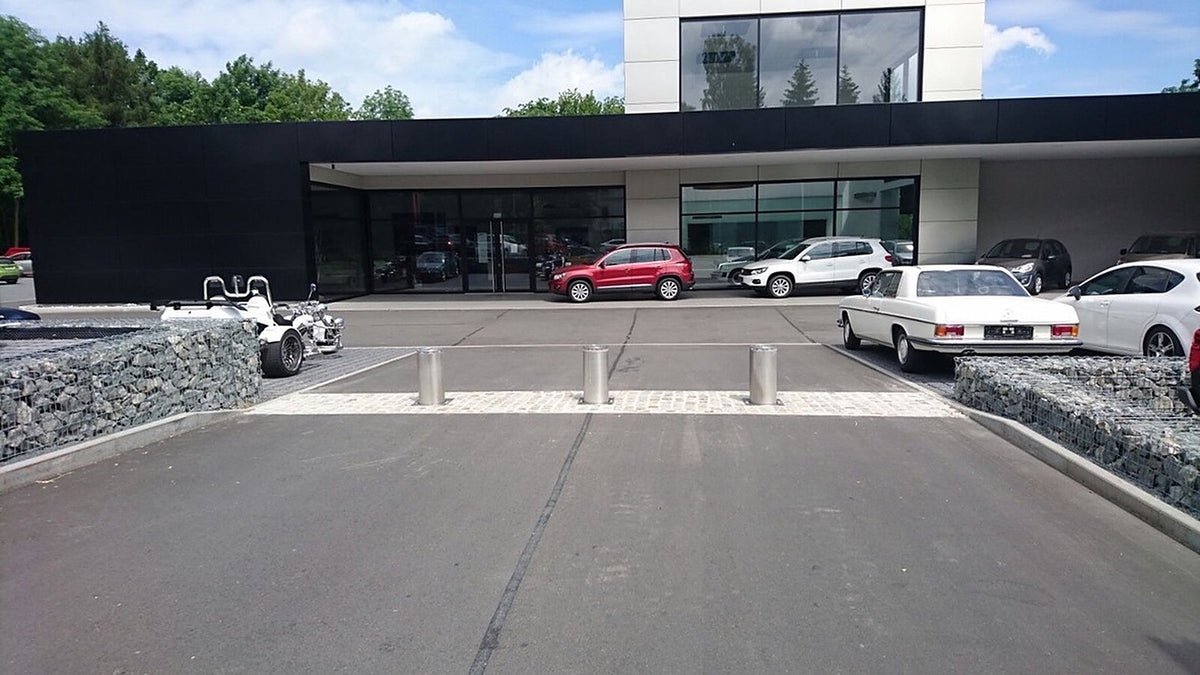
Retractable bollards are particularly unobtrusive when lowered. This can be an important advantage for high-end office buildings, hotels or architectural projects.
A barrier remains visible as a technical element and clearly signals that access is controlled.
A sliding gate shapes the boundary of the property much more strongly. This may be expressly desired, but it changes the perceived openness of the site.
The visual impact is therefore not just a matter of taste but part of the overall usage concept.
Which access barrier suits which application?
This allocation is intended as a guide. The actual solution should always be developed from the specific installation situation and the desired protection objective.
| Site or situation | Solution worth considering |
|---|---|
| Staff car park with many daily journeys | Barrier or highly automated system |
| High-end office building | Retractable bollards |
| Depot to be closed completely outside working hours | Sliding gate |
| Entrance should remain visually open during the day | Bollards |
| Customer car park | Barrier |
| Site should also be closed to pedestrians | Gate |
| Enhanced mechanical vehicle protection | Consider suitably designed bollards |
| Narrow entrance without lateral space | Consider bollards |
| Property with a long fence line | A sliding gate may be the obvious choice |
| Different requirements by day and by night | Consider a combination |
When does a combination of bollard, barrier and gate make sense?
At larger or security-relevant sites, a single system does not have to meet every requirement.
A gate can, for example, close off the property completely at night, while during the day retractable bollards control vehicle access and leave the open site visually accessible.
A combination of barrier and bollard is also conceivable: the barrier organises the regular traffic flow, while suitably designed bollards form an additional physical vehicle barrier.
Especially at complex sites, “either/or” is therefore not always the right planning logic.
Bollard, barrier or sliding gate: how to make your choice
If the entrance is also to be closed completely to pedestrians, a gate should be considered first.
If the focus is primarily on vehicles and there are a great many passages each day, a barrier may be of interest for the standardised traffic flow.
If the entrance should remain as visually open as possible when released, or if an additional physical vehicle barrier is wanted, retractable bollards are an option.
If requirements differ significantly between day and night, it should be checked whether two systems can be combined.
Which mistakes should be avoided when comparing bollards, barriers and gates?
The most common mistake is comparing them solely on purchase price. It is equally problematic to ignore traffic volume and peak times, or to check the space needed for an open sliding gate only after choosing the product.
Pedestrian access and mechanical vehicle protection should also be considered separately. A bollard can block vehicles but does not close the property to people. Conversely, a closed gate does not automatically mean a defined resistance to vehicle impact.
Control and physical barrier should also be planned separately. Number plate recognition answers who gets access – not whether a bollard, a barrier or a gate is better suited to the entrance.
Checklist: which access system suits our site?
Before deciding, daily traffic volume and peak times should be known, as well as vehicle types and the desired level of protection. It must also be clarified whether only vehicles or pedestrians too are to be controlled.
Space above and below the entrance, desired opening speed, automation and existing systems also influence the choice. Behaviour in a power cut, visual impact and future expansion options should also be taken into account.
Only then can a reliable judgement be made as to whether bollards, a barrier, a gate or a combination best meets the requirements.
Frequently asked questions about bollards, barriers and sliding gates
Which is better: a bollard or a barrier?
That depends on the task. Barriers are often particularly suitable for standardised traffic control with many daily passages. Bollards can be interesting when a physical vehicle barrier is to be combined with a high degree of visual openness.
When is a sliding gate more sensible than a bollard?
If not only vehicles but the entire entrance opening is to be closed, a sliding gate performs a function that a single bollard cannot.
Which solution suits many daily passages?
With high traffic volumes, the entire release process should be considered. Barriers are often used for busy car park entrances, but automated bollards may also be an option depending on the system.
Which system needs the least lateral space?
Retractable bollards need practically no lateral movement space above the entrance. However, suitable installation space is required below the road surface.
Can a barrier secure against vehicles breaking through?
A conventional barrier serves primarily for traffic and access control. The mechanical resistance actually provided must be assessed on the basis of the specific system.
Can a bollard also keep pedestrians off the site?
No. A bollard is primarily a vehicle barrier. People can generally pass between or beside bollards on foot.
Can number plate recognition be combined with bollards or gates?
Yes. Number plate recognition checks the access authorisation. A connected access barrier can then be activated accordingly.
Which solution suits lorry entrances?
That depends on factors such as lane width, swept paths, traffic volume and the desired protection objective. Planning should therefore be matched to the actual vehicle dimensions.
What happens in a power cut?
Every automatic system should have a defined failure concept. How the entrance is opened or secured depends on the specific system.
Can bollards and a gate be combined?
Yes. A combination can make sense, for example, if visually open vehicle control is wanted during the day and the property is to be closed completely at night.
Which access solution suits your site?
The selection should not start with a specific product but with your requirements. For an initial assessment, the type of site, entrance width, available lateral space, daily vehicle movements, peak traffic and vehicle types are particularly relevant.
Added to this are the desired level of security, the importance of pedestrian access, automation requirements and any existing access technology. Photos or a site plan also make the technical assessment easier.
Braun Antriebe develops its own bollard and drive solutions and helps to put together access technology that suits the use, installation situation and protection objective.
Have you decided on a solution, or would you like no-obligation advice?
View stainless steel bollardsRequest advice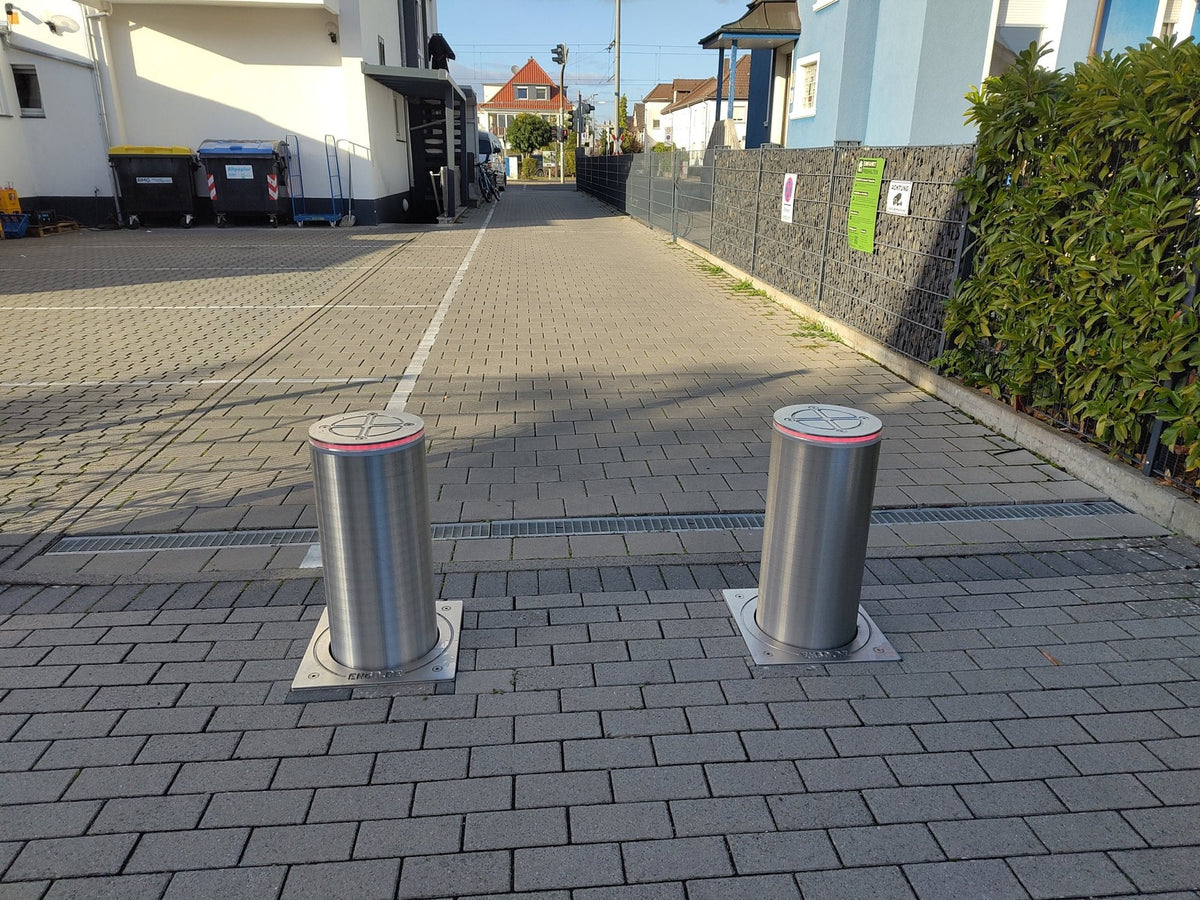

Share:
Ram-Raid, Burglary and Theft Protection for Car Dealerships and Retail
Retractable Bollards for Your Driveway: Selection, Planning and Operation