


A private driveway should always remain accessible for your own vehicles, but ideally not for anyone else’s. This applies to property entrances as well as to private parking spaces or open carports. With higher-value vehicles in particular, there may also be a wish to create a physical barrier between the car and the public road.
Retractable bollards combine such an access barrier with a high level of convenience. When the driveway is needed, the bollard lowers into the ground and clears the way. Afterwards, access can be blocked again. Which version makes sense, however, does not depend on price alone. Key factors include frequency of use, driveway width, structural conditions, the desired method of operation and the specific need for protection.
This guide is part of our comprehensive guide to protecting driveways, parking spaces and vehicles.
When does a retractable bollard make sense for a private driveway?
A retractable bollard is particularly suitable for regularly used driveways that are to be closed to unauthorised vehicles without being permanently blocked by a visible barrier. It can, for example, prevent unwanted parking or turning on the property and, depending on its design, form an additional mechanical hurdle between a vehicle and the public road.
The version chosen is crucial here. A simple parking bollard for a single space does not automatically perform the same protective function as a reinforced model or one designed specifically for higher security requirements.
How does a retractable bollard work?
The bollard sits in a housing permanently installed in the ground. When raised, it protrudes from the road surface and blocks access. When an authorised vehicle needs to pass, the bollard is lowered and, depending on its design, disappears completely or largely into the ground.

With automatic systems, this process can be triggered, for example, by radio, a mobile control or a connected building automation system. In simplified terms, the sequence is:
Grant access → bollard lowers → vehicle passes through the entrance → bollard rises again
How the lifting movement is generated technically varies from one bollard system to another. For our automatic retractable V4A bollards, we rely on pneumatic technology.
Which private driveways are retractable bollards suitable for?
Your own property entrance
If an open property entrance is regularly used by other vehicles for turning, stopping or driving on, a bollard can create a clear physical boundary. At the same time, the entrance remains convenient for residents to use.
Private parking space
Individual private parking spaces can also be protected against unauthorised use. Whether a manual or automatic bollard makes more sense depends mainly on how often the space is used and what level of convenience is wanted.
Open carport
Unlike a garage, a carport offers no closed access. A retractable bollard can restrict access to the parking space here without changing the open character of the carport with an additional gate.
Driveway with a high-value vehicle
If a high-value vehicle stands in the open on the property, a suitably designed bollard can form an additional mechanical barrier between the vehicle and the road. The actual level of protection depends on the design, material thickness, installation and any test evidence available.
Shared driveway
If several family members or residents use the same entrance, operation plays a bigger role. Automatic systems can then be combined with several authorisations or different control options.
Not every driveway is automatically suitable for a retractable bollard. Before choosing a product, the subsoil, existing utility lines, the necessary installation depth and drainage should therefore always be checked.
What should the bollard achieve at your driveway?
Before discussing model, operation or price, the actual protection objective should be clear. There are considerable differences between a simple parking barrier and an entrance with an increased need for mechanical protection.

The choice should therefore be based on the desired protection objective – and not solely on the appearance or price of a bollard.
| Objective | Typical problem | Key requirement |
|---|---|---|
| Restricting access | Other vehicles drive onto the property | Physical access barrier |
| Keeping a parking space free | Others park in your own space | Reliable access restriction |
| Additional vehicle protection | The vehicle should not be easy to drive off the property | Check for increased mechanical resistance |
| High security requirement | Deliberately breaking through a barrier is part of the risk scenario | Specially designed and, where applicable, tested security solution |
What types of retractable bollard are there?
Manually retractable bollards
Manual bollards are lowered and raised by the user. They are mainly an option if an entrance only rarely needs to be opened and a high level of convenience is not a decisive factor.
Automatic bollards
Automatic bollards are released via a control system and can be operated from inside the vehicle. This is particularly convenient if the driveway is used several times a day or several people need access.
Pneumatic bollards
With pneumatic bollards, movement is generated by compressed air. Depending on the system, this involves a compressor, lines, valves and control components, among other things. The automatic retractable V4A bollards from Braun Antriebe work on this principle.
Electric and hydraulic systems
There are also electromechanical and hydraulic concepts on the market. However, the type of drive alone does not determine which bollard is suitable for a particular driveway. What matters is the interplay of design, usage, installation situation and protection objective.
Reinforced bollards and security bollards
As the need for mechanical protection increases, design and material thickness become more important. If a specific resistance to vehicle impact is required, you should look not at general product names but at the actual technical properties and any available test values.
Which retractable bollard suits my driveway?
Width of the driveway
What matters is not just the total width of the property but the area a vehicle can actually use. A narrow entrance between two walls has different requirements from an open courtyard.
Frequency of use
If the bollard is only lowered occasionally, simpler operation may be sufficient. With several journeys in and out each day, an automatic solution becomes much more convenient.
Number of users
With only one user, access control is comparatively simple. If several family members use the same driveway or visitors are also to be given flexible access, the authorisation logic should be considered at an early stage.
Desired level of protection
Is the aim merely to deter an unauthorised parker, or to create an additional barrier for a high-value vehicle? These two requirements should not be met with the same choice of product.
Convenience
Radio remote control, smartphone or GSM, or integration into a smart home system can cover different usage situations. What matters is how the entrance is actually used day to day.
Structural conditions
Retractable bollards need sufficient space below the road surface. Existing utility lines, drainage, slope and subsoil can therefore determine whether and how installation is possible.
Appearance
A key advantage of retractable bollards is that the driveway remains largely open when the bollard is lowered. Especially for modern or deliberately open property designs, this can be an important selection criterion.
Choosing a retractable bollard by application
A specific product recommendation should only be made once the installation situation and the desired level of protection are known.
| Starting situation | Priority | Possible direction |
|---|---|---|
| Closing the driveway to other vehicles | Access control | Automatic standard bollard |
| Keeping a private parking space free | Simple blocking | Manual or automatic bollard |
| Several journeys in and out each day | Convenience | Automatic bollard |
| Several family members | Flexible operation | Automatic bollard with several authorisations |
| High-value vehicle in an open carport | Additional vehicle protection | Consider a reinforced version |
| Very high security requirement | Resistance to vehicle attack | Consider a security solution designed specifically for this |
What needs to be checked before installing a retractable bollard?
Installation depth
As the bollard disappears below the road surface when lowered, sufficient underground space is required. The required depth depends on the model.
Utility lines in the ground
Before work begins, it must be clarified whether electricity, water, gas, telecommunications or drainage lines cross the intended installation area.
Subsoil and surface
Paving, asphalt or concrete influence the construction effort. At the same time, the bollard housing must be integrated permanently and stably into the driveway.
Drainage and slope
Water in the installation area must not simply be ignored. Rainfall, meltwater and the natural water flow on the property should therefore be taken into account at the planning stage.
Driveway width and edges
It is not only the position of the bollard itself that matters. It should also be checked whether a vehicle could drive around the barrier via a verge, lawn, pavement or another open area.
How many bollards does a driveway need?
A blanket rule such as “one bollard per X metres” falls short. What matters is the usable width of the driveway, the width of the vehicles, possibilities for swerving round at the side and the desired level of protection.
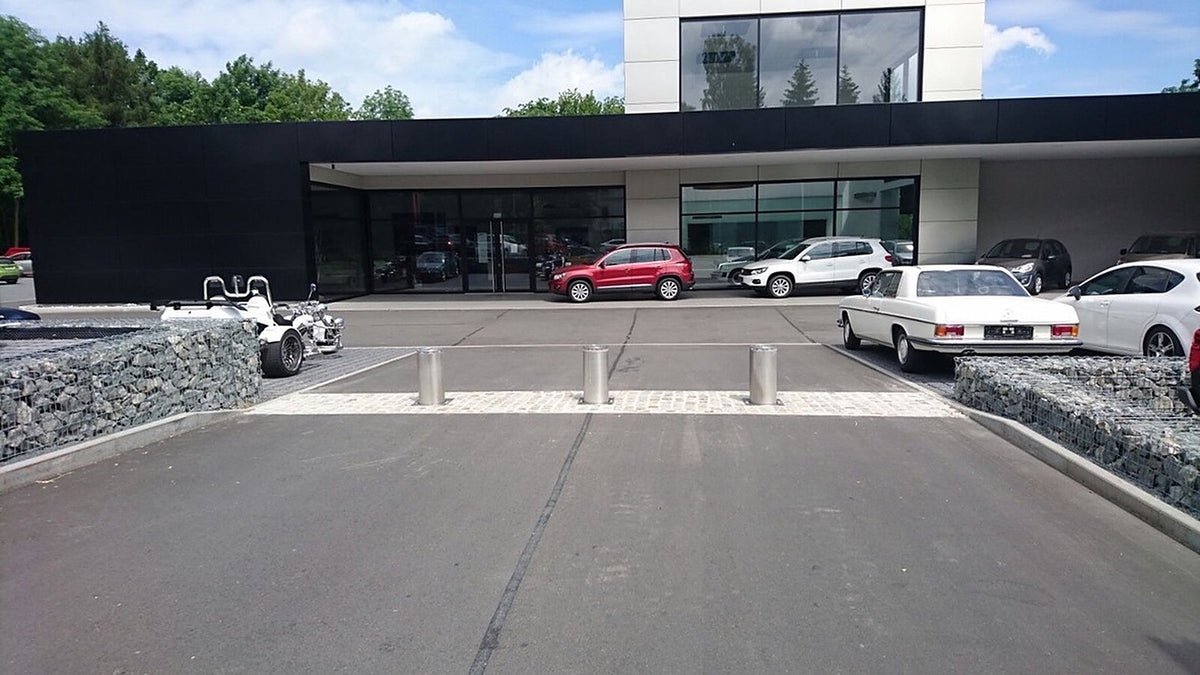
A narrow entrance between two solid walls, for example, can be planned differently from a wide courtyard entrance where vehicles can swerve sideways. Walls, hedges, posts or other existing obstacles can also be part of the overall planning.
The number of bollards should therefore be derived from the specific traffic geometry.
How can a retractable bollard be operated?
When choosing, you should not only ask which technology is possible. More important is which method of operation causes the least effort in everyday life.
| Operation | Particularly suitable for | Advantage | Points to consider |
|---|---|---|---|
| Radio remote control | Individual households | Direct, simple operation | Handheld remote required |
| GSM control | Several users | Flexible access via mobile network | Consider mobile reception |
| Smart home | Connected homes | Integration into existing routines | Check technical compatibility |
| Fixed push button | Local operation | Simple operating principle | Operation only at the designated point |
How does a retractable bollard work in everyday life?
Do I have to get out of the car?
Not with a suitably automated system. The bollard can be released from inside the vehicle. The specific operation depends on the control system chosen.
Can several people use the bollard?
Yes, provided the control system is designed for it. Depending on the system, several handheld remotes or different access authorisations can be provided, for example.
How do visitors get access?
That depends on the operating concept. Visitors can, for example, be let in via a separate release, while regular users have their own authorisation.
What happens after passing through?
Whether the bollard rises again automatically or by a further command depends on the system configuration.
Which safety functions are important for automatic bollards?
With automatic access systems, it is not only a matter of preventing unauthorised vehicles from entering. The bollard’s movement area should also be taken into account in the planning.
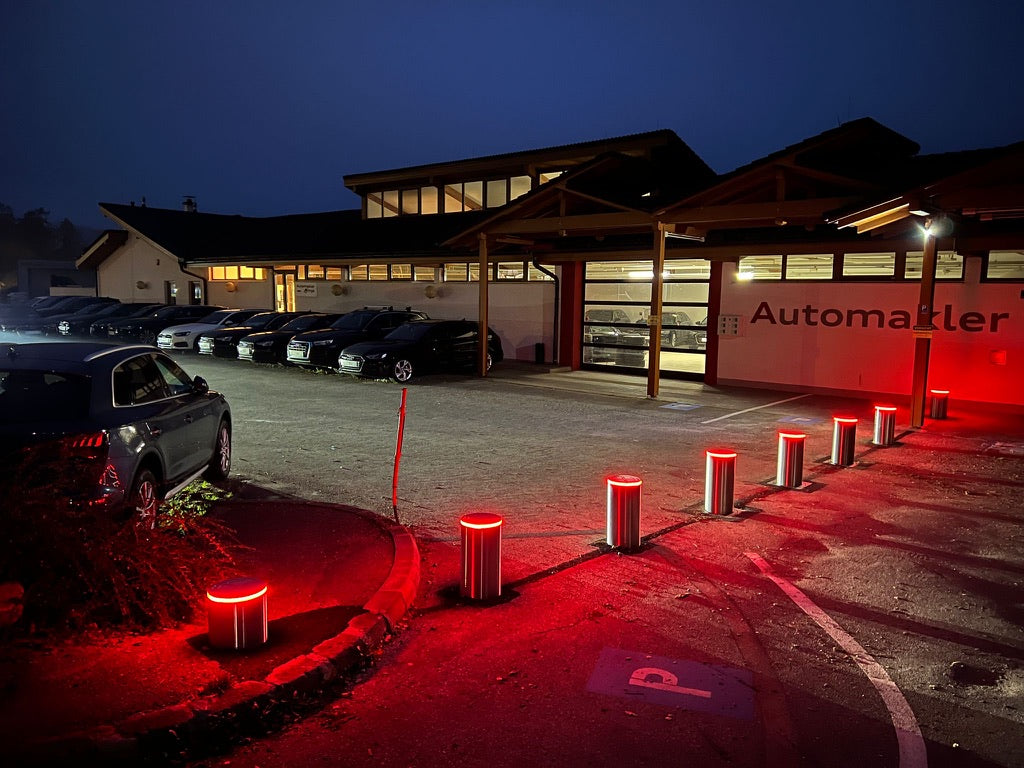
Depending on the system, vehicle or obstacle detection, sensors, visual signalling, emergency operation and defined control sequences may be relevant. Which functions are actually required and available must be checked on the basis of the chosen bollard and the specific installation situation.
Do retractable bollards work in rain, snow and frost?
A bollard is permanently outdoors and must therefore be able to cope with rain, dirt, leaves, snow and low temperatures. It is not only the product itself that matters. A professional installation situation is just as important.
Drainage and water flow in particular should be planned so that no avoidable problems develop in the installation area. Movement areas should be kept clear and dirt checked regularly.
Braun Antriebe manufactures its bollards from corrosion-resistant V4A stainless steel and offers pneumatic versions for permanent outdoor use.
What maintenance does a retractable bollard need?
Even a robust bollard system should be checked regularly. This includes, in particular, the visible condition of the bollard, a clear movement area and the drainage around the installation.
With automatic systems, technical components such as the control system, lines or drive technology are added. Which maintenance work is planned at which intervals should not be set across the board but taken from the specifications of the respective manufacturer and the specific system.
How much does a retractable bollard for a private driveway cost?
The price of the bollard is only part of the total cost. Depending on the project, there may also be costs for the control system, drive technology, number of bollards, cable routing, groundwork, installation and additional safety or automation components.
An existing, well-prepared driveway with one bollard can therefore involve a completely different project scope from a wide driveway with several bollards, new drainage and an extensive control system.
For a realistic calculation, the entire system should therefore be considered – not just the unit price of the bollard.
Retractable bollard, manual bollard or gate?
None of the three solutions is “better” in principle. What matters is the function the entrance is to perform in everyday life.
| Criterion | Automatic retractable bollard | Manual bollard | Gate |
|---|---|---|---|
| Convenience | High | Low to medium | High, depending on automation |
| Frequent use | Very well suited | Less convenient | Well suited |
| Visual openness | High | Medium to high | Lower |
| Space above the entrance | Very little | Depends on design | Movement space required |
| Controlling vehicle access | Well suited | Well suited | Well suited |
| Keeping pedestrians out completely | No | No | Possible, depending on design |
| Construction work | Underground installation | Usually less | Foundation and movement space |
Checklist: is a retractable bollard suitable for my driveway?
A retractable bollard is particularly appropriate if you use the driveway regularly yourself, unauthorised vehicles are to be kept out and, at the same time, no permanently visible barrier is wanted. In addition, there should in principle be sufficient underground space. It must be possible to check utility lines and drainage, convenience and the desired level of protection should be established, and it must be possible to plan the bollard positions so that they cannot simply be bypassed.
If several of these points are still open, the installation situation should be checked first before a specific model is chosen.
Retractable bollards at private driveways: practical examples
In practice, wide, open driveways are often used by delivery vehicles or other road users for turning. We have fitted numerous such properties with retractable bollards. The entrance remains usable for the owners, while other vehicles can no longer simply drive onto the property.
Integration into modern building automation is also possible. At one private driveway, for example, a retractable V4A bollard was integrated into a KNX home automation system. This allows the physical access barrier to be linked with the building’s existing control routines.
With higher-value vehicles, the focus may be different again: here, not only access control but in particular the mechanical design of the bollard should be considered.
Frequently asked questions about retractable bollards for driveways
Can I retrofit a retractable bollard?
Retrofitting may generally be possible. What matters is whether there is sufficient underground space at the intended location and whether utility lines, drainage and ground structure allow installation. The existing driveway should therefore be technically checked before choosing a product.
How deep does a retractable bollard need to be installed?
The necessary installation depth depends on the model. It results from the length of the underground bollard structure and the required installation situation. The technical data of the specific model chosen are therefore always decisive.
How many bollards do I need for my driveway?
This cannot be answered on the basis of driveway width alone. What matters is vehicle width, bollard position, possibilities for swerving round at the side, fixed boundaries and the desired level of protection.
Can I control a bollard with my smartphone?
Depending on the control system, mobile operation is possible. We offer GSM-based control options and solutions for integration into building automation, among other things.
Does a retractable bollard work in frost?
For winter operation, both the technical design of the bollard and a suitable installation situation are relevant. Drainage, dirt, snow and ice should be taken into account at the planning stage.
What happens in a power cut?
That depends on the bollard and control system concerned. It should therefore be determined at the planning stage how the entrance can be opened if the regular technology fails and who may carry out such emergency operation.
Can several people operate the same bollard?
Yes. Depending on the control system, several handheld remotes or other authorisations can be set up, for example. This is particularly relevant for families or shared driveways.
Can a bollard protect my car from theft?
A suitably designed bollard can provide an additional physical barrier between the vehicle and the road. However, it does not follow that every bollard automatically offers defined protection against theft or ramming. Design and protection objective are decisive.
Do I need permission for a bollard on my private property?
There is no blanket answer. Key factors include the location, the structural situation and possible effects on public land or other legal requirements. If in doubt, the specific situation should be checked before installation.
How much does an automatic bollard system cost?
The total cost is made up of the bollard model, number of bollards, control system, cable routing, groundwork and installation, and any additional components. You should therefore not look only at the price of a single bollard.
Which bollard suits your driveway?
If you already know what protection objective you are pursuing, the choice can be narrowed down considerably. For a technical assessment, the driveway width, desired number of bollards, ground and installation situation, daily use, preferred method of operation and the required level of protection are particularly relevant.
Photos or a site plan also help to assess the entrance realistically.
Braun Antriebe develops and manufactures retractable bollard solutions in V4A stainless steel and, depending on the project, combines them with suitable control and drive technology.
Would you like to know which bollard suits your driveway?
View stainless steel bollardsRequest advice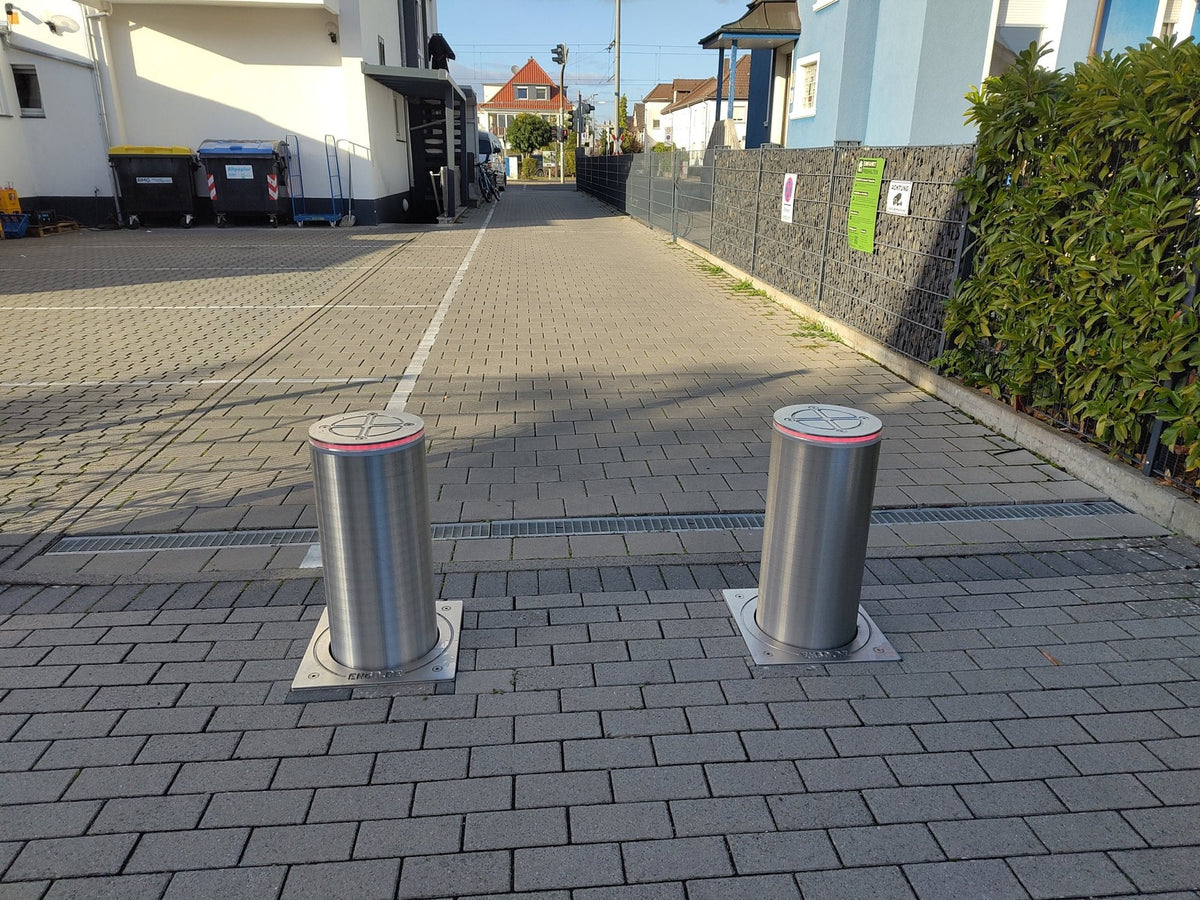

Share:
Bollard, Barrier or Sliding Gate: Which System Suits Your Entrance?
Planning Vehicle Access Control for Business Premises Properly