


A commercial entrance often has to meet several requirements at the same time. Staff should be able to pass with as little waiting as possible, visitors should be let in under control and suppliers reliably directed to the right area. At the same time, unauthorised vehicles should stay out. Different rules may apply at night than during the day, and power cuts, technical faults and access for emergency services must also be taken into account.
Effective access control therefore does not begin with the question of whether bollards, a barrier or a gate should be used. First, the user groups, vehicle types, traffic volume, authorisations and desired security level of the site must be understood. Only then can a suitable technical solution be derived.
This guide is part of our comprehensive guide to access management for businesses and properties.
What needs to be considered when planning access control for business premises?
Companies should first establish who is allowed to drive onto the site, which vehicles are involved, how many entries and exits take place each day and at what times traffic is particularly heavy. Visitor and delivery processes, emergency access, different security zones and existing systems are just as important.

Only once these requirements have been clarified can a sensible decision be made as to whether bollards, a barrier or a gate are needed, and whether number plate recognition, sensors, traffic light control or a central access control system should be added.
Why should the access process be planned first and the technology second?
“We need two bollards with number plate recognition” already sounds like a concrete solution. Yet key questions remain unanswered: Which vehicles are authorised? Who decides when a visitor turns up unannounced? How are suppliers handled? What happens after closing time? How does the system behave if it fails? And how does the fire service get onto the site?
Robust planning therefore follows a different sequence:
Users → traffic flow → authorisations → security requirement → technology
The technical access barrier is the result of this process – not its starting point.
What should access control achieve?
Preventing unauthorised parking
Staff, visitor or customer car parks should be used only by authorised vehicles.
Preventing unauthorised access
Depots, storage areas or other internal areas should not be accessible without authorisation.
Organising traffic flow
Vehicles entering and leaving must be routed so that waiting times and queues are kept to a minimum.
Reducing theft risks
If there are high-value vehicles, goods or equipment on the property, the entrance can be part of a more comprehensive protection concept.
Controlling visitor flows
Visitors often only need authorisations restricted in time or space.
Automating operations
Automated releases can reduce recurring manual gate or gatehouse processes.
Separating areas within the site
A visitor car park, a depot and a loading area do not necessarily have to use the same access logic. Larger sites in particular often benefit from tiered authorisations.
Who needs to be able to drive onto the business premises?
Not all user groups should automatically receive the same authorisation. Separating different use cases is often an essential part of the security and traffic concept.

| User group | Typical use | Possible requirement |
|---|---|---|
| Staff | Daily | Fast automatic release |
| Management | Daily | Convenient access |
| Customers | Regularly or spontaneously | Simple visitor guidance |
| Pre-registered visitors | Temporary | Time-limited authorisation |
| Suppliers | Regularly or by time window | Defined delivery entrance |
| Parcel services | Briefly | Straightforward release |
| Service providers | Temporarily or regularly | Flexible authorisation |
| Cleaning and maintenance | Often outside core hours | Time-controlled access |
| Fire and ambulance services | Unplanned | Reliable emergency access |
| Unauthorised vehicles | No authorisation | Prevent access |
Which vehicle types need to use the entrance?
Cars
At many sites, cars make up the largest share of staff and visitor traffic and therefore often determine everyday processes.
Vans and delivery vehicles
They need more space and can place different demands on the lane, turning area and sensors.
Lorries
With lorries, lane width, swept paths, waiting areas and the position of bollards, barriers or gates must be taken into account, among other things.
Motorcycles and bicycles
Not every detection system registers two-wheelers in the same way as cars. Here too, it should be established early on whether and how access is provided.
Emergency and special vehicles
Fire engines, ambulances, refuse lorries, buses, construction machinery or other special vehicles may have their own requirements for dimensions, access routes and emergency releases.
An important planning question is therefore: does every vehicle really need to use the same entrance?
How many vehicles pass through the entrance each day?
The daily average alone is not enough for planning. 50 vehicles spread over ten hours represent a different load from 50 vehicles within 20 minutes at a shift change.
In addition to the total number of passages, morning peak times, shift changes, end-of-day traffic, simultaneous deliveries and possible special events should therefore be considered. These give rise to requirements for opening speed, number of lanes, sensors and degree of automation.
The more traffic is concentrated at certain times, the more important the question of whether an entrance could cause queues becomes.
Does the site need a shared or separate entrance and exit?
With low traffic volumes, a shared lane may be sufficient. If two-way traffic has to be organised on the same lane, traffic light or other traffic control may be required.
At busier sites, separate entrances and exits can make sense. It becomes even more complex if staff, visitors and delivery traffic are to use different routes.
| Situation | Possible planning |
|---|---|
| Few vehicles | Consider a shared entrance and exit |
| Two-way traffic on one lane | Consider traffic or traffic light control |
| High traffic volume | Consider separate lanes |
| Cars and regular lorry traffic | Consider separate traffic routing |
| Visitors and internal depot | Separate access logic advisable |
When must the entrance be open or closed?
During normal working hours, there are often many known users on site. After hours, at night or at weekends, the requirements may change significantly.
An authorisation therefore does not necessarily have to apply around the clock. Shift workers, cleaning staff, external service providers or regular suppliers may, for example, need different time windows. Public holidays, stocktaking, events or construction phases should also be manageable organisationally.
The relevant question is: who may use which entrance, on which day and at what time?
How can staff get access as efficiently as possible?
With many regular users, the access process should involve as little additional operation as possible. Depending on the existing infrastructure, options include radio, GSM, number plate recognition, existing access control systems, building automation or other individual authorisation media.
The higher the number of daily journeys, the more important a fast process and a centrally manageable authorisation structure become.
How should access for visitors be organised?
For visitors who register in advance, a temporary authorisation can be set up before they arrive. Unannounced visitors, on the other hand, need a different way of being let in, for example via a bell, intercom or reception.
It should also be established how long an authorisation is valid, where the visitor may park and whether they may drive only to the visitor car park or further onto the actual business premises.
Good visitor guidance combines the simplest possible processes with clearly limited authorisations.
How can delivery traffic be integrated into access control?
Regular suppliers
Recurring suppliers can be given fixed or vehicle-specific authorisations if this fits the site’s security concept.
Irregular suppliers
With changing drivers or hauliers, temporary releases are often more suitable.
Time windows
Entrances can be organised so that delivery traffic is only possible at certain times.
Different delivery areas
Not every supplier needs access to the entire business premises. A separate entrance or tiered authorisation can separate internal traffic and security areas from each other.
With regular lorry traffic, lane width, waiting areas, two-way traffic, sensor positions and the placement of the actual access barrier must also be taken into account.
How should access authorisations be assigned?
The more clearly this model is defined at the planning stage, the more precisely the right control system can then be selected.
| Type of authorisation | Typical example |
|---|---|
| Permanent | Staff |
| Time-limited | External service provider |
| Day-specific | Visitors |
| By time of day | Cleaning or maintenance |
| Vehicle-specific | Company vehicle |
| Person-specific | Individual user |
| Group-specific | Suppliers |
| Manual release | Unannounced visitor |
What level of security do the business premises need?
Not every commercial entrance needs the same protection. For a staff car park, the main aim may be to keep out unauthorised parkers. For enclosed business premises, it may be about controlled entry. If there are high-value goods, vehicles or technical installations on the property, greater mechanical protection may become relevant.
For particularly sensitive areas or a deliberately considered vehicle attack scenario, different requirements apply again. Then the specific designs and any available test evidence are decisive.
The higher the protection objective, the less meaningful general terms such as “secure bollard” or “sturdy gate” become.
Which technology suits which requirement?
At more complex sites, access control almost always consists of several coordinated components.
| Requirement | Possible technical solution |
|---|---|
| Physically blocking access | Bollard, gate or barrier |
| Recognising staff automatically | Number plate recognition or existing access system |
| Managing many users | Central control system |
| Organising two-way traffic | Traffic light or traffic control |
| Detecting vehicle position | Induction loop or other sensors |
| Time-dependent release | Programmable control |
| Letting visitors in manually | Push button, intercom or control room integration |
| Complex processes | Central building or access control system |
Which physical access barrier suits the business premises?
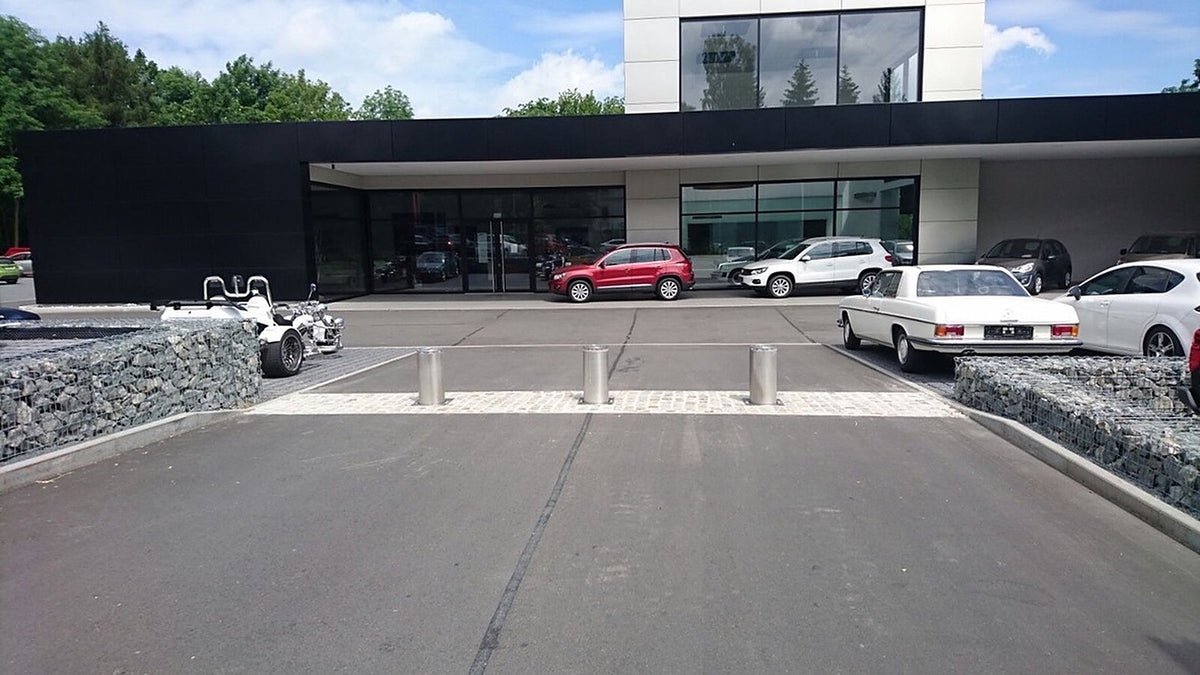
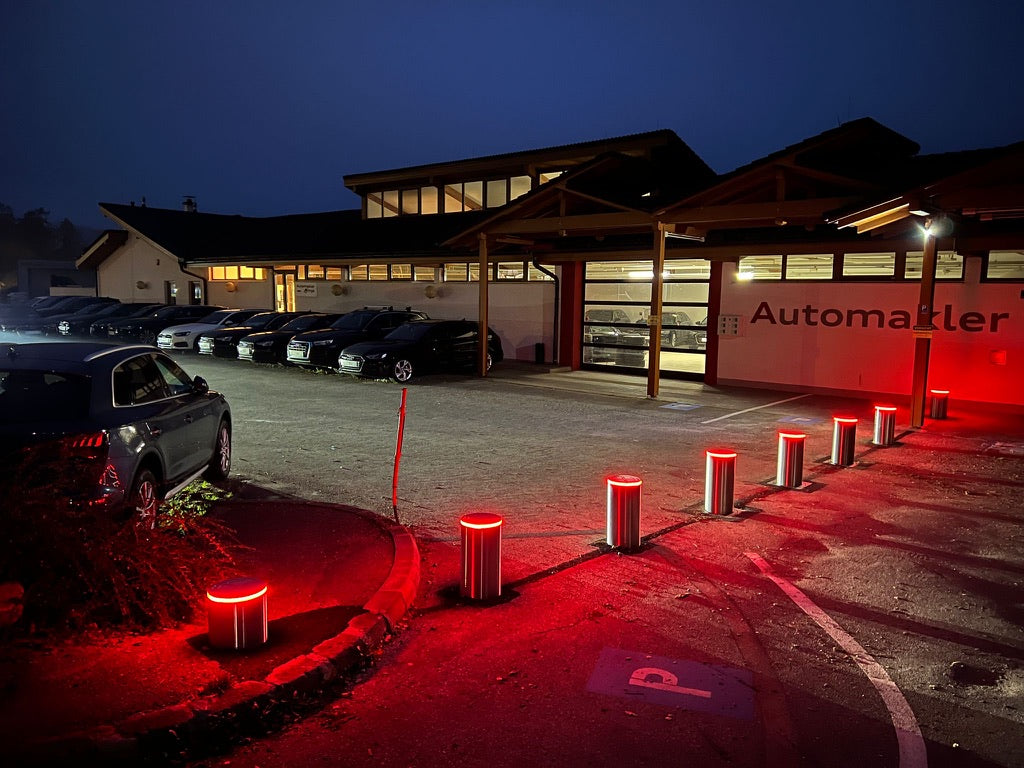
Retractable bollards are particularly suitable when vehicles are to be physically blocked and the entrance should remain largely visually clear when open.
Barriers come into their own above all where many vehicles enter and leave under control in standardised processes – for example in staff or customer car parks.
A sliding gate, on the other hand, can close the entire entrance opening and thus perform a different function from bollards or barriers. Which option is right therefore depends not only on traffic volume but also on the desired enclosure of the property.
When is automatic access control worthwhile?
Automation becomes more important when there are many journeys each day, several user groups need different authorisations or manual releases involve a great deal of organisational effort.
Several entrances, different time windows or the wish for central management are also reasons to plan the process not only mechanically but also in terms of control.
The more complex the site and traffic volume, the greater the benefit of clearly structured automatic access logic can be.
When must data protection be considered in access planning?
Data protection becomes relevant in particular when number plates are recognised, entries are logged, personal user accounts are managed or video and movement data are processed.
The resulting requirements depend on the system and usage concept. Data protection should therefore be considered during planning and not only once cameras or user management have already been installed.
What happens if access control fails?
An access system should not only be planned for normal operation. It is just as important how the system behaves in the event of a power, network or mobile network failure and what happens if a control or sensor fault occurs.
Before commissioning, it should be clarified whether the entrance should remain open or closed in the event of a fault, how staff will continue to get access, who may carry out a manual release and how the fire or ambulance service will reach the site.
An alternative means of operation is therefore just as much part of the concept as the automation itself.
Which existing systems should be integrated?
If access control, KNX, Loxone, PLC, a control room, intercom, alarm system, parking management or other building and security systems already exist, possible interfaces should be checked early.
The same applies to existing barriers or gates. New access control should not be set up unnecessarily as an isolated stand-alone system if existing infrastructure can be used sensibly.
Which costs should be considered in planning?
Investment costs include not only bollards, barriers or gates. Control systems, sensors, cabling and construction work can also account for a significant share.
Over the service life, there are also energy, communication, maintenance and repair costs. The organisational effort can be just as relevant: if visitors have to be let in manually every day or authorisations require extensive management, this too creates ongoing effort.
Cost-effective planning therefore considers purchase, operation and organisation together.
What requirements must access control meet?
A compact planning matrix helps to bring together the most important information:
| Planning question | Example |
|---|---|
| Number of entrances | 2 |
| Vehicles per day | 250 |
| Peak traffic time | 07:00–09:00 |
| Staff | 150 |
| Visitors | approx. 20 per day |
| Suppliers | 15 per day |
| Lorry traffic | Yes |
| Night operation | Partly |
| Changing users | Yes |
| Automatic recognition | Wanted |
| Security level | Controlled access |
| Emergency services access | Required |
| Two-way traffic | Yes |
| Existing system | For example KNX |
| Expansion planned | Further entrance possible |
From an overview like this, a technical solution can be developed far more precisely than from the bare instruction “We need a barrier” or “We would like bollards”.
Which mistakes should be avoided when planning a company entrance?
One of the most common mistakes is choosing hardware before the requirements are fully known. It is equally problematic to consider only staff and to build visitors, suppliers or external service providers into the concept later.
Average daily traffic can also be misleading if, in the morning at a shift change, many times the normal number of vehicles arrive at once. Lorries, two-way traffic and necessary waiting areas should therefore be considered as early as emergency routes and operation during technical faults.
Other typical problems arise when data protection is only considered after the technology has been installed, the ongoing management of authorisations is underestimated or future expansion of the site is not taken into account.
Checklist: planning access control for business premises
Before choosing the technology, all entrances and exits, daily vehicle numbers and peak times should be known. User groups, vehicle types, visitor and delivery processes, and operating and shift times should also be defined.
On this basis, authorisations, the necessary security level and traffic routing are determined. Emergency access, behaviour in the event of technical failures, existing interfaces, data protection, operating costs and possible future expansion should then be checked.
Only when these points fit together should the specific combination of barrier, sensors and control be determined.
Frequently asked questions about access control for business premises
How can business premises be secured against unauthorised vehicles?
Depending on the site, bollards, barriers, gates or combinations can be used. Which solution is suitable depends on traffic volume, available space and the desired level of mechanical protection.
Bollard or barrier – which solution is better?
There is no blanket answer. Barriers are often of interest for busy, standardised entrances. Bollards can offer advantages if the entrance is to remain visually open while also creating a physical vehicle barrier.
How can staff drive onto the site automatically?
Options include number plate recognition, existing access systems, radio or other individually managed authorisations. What matters is that the system suits the daily traffic volume.
How do visitors get access?
Visitors who register in advance can be given temporary authorisations. For unannounced visitors, access can be controlled via reception, intercom or another manual release, for example.
How can suppliers be given time-limited access?
Authorisations can be limited to certain periods organisationally or technically. In addition, access can be restricted to certain entrances or areas of the business premises.
Which solution is suitable for high traffic volumes?
What matters is not just the barrier itself but the entire release process. With heavy throughput, fast recognition, separate lanes and largely automated control can be more important than individual product features.
How does an entrance with number plate recognition work?
The vehicle’s number plate is captured and compared with a stored authorisation. If the vehicle is authorised, the connected access system can open the way.
How is two-way traffic regulated at a single-lane entrance?
With corresponding traffic volumes, traffic or traffic light control may be required. It must be ensured that vehicles do not enter the bottleneck from both directions at the same time.
How does the fire service get onto the site when the entrance is closed?
Emergency access should be defined during planning. Which technical or organisational solution is used depends on the system and the site.
What happens in a power cut?
The behaviour should be defined in advance. What matters is whether the entrance should remain open or closed in the event of a fault and which alternative means of release is provided.
Planning access control for your site
A robust access solution is based on the actual processes at your site. For initial planning, the number and width of entrances, daily vehicle movements, staff and visitor numbers, delivery traffic, vehicle types, operating hours and existing systems are particularly relevant.
The desired level of security and photos or a site plan should also be available. This makes it possible to assess which combination of physical access barrier, control system and sensors suits the site.
Braun Antriebe develops access solutions with its own bollard systems and suitable control and automation components.
Are you planning access control for your business premises?
View stainless steel bollardsRequest advice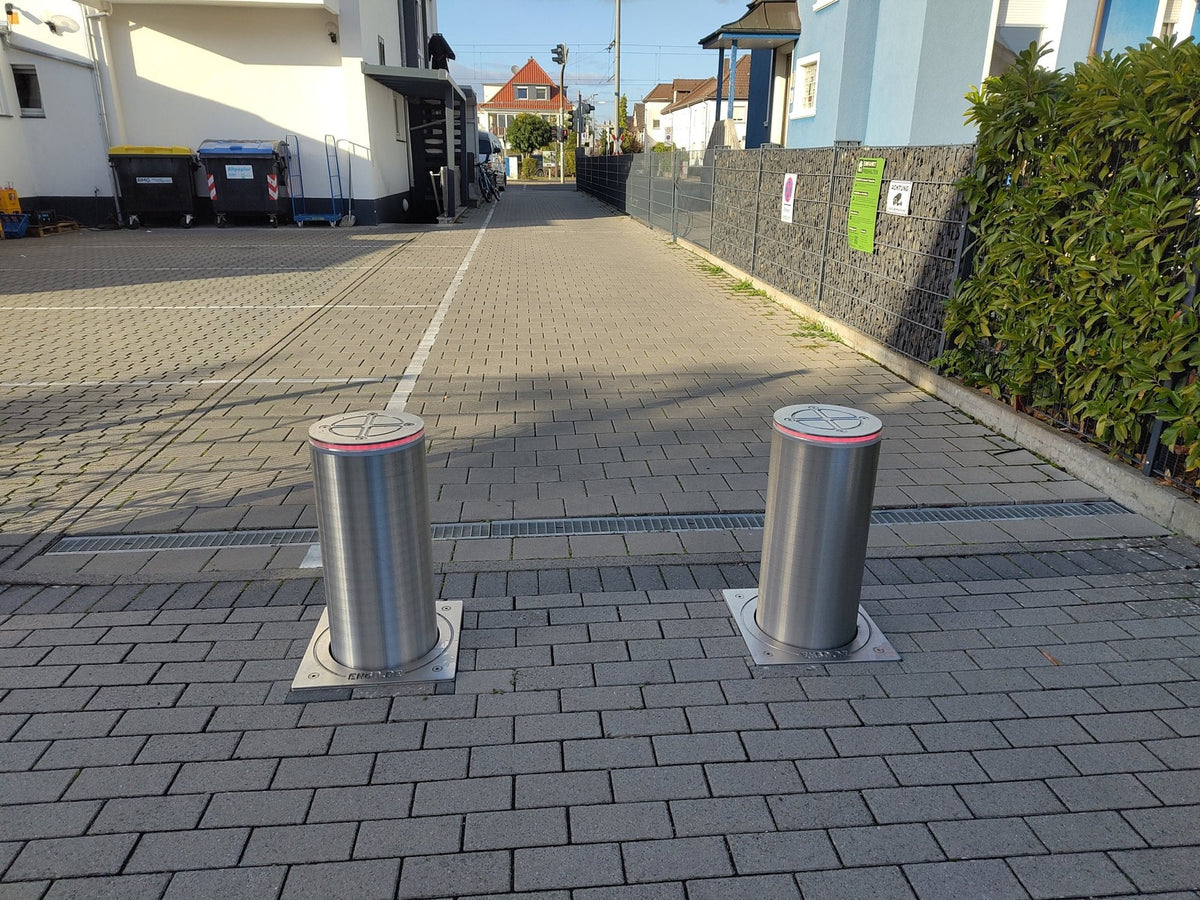

Share:
Retractable Bollards for Your Driveway: Selection, Planning and Operation
How Much Does a Bollard System Cost? Bollards, Groundwork, Controls and Running Costs