


In brief
- A pneumatic retractable bollard system in V4A stainless steel from Braun Antriebe costs from around €1,950 as a technology package for a private driveway (one bollard with 60 cm travel €1,450, compressor €195, radio control €245, two handheld remotes at €29.50 each). Prices incl. German VAT, as of September 2026.
- The bollard itself costs between €1,450 (3 mm, approx. 80 kg) and €8,950 (30 mm, approx. 500 kg, 80 cm travel), depending on wall thickness.
- On top of this come groundwork (pit approx. 80 × 80 cm, 1.0 to 1.2 m deep, no concrete foundation), a cable trench approx. 30 cm deep and the 230 V connection by a qualified electrician.
- Running costs are low: drain condensate every 4 to 8 weeks and, if a repair is needed, replace the compressor and valve yourself for around €240 in total.
Anyone looking up the price of a retractable bollard quickly finds a figure for the bollard. What ends up on the invoice, however, depends on five items: the bollard, the compressed-air and control technology, the groundwork, the cable routing and operation over the years. This article works through all five items – with the prices from our range, the dimensions from our installation instructions and three example systems, from a detached house to a commercial entrance. It belongs to our topic hub Protecting your driveway, parking space and vehicle.

Which items make up the cost of a bollard system?
An automatic bollard system consists of five cost blocks: the bollard (€1,450 to €8,950 each), the drive and control technology (from €440 for compressor and radio control), the groundwork for pit and trench, the electrical connection and the running costs. Only the first two blocks have fixed list prices; groundwork and electrical work depend on the property and on regional tradespeople’s rates.
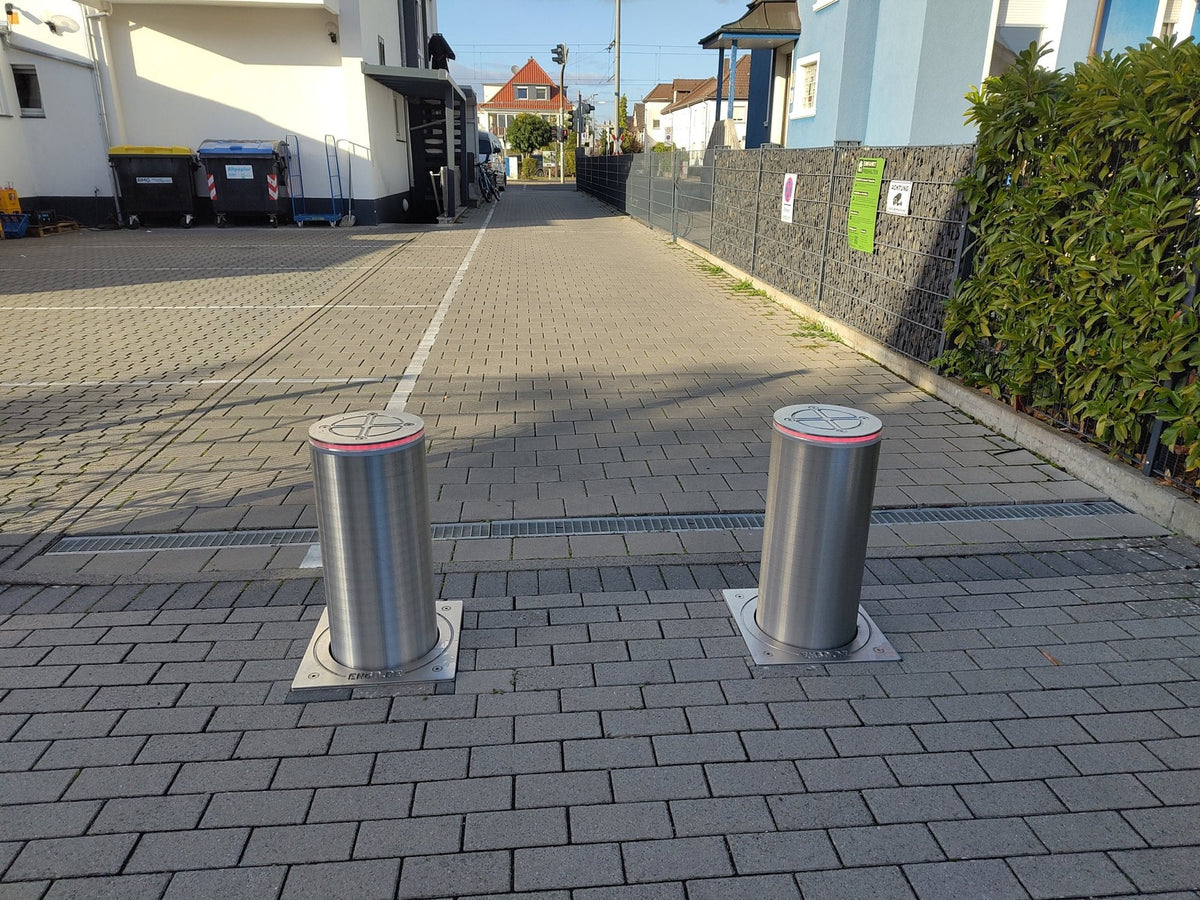
A pneumatic retractable bollard is a stainless steel cylinder that sits in a ground sleeve and is raised and lowered by compressed air (8 to 10 bar). The compressed air is generated by a compressor that is located not in the ground but in the house or in a technical cabinet. This matters for the cost calculation: only mechanical parts are in the ground, no electronics – and that shapes both installation and running costs.
| Cost block | What it includes | Braun Antriebe price (incl. VAT) | Supplied by |
|---|---|---|---|
| Bollard | V4A stainless steel cylinder (1.4571), ground sleeve, pneumatic cylinder, quick coupling | €1,450 to €8,950 each | Braun Antriebe, manufactured in Seevetal near Hamburg |
| Drive | Quiet drive compressor (approx. 50 dB), 8–10 bar, 0.3–1 kW | €195 (1–4 bollards) or €450 (1–20 bollards) | Braun Antriebe |
| Control | Radio control, handheld remotes, GSM module or street control with Loxone Miniserver | €29.50 to €2,150 | Braun Antriebe |
| Groundwork | Pit approx. 80 × 80 cm, 1.0–1.2 m deep; gravel and sand bed; cable trench approx. 30 cm deep; reinstating the surface | varies by region, obtain a quote | Landscaper, groundworks contractor or DIY |
| Electrical | 230 V connection for compressor and control, 25 mm hole into the building | Electrician’s hourly rate | Local electrician |
| Operation | Electricity for the compressor, draining condensate, cleaning, spare parts | a few euros per year; worst case approx. €240 | The operator |
What does the bollard itself cost – and why does the range go from €1,350 to €8,950?
With us, the price of a retractable bollard is determined by its wall thickness and therefore its weight: 3 mm wall and approx. 80 kg cost €1,450, 6 mm with internal reinforcement and approx. 160 kg cost €2,950, 12 mm at approx. 320 kg costs €4,950, and the security bollard with 30 mm wall and approx. 500 kg costs €6,950. Every model is available with 60 cm or 80 cm travel; the 80 cm version costs €300 to €2,000 more.
All four models are pneumatic, have IP69 protection (dust-tight and protected against high-pressure cleaning) and are manufactured in Seevetal from 1.4571 stainless steel. The difference lies in the mass that an approaching vehicle has to be stopped by. For a driveway intended to keep out unwanted parkers and turning delivery vans, the entry-level bollard is sufficient. Anyone parking a high-value vehicle behind the bollard chooses the 160 kg standard bollard. The 12 mm and 30 mm models are intended for properties where a deliberate ram attack is part of the risk.
| Model | Wall thickness / weight | 60 cm travel | 80 cm travel | Delivery time |
|---|---|---|---|---|
| Security bollard 60 cm travel (entry level) | 3 mm / approx. 80 kg | €1,450 | €1,750 | approx. 3–4 working days |
| Standard security bollard | 6 mm + reinforcement / approx. 160 kg | €2,950 | €3,450 | approx. 3–4 working days |
| Security bollard 12 mm | 12 mm / approx. 320 kg | €4,950 | €5,950 | approx. 12 working days |
| High-security bollard 30 mm | 30 mm / approx. 500 kg | €6,950 | €8,950 | approx. 12 working days |
| Fixed version (not retractable) | set in concrete | €1,350 (60 cm above ground) | €1,450 (80 cm above ground) | approx. 3–4 working days |
Prices incl. German VAT, as of September 2026. The fixed version is listed only for comparison: it needs neither compressor nor control, but blocks access permanently.
What technology is added to the bollard and what does it cost?
Every retractable bollard needs a compressor and a control unit: the quiet drive compressor for one to four bollards costs €195, the compact radio control €245, a handheld remote €29.50. That completes the technology for a private driveway; commercial entrances with more than ten passages a day get the street control with Loxone Miniserver for €2,150 instead.
One compressor supplies several bollards. The small version handles up to four, the large one for €450 up to twenty bollards. Six bollards, as in the courtyard entrance in Upper Bavaria, therefore need only one compressor, not six. Both units run at around 50 dB, about as loud as a washing machine, and are placed in a garage, utility room or cellar. If there is no dry room close to the cable route, compressor and control go into a technical cabinet for €165.
With the control system, the number of users determines the price. Which option makes sense when is explained in detail in the article Bollard control: radio, GSM, number plate recognition or smart home. For the cost calculation, this overview is enough:
- Radio control €245 plus handheld remote €29.50 per user – for families and individual users.
- GSM module €85 – opens via a free phone call, up to 200 phone numbers, for residential complexes and suppliers.
- Street control with Loxone €2,150 – induction loop, automatic re-raising, schedules, KNX and smart home integration.
- Number plate recognition €1,950 – as an add-on to the street control, opens for registered vehicles.
- Stainless steel traffic light post €1,350 (red) or €1,450 (red/green) – for busy entrances.
What does the groundwork for a retractable bollard cost?
For each bollard, a pit of about 80 × 80 cm and 1.0 to 1.2 m deep is excavated – around 0.8 m³ of spoil per bollard; a concrete foundation is not required for our bollards. The bollard stands on a compacted gravel and drainage layer, the pit is backfilled with heavy sand and the surface above is reinstated. It is precisely this absence of concrete that keeps the groundwork manageable.
The depth depends on the blocking height: a bollard with 60 cm travel needs less installation space than one with 80 cm. In natural ground, excavation with a mini digger is usually a matter of hours. It becomes more expensive if rock, old concrete or a high water table get in the way, or if bonded paving has to be lifted and relaid – then a paver joins the job.

To estimate groundwork costs, it helps to have a quantity list you can give to a landscaper or groundworks contractor:
- Number of bollards and, per bollard, one pit 80 × 80 cm, 1.0 to 1.2 m deep (approx. 0.8 m³ of spoil)
- Gravel and drainage layer under each bollard, backfill with heavy sand (no concrete)
- Cable trench approx. 30 cm deep from the bollard to the building – measure the length in metres
- Cable/hose bundle: supplied by us made to length; lengths from 1 m to over 100 m are common
- One 25 mm core hole through the building wall for the bundle
- Reinstating the surface: lifting and relaying paving, cutting asphalt or opening a concrete slab
- With street control: slot in the surface for the induction loop
- State the ground conditions: natural ground, rock, old concrete, groundwater
Many customers do the excavation themselves or hire the firm that is re-paving the driveway anyway. We support installation free of charge by photo: you send pictures of the pit, gravel bed and backfill via WhatsApp or email, and we give the go-ahead for the next stage. The installation instructions are available as a PDF. There is only one thing you must not do yourself: the 230 V connection of compressor and control. That belongs in the hands of a qualified electrician.
What do cables, electrical connection and control installation cost?
Between bollard and compressor runs a cable/hose bundle in a trench approx. 30 cm deep, which we make up to the measured length – lengths of over 100 m are common, and considerably more on request. Inside the building you need a 25 mm hole, a socket or a fixed 230 V connection for the compressor and control, and a dry space of about 50 × 50 × 15 cm for the compressor.
The electrician connects the compressor and control and, with the street control, establishes the network connection. With a radio control, this takes just a few working hours. If you are installing a street control with induction loop, traffic light post and number plate recognition, allow a day – the loop is cut into the surface, sealed and connected to the Miniserver. As a general rule: the further the compressor is from the bollard, the longer the trench and bundle, and the higher the groundwork costs. A location in the garage right next to the driveway is therefore almost always the cheapest solution.
Three example systems: what does the technology actually cost?
The following three configurations are calculated using our list prices from September 2026 and include only the technology – groundwork and electrician come on top, depending on the property.
| System | Components | Total technology (incl. VAT) |
|---|---|---|
|
A: Detached house, one bollard Closing the driveway to unwanted parkers and turning vehicles |
1 × security bollard 60 cm travel €1,450 Compressor 1–4 bollards €195 Radio control €245 2 handheld remotes €59 |
€1,949 |
|
B: Courtyard entrance, two standard bollards High-value vehicle in a carport, wide entrance |
2 × standard security bollard €5,900 Compressor 1–4 bollards €195 Radio control €245 3 handheld remotes €88.50 |
€6,428.50 |
|
C: Commercial entrance, two standard bollards Staff, suppliers, more than ten passages a day |
2 × standard security bollard €5,900 Compressor 1–4 bollards €195 Street control Loxone €2,150 Number plate recognition €1,950 Traffic light post red/green €1,450 Technical cabinet €165 |
€11,810 |
System A corresponds to the single bollard in front of a carport that we installed in Kassel. System B is the configuration of the Berlin driveway with two sports cars: two standard bollards directly in front of the carport, operated by handheld remote. System C is similar to the passage of a Berlin residential complex, where the exit is released automatically via an induction loop.

What running costs does a bollard system involve?
The running costs of a pneumatic bollard system are limited to electricity for the compressor, draining condensate every four to eight weeks and occasional cleaning of the bollard head; a maintenance contract, oil changes or heating are not needed. The compressor runs for only about 30 seconds per stroke – at 0.3 to 1 kW, that is less than 0.01 kWh per movement, so even with ten journeys a day it amounts to only a few euros of electricity per year.
If you would rather not drain the condensate by hand, add an automatic drain module. Otherwise: sweep leaves and sand off the bollard head, rinse the stainless steel with clean water, avoid road salt around the bollard in winter and use a wooden pusher rather than a steel shovel to clear snow. The seals are rated down to −35 °C, and the operating range is −20 °C to +50 °C.
What does a repair cost in the worst case?
The worst case with a pneumatic system is a faulty compressor or a faulty solenoid valve: a new compressor around €180 to €195, a valve around €50, express shipping around €10 – about €240 in total. Both parts are attached with quick couplings and are located in the house. You replace them yourself, with our support via WhatsApp video if you wish, and the system is running again the same day. The paving stays closed, because only the cylinder is in the ground.
For comparison, here are the worst-case costs of other drive principles, as documented in our FAQ on retractable bollards:
| Drive principle | Technology in the ground | Regular maintenance | Worst-case repair |
|---|---|---|---|
| Pneumatic (Braun Antriebe) | only cylinder and sleeve, no electronics | condensate every 4–8 weeks, cleaning | approx. €240, DIY replacement of compressor and valve |
| Electric spindle | motor, spindle, limit switches, electronics, usually heating and sump pump | check heating and drainage | approx. €2,500, specialist technician only |
| Hydraulic | power unit with oil, pump and hoses | oil and hoses approx. every 4 years, approx. €2,500 | approx. €3,750 (call-out, two fitters, pump, hotel) |
How can you save on a bollard system without compromising on protection?
The biggest levers are a short cable route, the right timing and the appropriate security level: compressor close to the driveway, installation combined with paving work that is planned anyway, and the standard bollard instead of the 12 mm model if no ram attack is to be expected. The gravel-and-sand construction avoids a concrete foundation from the outset.
- Combine installation with the driveway works. The KNX bollard from our reference at a detached house was installed while the driveway was being redesigned anyway – the pit only cost the additional excavation there.
- DIY excavation. Pit, gravel bed and backfill are manageable even for DIYers with our photo support.
- Only as many bollards as necessary. A narrow driveway between two walls often needs just one bollard; only wide courtyards without side boundaries need several.
- Handheld remote instead of app. For one household, the radio control is sufficient; the street control pays off from about ten passages a day or with changing users.
- Buy direct from the manufacturer. We sell without intermediaries; specialist firms, landscapers and electricians receive trade prices on request.
What should you budget overall?
For a private driveway with one bollard, the technology costs around €1,950; for two standard bollards around €6,400; for a commercial entrance with street control, number plate recognition and traffic light around €11,800 – in each case plus groundwork and electrician, which vary with ground conditions, cable length and region. If you request quotes using the quantities from the checklist above, you will get reliable figures instead of estimates.
Important when comparing with other offers: always calculate the total cost over ten years. A bollard with hydraulics or an electric spindle may be similar in purchase price, but over its service life it incurs maintenance call-outs and technician days that do not arise with pneumatics. If you allow for the delivery time – bollards up to €4,000 in three to four working days, 12 mm and 30 mm models in about twelve working days – you can schedule the groundwork accordingly.
Frequently asked questions about the cost of a bollard system
How much does a retractable bollard cost including installation?
The technology for a single bollard with compressor, radio control and two handheld remotes costs around €1,950 incl. VAT at Braun Antriebe. Installation adds the excavation of a pit 80 × 80 cm and 1.0 to 1.2 m deep, a cable trench 30 cm deep and the 230 V connection by a qualified electrician; these items depend on the property and regional tradespeople’s rates.
Do I need a separate compressor for each bollard?
No. The quiet drive compressor for €195 supplies up to four bollards, the larger version for €450 up to twenty. A courtyard entrance with six bollards therefore needs only one compressor.
Is a concrete foundation necessary?
No. Our pneumatic bollards stand on a compacted gravel and drainage layer, and the pit is backfilled with heavy sand. When lowered, the bollard can still be driven over by vehicles of up to 40 t.
How high are the electricity costs of a bollard system?
Very low. The compressor is rated at 0.3 to 1 kW and runs for about 30 seconds per stroke. That is less than 0.01 kWh per movement; with ten journeys a day, it adds up to only a few euros a year.
What does a repair cost if the system fails?
In a pneumatic system, the compressor and solenoid valve are the only wear parts. Both are located in the house, attached with quick couplings, and together cost around €240 including express shipping. The operator can replace them without opening the paving.
Can I install the bollard system myself?
Yes, excavation, gravel bed, inserting the bollard and backfilling are manageable with the installation instructions and our free photo support via WhatsApp. Only the 230 V connection of compressor and control must be carried out by a qualified electrician.
How long does delivery take?
Compressors, controls and accessories leave our warehouse within one to two working days. Bollards up to about €4,000 are delivered in three to four working days, the made-to-order 12 mm and 30 mm bollards in about twelve working days.
The key points in three sentences
A pneumatic retractable bollard system from Braun Antriebe costs from around €1,950 as a technology package for a single bollard and around €11,800 for a commercial entrance with street control, number plate recognition and traffic light; groundwork and electrical connection come on top, depending on the property. Because only a stainless steel cylinder without electronics sits in the ground, installation (no concrete) and running costs (draining condensate, worst case approx. €240) remain low. Braun Antriebe manufactures the V4A stainless steel bollards itself in Seevetal near Hamburg and delivers direct, without intermediaries – the prices in this article are our list prices from September 2026.
How you then operate the system – by handheld remote, phone call, number plate or from your smart home – is covered in the article Bollard control: radio, GSM, number plate recognition or smart home. Which system suits your driveway is described in the article Retractable bollards for your driveway; why we deliver direct for reasons of price and quality is explained on the page Bollard costs.
Would you like to know what your bollard system will cost? Send us photos and measurements of your driveway – we will work out the figures for you.
Phone +49 40 226390411 · WhatsApp +49 172 4544485
View stainless steel bollardsRequest advice

Share:
Planning Vehicle Access Control for Business Premises Properly
Bollard Control: Radio, GSM, Number Plate Recognition or Smart Home?