


Market squares, pedestrian zones and event spaces should remain open, accessible and pleasant places to be. At the same time, it may be necessary to prevent unauthorised or dangerous vehicle access and to protect particularly busy pedestrian areas in a targeted way.
Effective municipal hostile vehicle mitigation therefore does not begin with choosing a particular bollard. First, the use of the area, threats, vehicle approach routes and protection objectives must be analysed. Only then can requirements for organisational measures and vehicle security barriers be derived.
At the same time, delivery traffic, the fire and ambulance services, accessibility, urban design and the subsequent operation of the system must all be taken into account.
What does a municipal vehicle access protection concept include?
A municipal access protection concept first examines which areas and people are to be protected, which routes vehicles can use to reach an area and what threats exist. Protection objectives are then defined, weak points considered and suitable organisational, structural and technical measures selected. These may include permanent or temporary vehicle security barriers. At the same time, delivery traffic, accessibility, fire and emergency routes as well as operation, maintenance and emergency procedures must be taken into account.
What does municipal vehicle access protection mean?
Several terms are often mixed up in connection with bollards and public spaces. For robust planning, they should be considered separately.

Access control: The central question here is: who may drive into a particular area, and when? A typical example is a pedestrian zone that generally remains closed to general vehicle traffic but is opened in the morning for authorised deliveries.
Impact protection: Impact protection can be designed to protect buildings, facilities or other objects against unintentional or specific vehicle contact.
Protection against vehicle attacks: Here, a vehicle is considered as a deliberate means of attack against people or particularly sensitive areas. This involves very different requirements for the threat analysis, planning and proven performance of the barriers used.
Important: not every traffic bollard is automatically a tested vehicle security barrier against vehicle attacks.
Which risks should be assessed before planning?
Possible vehicle approach routes
From which roads, paths or other surfaces can a vehicle reach the area to be protected?
Direction of approach
A straight approach differs from an approach via bends or winding street layouts.
Potentially achievable speed
This should not be estimated across the board but determined as part of the professional threat and site analysis.
Vehicle types
Which types of vehicle can reach the area at all? The answer influences the attack scenario on which planning is based.
Crowd density
How many people are in the area to be protected, and at what times? An everyday market can differ considerably from a major event.
Weak points and the possibility of driving around barriers
A barrier is only one element within the overall concept. It must therefore be examined whether it can be bypassed, for example via pavements, parking areas, side streets or adjacent areas.
Different usage situations
A market square may handle delivery traffic on weekdays and a few days later host an event with a high crowd density. Protection concepts must take such changing uses into account.
What exactly should the access protection achieve?
A clearly defined protection objective is a prerequisite for any further technical selection. Possible objectives include:
- Preventing unauthorised access – for example in a pedestrian zone or a permanently closed area.
- Protecting pedestrian areas from vehicles – for example at a Christmas market or an event.
- Securing public buildings – where certain approach directions or entrances may be particularly relevant.
- Allowing traffic only at certain times – for example deliveries in the morning and closed access during peak usage times.
- Demonstrating resistance to a defined vehicle attack scenario – in this case, the specifically tested performance of a vehicle security barrier becomes decisive.
Without a protection objective, it is impossible to judge seriously what type of barrier or what proven performance is needed.
How is a municipal access protection concept developed?
A sensible planning process can be structured in ten steps:
- Record how the area is used
- Analyse threats
- Define the protection objective
- Examine approach routes and weak points
- Specify requirements for vehicle security barriers
- Select permanent and/or temporary measures
- Integrate delivery, operational and emergency traffic
- Take accessibility and urban design into account
- Define operation and emergency processes
- Document the implementation and review it when conditions change
What types of vehicle security barrier are there?
Fixed bollards
These are mainly suitable for areas that vehicles should never drive on.

Retractable bollards
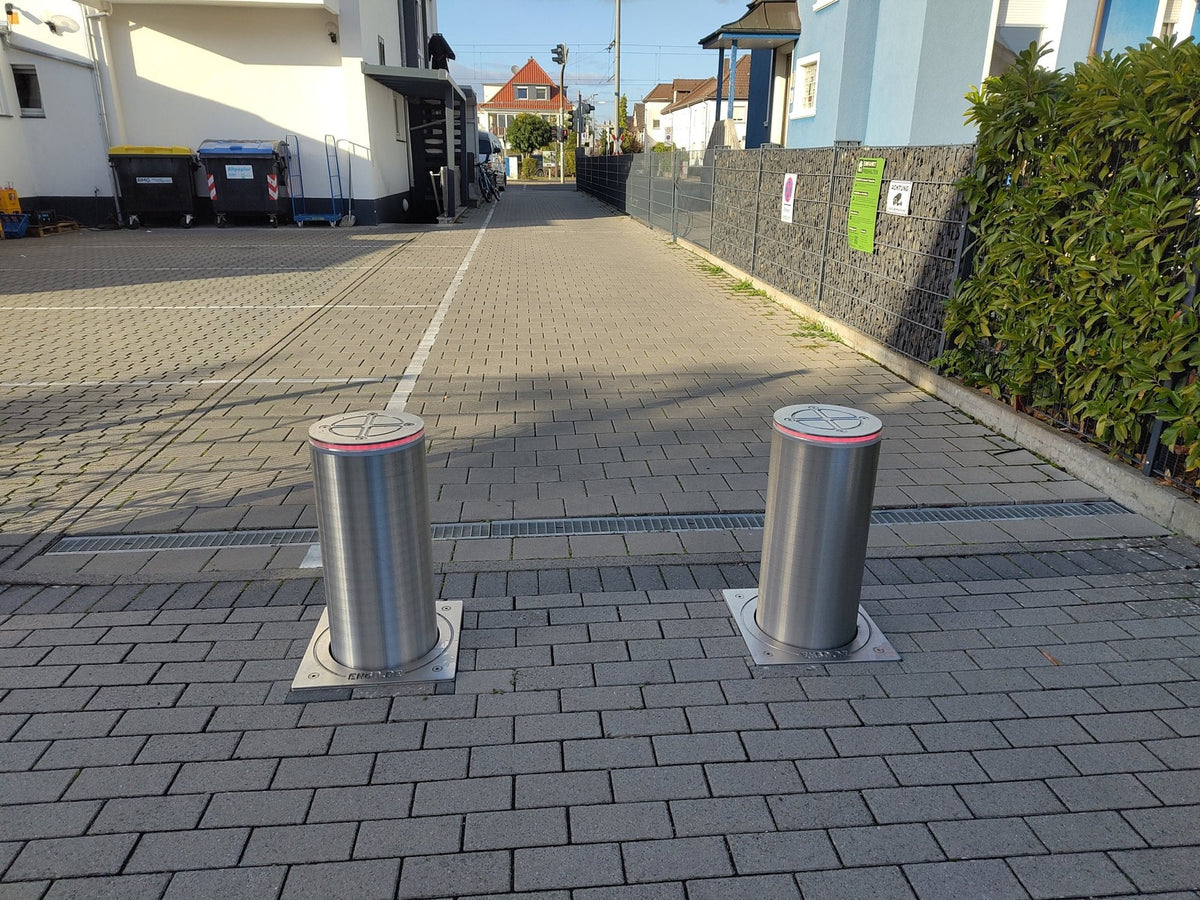
They provide a physical boundary and can be lowered when authorised vehicles need to pass.
Temporary vehicle barriers
Mobile systems can be particularly interesting for time-limited events when no permanent installation is planned.
Other structural barriers
Depending on the protection concept, other suitable or appropriately tested systems can also be used or combined. The design type alone, however, says nothing about the specifically proven impact performance.
When do permanent and when do temporary vehicle barriers make sense?
The decision should not be made in isolation on the basis of mobility or cost, but should follow from the duration of use, the protection objective and site-specific requirements.
| Criterion | Permanent solution | Temporary solution |
|---|---|---|
| Permanent use | Very well suited | Less obvious |
| Temporary event | Often disproportionate | Particularly relevant |
| Set-up / dismantling | Permanently installed | Regularly required |
| Townscape | Must be integrated permanently | Removable after the event |
| Groundwork | Often required | Less, depending on the system |
| Regular access release | Retractable version possible | Depends on the system |
| Planning objective | Long-term protection | Temporary protection concept |
Which standards are relevant to vehicle access protection?
As of August 2026, the following standards in particular should be considered:
ISO 22343-1:2023
This international standard defines performance requirements, a vehicle impact test method and the performance rating of vehicle security barriers. It is aimed at, among others, manufacturers and purchasers of such systems.
ISO 22343-2:2023
Part 2 covers the selection, installation and use of vehicle security barriers and describes, among other things, the process for determining the “operational requirements”.
DIN SPEC 91414-2:2022-11
This German specification covers requirements for planning vehicle access protection using tested vehicle security barriers and explicitly takes compatibility with the townscape into account.
What does a crash test say about a security bollard?
The statement “crash test passed” is not sufficient for a professional assessment. What matters is which barrier was tested under which conditions and what performance was demonstrated. Relevant factors include:
- test vehicle used
- vehicle mass
- impact speed
- specific impact conditions
- tested barrier configuration
- installation situation
- measured or rated vehicle penetration
ISO 22343-1:2023 standardises the performance requirements, the vehicle impact test method and the performance rating of vehicle security barriers.
For a tender or security plan, you should therefore not simply ask for a “crash-proof bollard”, but for the proven performance required for the defined scenario.
Which solution suits which municipal application?
The table can only give an initial direction. Especially for protection against deliberate vehicle attacks, the site-specific threat and protection objective analysis is decisive.
| Application | Main requirement | Possible direction |
|---|---|---|
| Pedestrian zone with delivery traffic | Regular opening and closing | Consider retractable barriers |
| Permanently car-free area | Permanent vehicle restriction | Consider fixed barriers |
| Christmas market | Temporary protection of people | Consider mobile or temporary solutions |
| Market square with changing use | Flexible use | Consider a combination of solutions |
| Public event | Temporary protection concept | Mobile/tested systems in line with the concept |
| Town hall entrance | Controlled vehicle access | Consider an automatic retractable system |
| City centre with regular logistics | Traffic control + security | Consider a retractable system + control |
| Particularly high-risk area | Defined impact performance | Tested vehicle security barrier |
How can vehicle access protection be integrated into the townscape?
Municipal access protection often takes place in locations whose quality lies precisely in being open and inviting. Historic town centres, market squares or shopping streets should, wherever possible, not take on the character of a permanent security zone. Relevant aspects in planning may include:
- heritage protection
- historic sightlines
- existing street furniture
- material and design of the barriers
- quality of the public space
- pedestrian routing
- accessibility
DIN SPEC 91414-2 explicitly takes compatibility with the townscape into account as part of access protection planning. Security and quality of the public realm should therefore not be planned as opposites.
What needs to be considered for pedestrians, wheelchair users and cyclists?
Vehicle barriers are meant to control vehicles – but they must not create new, unexamined obstacles to the regular use of public space. The following, among others, should therefore be considered at the planning stage:
- sufficiently wide passages
- avoiding unnecessary trip hazards
- necessary manoeuvring space
- requirements of people with visual impairments
- wheelchair users
- pushchairs
- bicycles
- large visitor flows
- escape and emergency routes
How these requirements are specifically implemented must be checked for the site in question and the regulations applying there.
How does a secured town centre remain accessible for deliveries?
In a lively town centre, a protection concept cannot simply mean: “From now on nobody drives in.” Shops, restaurants, residents and public infrastructure still need supplies. This often involves suppliers, refuse collection, utility companies, tradespeople, residents and municipal vehicles.
One solution can be defined time windows, for example deliveries in the morning and closure during busy periods. Depending on the concept, technical options include central control rooms, radio, number plate recognition, defined authorisations or time programmes. In this way, access protection becomes part of traffic management – not a replacement for it.
How do the fire and ambulance services remain able to act?
Access for emergency services must be part of the planning from the outset. The following in particular must be clarified:
- Which entrances do emergency services need?
- Which barriers are located there?
- How can they be opened?
- Is independent opening by emergency services planned?
- How does access work during power or communication failures?
- Which relevant authorities need to be involved in the planning?
No nationwide standard technical solution can be derived from this. Implementation should be agreed with the locally responsible authorities and emergency organisations. A vehicle access protection concept must not plan protection against vehicle attacks at the expense of the operational capability of the fire and ambulance services.
How does access protection for events differ from permanently protected areas?
A permanently protected public space is used every day. The townscape, residents, delivery traffic, maintenance and long-term infrastructure therefore play a central role.
An event, by contrast, is time-limited. Visitor numbers change, traffic routing is adjusted temporarily, and set-up and dismantling may temporarily create new access routes. Emergency routes or blocking points may also differ from event to event.
A solution that makes sense for a permanently secured pedestrian zone may therefore be unsuitable for a town festival held once a year – and vice versa.
Who is responsible for access protection on a day-to-day basis?
A protection concept does not end with the installation of the bollards. Clear responsibilities should be defined for operation: who manages access authorisations, who operates the system, who receives fault reports, who checks that it works, who carries out or arranges emergency openings, who organises maintenance, who documents changes and who reviews the concept when use changes?
Depending on the municipality and site, the public order office, highways or civil engineering department, event organisers, control room, facility management or external security service providers may be involved, among others.
Does an access protection concept need to be reviewed regularly?
Yes – especially when the underlying conditions change. Possible triggers include: a new road layout, roadworks, new car parks, additional events, changed market areas, additional entrances, new traffic routing, a changed threat level or new user groups.
One important point: a barrier can remain technically unchanged while the possibility of driving around it changes considerably due to changes in its surroundings. Consideration of the overall system should therefore not end with the acceptance of the original installation.
What should a municipality specify in the tender and procurement process?
A professional tender should not start with “We need bollard model XY” but should describe the requirements. These may include: protection objective, planned deployment scenario, required proven performance, number and position of barriers, permanent or temporary use, frequency of use, opening requirements, control system, access for fire and emergency services, necessary documentation, maintainability, spare parts supply, required technical evidence, installation, acceptance and training of those responsible.
Which mistakes should be avoided in municipal access protection?
- Starting with the product rather than the protection objective
- Automatically regarding every bollard as a tested vehicle security barrier
- Examining only the obvious main entrance
- Rating a crash test merely as “passed”
- Considering delivery traffic only after the technical planning
- Involving the fire and ambulance services too late
- Ignoring urban design and accessibility
- Not weighing permanent and temporary solutions against each other
- Procuring only hardware and forgetting the operating organisation
- Not defining clear responsibilities
- Not planning for power, communication and other failure scenarios
- Never reviewing a concept once created despite a changed environment
Municipal vehicle access protection in practice
Our experience shows that references are particularly helpful for municipal decision-makers when it comes to choosing the right security features. Take a look at our case study showing how the City of Hamburg uses retractable bollards to protect the Große Freiheit nightlife strip against vehicle attacks.
Are you planning vehicle access protection for a municipality or a public space?
View stainless steel bollardsRequest adviceFrequently asked questions about municipal vehicle access protection
What is a municipal access protection concept?
It is a structured plan that considers the threats, possible vehicle routes, protection objectives and weak points of a public area and derives organisational, structural and technical measures from them.
What is the difference between a normal bollard and a vehicle security barrier?
A bollard can perform different functions. A solution should only be classed as a tested vehicle security barrier if the corresponding performance has been demonstrated under defined test conditions.
Which standards are relevant for vehicle security barriers?
Internationally, ISO 22343-1:2023 for performance requirements and vehicle impact testing and ISO 22343-2:2023 for application, selection and installation are particularly relevant. In Germany, current developments in standards and regulations must also be taken into account.
What does a passed crash test mean?
The statement is only meaningful together with the specific test conditions. Vehicle, mass, speed, tested barrier configuration, installation situation and performance rating must be considered together.
Does a pedestrian zone need fixed or retractable bollards?
That depends on the usage concept. If delivery, resident or emergency traffic has to pass regularly, movable or retractable solutions may be relevant. Permanently car-free areas have different requirements.
When do temporary vehicle barriers make sense?
They can be particularly interesting for time-limited events. Whether they provide the required protection, however, depends on the specific protection objective and the proven performance of the system.
How are deliveries made possible despite bollards?
Through defined access times and authorisations. Depending on the system, central control, radio, number plate recognition or time programmes can be used, for example.
How does the fire service get through a secured entrance?
A site-specific opening and deployment concept must be defined for this. The relevant emergency organisations should be involved at the planning stage.
Does an access protection concept need to be reviewed regularly?
Yes, whenever the use, traffic routing, access options or threat situation change. New roadworks or parking areas, for example, can also change whether existing barriers can be bypassed.
What information does a tender for vehicle security barriers require?
At a minimum, the protection objective, deployment scenario, required proven performance, installation situation, operational requirements, control system, emergency access, maintainability and technical evidence should be clearly described.
Planning vehicle access protection for public areas professionally
A market square, a pedestrian zone, an event area or the entrance to a public building each has its own requirements. For an initial project assessment, the location, possible vehicle approaches, traffic routing, delivery traffic, emergency routes, usage times and any protection objectives already defined are therefore particularly relevant.
Braun Antriebe supports the technical planning and configuration of suitable bollard and vehicle security solutions. Existing site plans, photos, protection concepts and any test requirements already defined help to assess the starting situation thoroughly. Discover our retractable stainless steel bollards or discuss your vehicle access protection project with us.

Share:
Access Management for Businesses and Properties: Controlling Entrances Safely and Efficiently
Ram-Raid, Burglary and Theft Protection for Car Dealerships and Retail