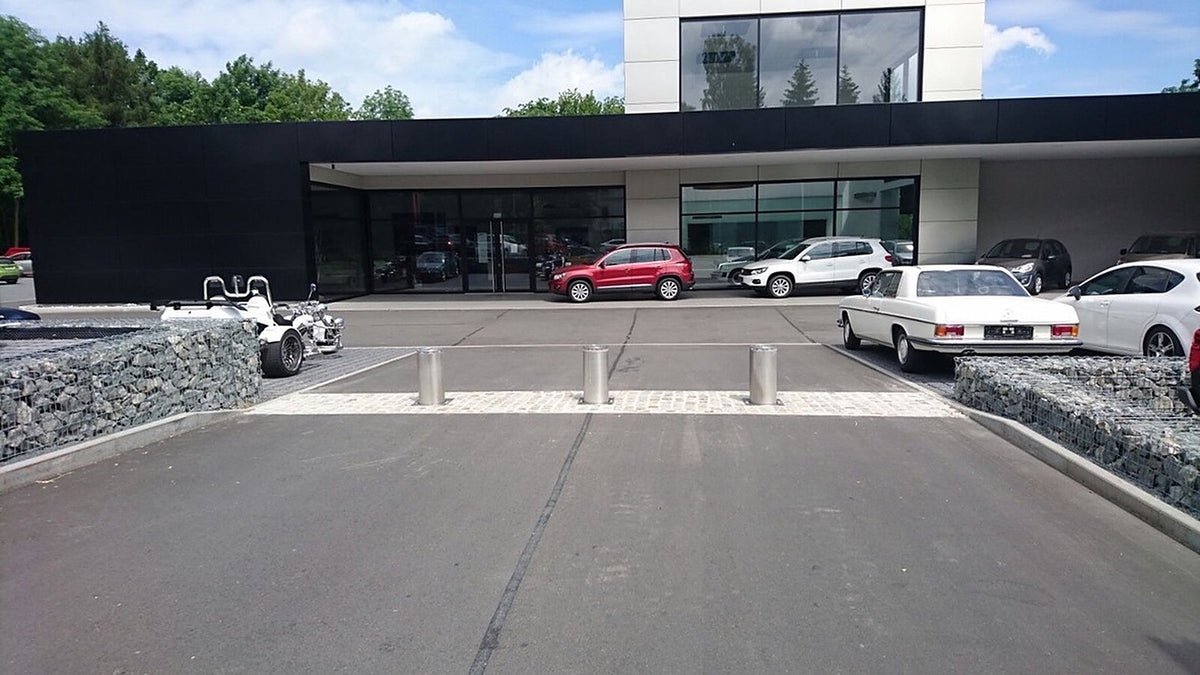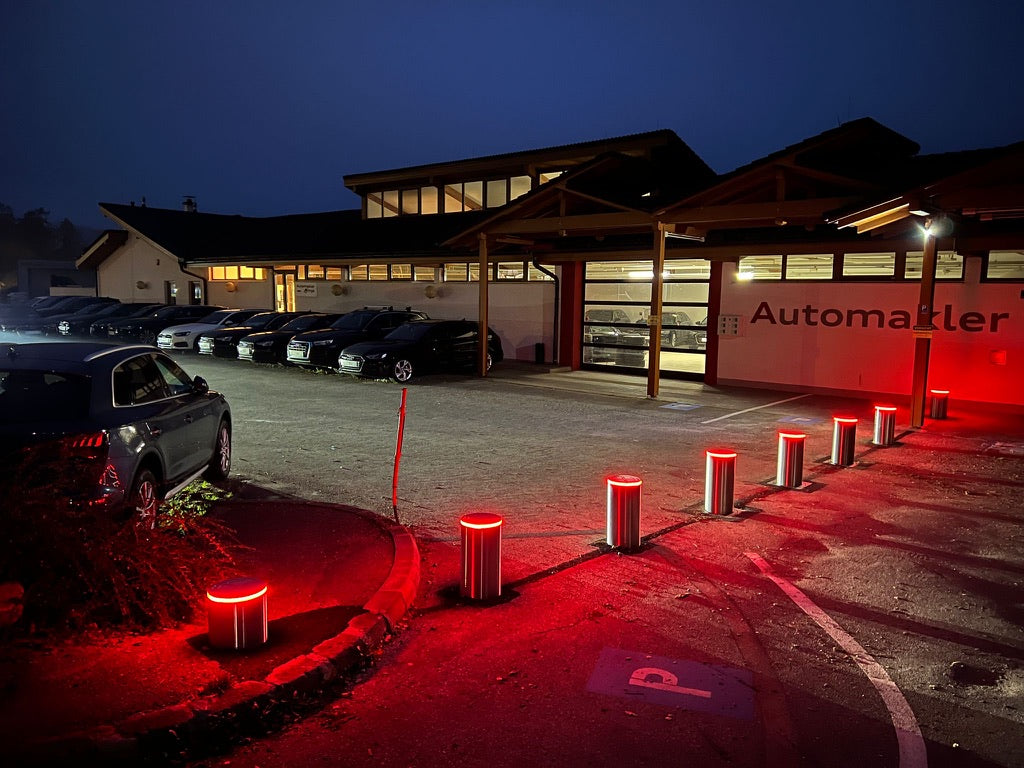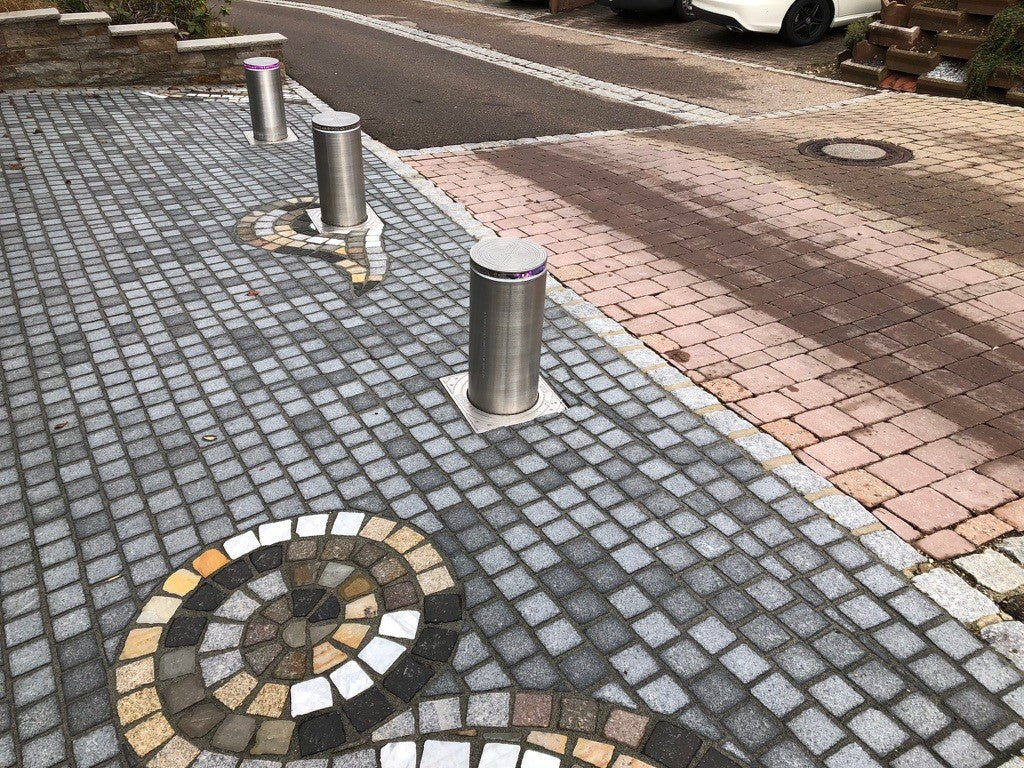

There are sites where a retractable bollard does not just get wet now and then but stands permanently in water. At this customer's site the groundwater was only five centimetres below the turf – the entire area was, as he put it himself, completely waterlogged. For a bollard this means: the installation sleeve stands constantly in groundwater, during heavy rain more water flows in from above, and there is never a dry day in between. Our pneumatic bollards made of stainless steel V4A (316) still run at this site – not because they somehow withstand the water, but because there is nothing inside them that water could harm.
When the foundation never dries out
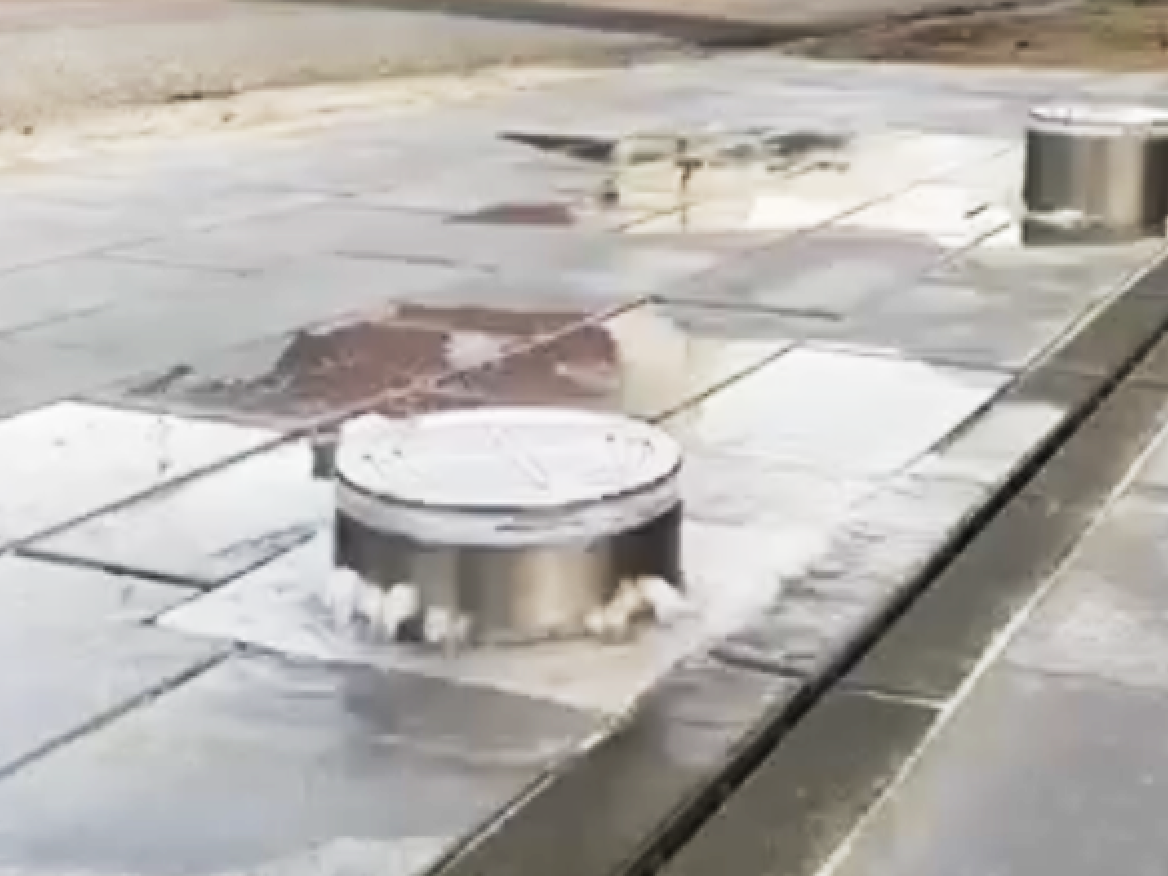
Most driveways are about rain that drains away and frost in winter. A flood zone is in a different league. Groundwater that stands almost up to the surface pushes into every sleeve from below; during floods or heavy rain the bollard also fills from above. The water then stays for weeks, with everything it brings along: mud, fine sand and, in winter, road salt. The photo above shows this clearly – the bollards stand in the paving right next to the drainage channel, and the water still stands on the surface.
Why technology inside the bollard has no chance here
A bollard whose housing contains an electric motor, a spindle, limit switches and a circuit board depends on a dry interior. That is why such systems need a heater against condensation and a drain that carries water out of the sleeve. But if the groundwater is five centimetres below the surface, a drain has nowhere to go – it would let water in rather than out. The interior gets wet, and then it is only a matter of time before the motor, contacts or electronics fail. Incidentally, this does not only apply to floods: heavy rain on the bollard head, dog urine and road salt take their toll on any drive that is not truly watertight.
Compressed air: all that sits in the ground is a stainless steel cylinder
Our bollards work pneumatically. Inside the bollard there is a stainless steel pneumatic cylinder – nothing else. No motor, no circuit board, no limit switch, no heater. The compressor, valves and control unit stand dry inside the building and are connected to the bollard by an underground cable and hose bundle. The water in the sleeve therefore only meets stainless steel and a cylinder that is sealed to IP69. The piston rod is protected by a metal scraper and a grease chamber, and the seals are designed for temperatures down to –35 °C. Whether the cylinder stands in air or in water makes no difference to its function. This is exactly what the customer experienced in his flood zone: the area was under water, and the bollards rose and lowered as on any other day.
What IP69 really means for a bollard
The IP69 protection rating is the highest level: dust-tight and protected against high-pressure and steam-jet cleaning – far more water than a bollard is exposed to in everyday use. What matters is less the number than the design behind it. Only a component with no electronics, no ventilation opening and no plug connection in the water can achieve this rating. A pneumatic cylinder meets this requirement by its very nature. That is why water is not a special case for our bollards that has to be managed with additional technology, but the normal case they are built for. We have summarised what else speaks for compressed air in our comparison of bollard drives.
And if something ever needs replacing?
With a pneumatic system this question is quickly answered: the compressor and valve sit indoors on quick-release couplings and can be replaced in a few minutes – without anyone opening up the paving or reaching into a flooded sleeve. The bollard itself stays in the ground. At a site where every opening of the surface means working in groundwater, this is not a detail but the decisive difference. This makes the system very low-maintenance – even after years in water.
What to look out for at a wet site
Three questions you should ask every supplier if your property lies in a flood plain, near a river or on high groundwater. First: what sits inside the bollard itself, and does it still work when the sleeve is permanently full of water? Second: does the system need a drain or a heater – and where should the drain carry the water if there is groundwater all around? Third: where is the technology that will need servicing at some point, and does the ground have to be opened for it?
A similar challenge – with salt water, storms and drifting sand instead of groundwater – is shown in our reference Sansibar on Sylt. Answers on installation, control and winter operation can be found in the frequently asked questions about retractable bollards.
Is your site wet, at risk of flooding or close to water?
Send us a photo of your driveway via WhatsApp to +49 172 4544485 or call us on +49 40 226390411. We will tell you whether and how a retractable bollard can be installed at your site, and we support the installation by photo and video. You will find all models and prices in the overview retractable bollards made of stainless steel V4A.