

A beach restaurant made of weather-beaten wood in the middle of the dunes, long known far beyond Sylt. From the car park near the road, a paved beach path leads up to the Sansibar – usually full of people and, if nobody kept watch, full of vehicles too. Since autumn 2018, a single retractable bollard made of stainless steel V4A (316) from Braun Antriebe has stood on exactly this path, flanked by two massive boulders. It is the bulwark against illegal parkers and all-too-comfortable contemporaries who would love to park right outside the door.

The access at the car park: on the left the boulder with the Sansibar lettering, on the right the stone marked “Rettungsweg” (emergency access), and the bollard in between. No more barrier is needed here.
Why a bollard and not a gate or a barrier arm?
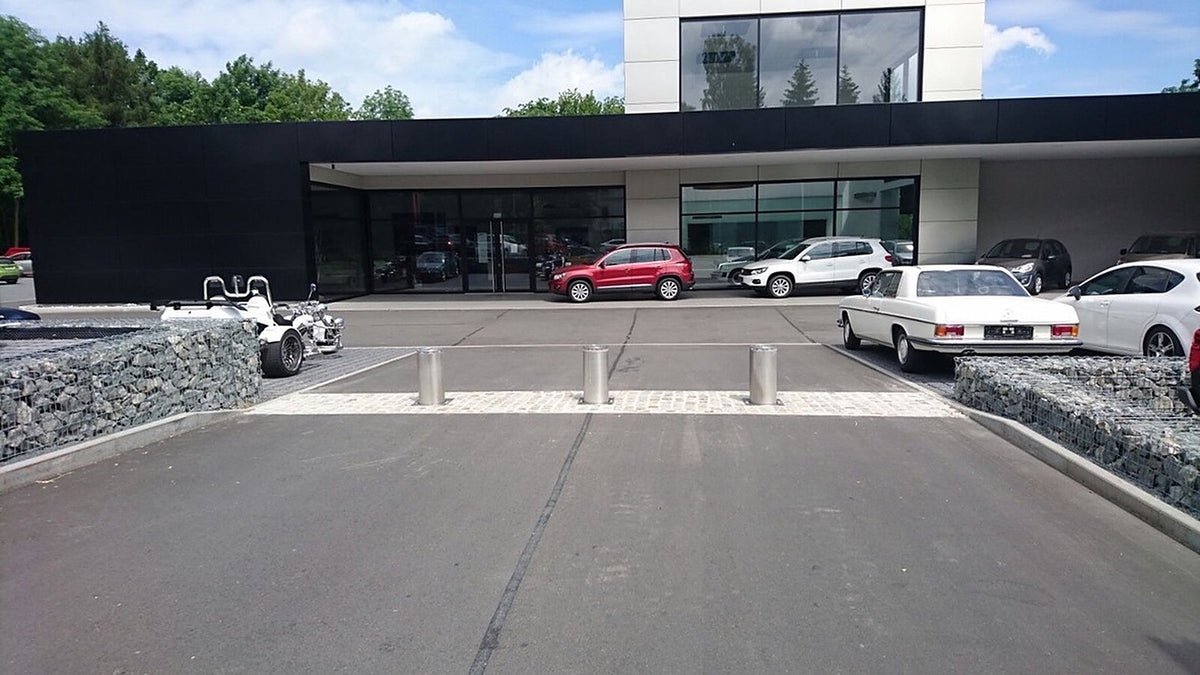
A gate or a barrier arm would be in the way at this spot. Guests come on foot, by bike, with prams and handcarts – and they come in their hundreds. A barrier boom would block their way, a gate would constantly have to open and close, and both would have to battle wind, drifting sand and salt in the long run. The retractable bollard, on the other hand, is just a stainless steel lid when lowered, flush with the paving, which everyone walks over without noticing it. When raised, it stands exactly where a car would fit through, leaving so much space to the left and right by the boulders that pedestrians can pass unhindered.
In addition, the path is an emergency access route. In an emergency, rescue vehicles must get through to the Sansibar without delay. The bollard lowers in a few seconds, and the behaviour in the event of a power failure can be selected with our pneumatic systems – for an emergency route, the system can be set so that the bollard lowers without power and the access is clear.

Pedestrians can pass at any time, even the smallest ones. By the way, the unicorn on the bollard head belongs to the boss's daughter, who came along on the visit to Sylt.
Who is allowed in – and how?
Suppliers, taxis and the restaurant's own VIP shuttle naturally drive right up to the door. There are three ways to do this: anyone not known registers via the intercom, regular suppliers lower the bollard with a chip card, and the VIP shuttle has a radio transmitter on board. In addition, induction loops with direction detection are installed in the access: they detect whether a vehicle has passed the bollard and then raise it again automatically. The traffic light on the mast next to the path (clearly visible in the cover photo) shows the driver whether the way is clear.
Today we supply this combination of loops, traffic light and several opening methods as a road control system with Loxone technology – for restaurants, hotels and commercial yards where many different vehicles are authorised.
Salt, sand and storms: why compressed air and V4A here
The North Sea coast is the toughest location in Germany for technology in the ground: salty air around the clock, drifting sand that creeps into every crack, heavy rain, storm surges and frost in winter. A bollard with a motor, circuit board and limit switches in its housing has a hard time here. That is why, in our systems, the only thing in the ground is a stainless steel cylinder – the compressor, valves and control unit stand protected in the building. There is nothing in the bollard that could rust, get damp or overheat, and no heater or drain that could silt up with sand.
- Stainless steel V4A (1.4571): seawater-resistant, brushed – salty air and spray cannot harm the material.
- Sealed to IP69: flooding, sand and high-pressure cleaners are no issue for the cylinder.
- Piston rod with metal scraper and grease chamber: sand is wiped off as the bollard lowers, and the seals are designed for down to –35 °C.
- Low-maintenance: if something does need replacing after years, it is the compressor or a valve in the building – not the bollard in the paving.
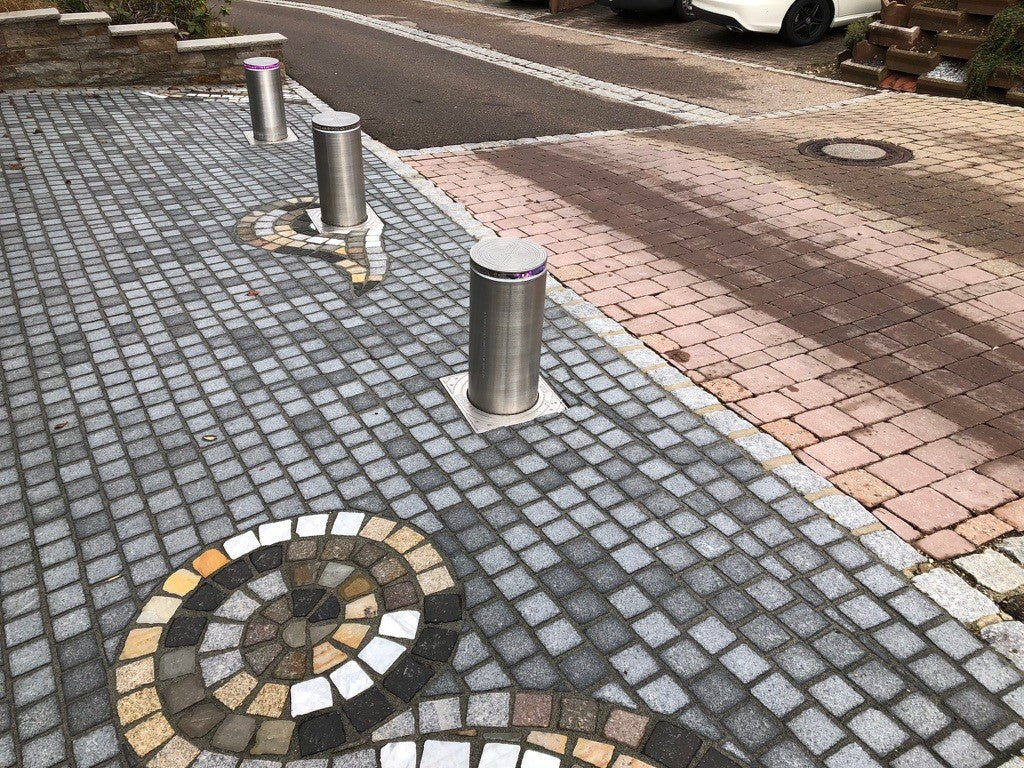
We pre-assembled the entire system to size in our works in Seevetal near Hamburg: cable and hose bundle cut to length, protected in armoured conduit, control unit fully wired. On site, installation mainly involved groundwork and paving. Our model designation EH60 can be read on the bollard's base frame: Ø 273 mm, 600 mm stroke, 6 mm wall thickness – the same series we supply today.

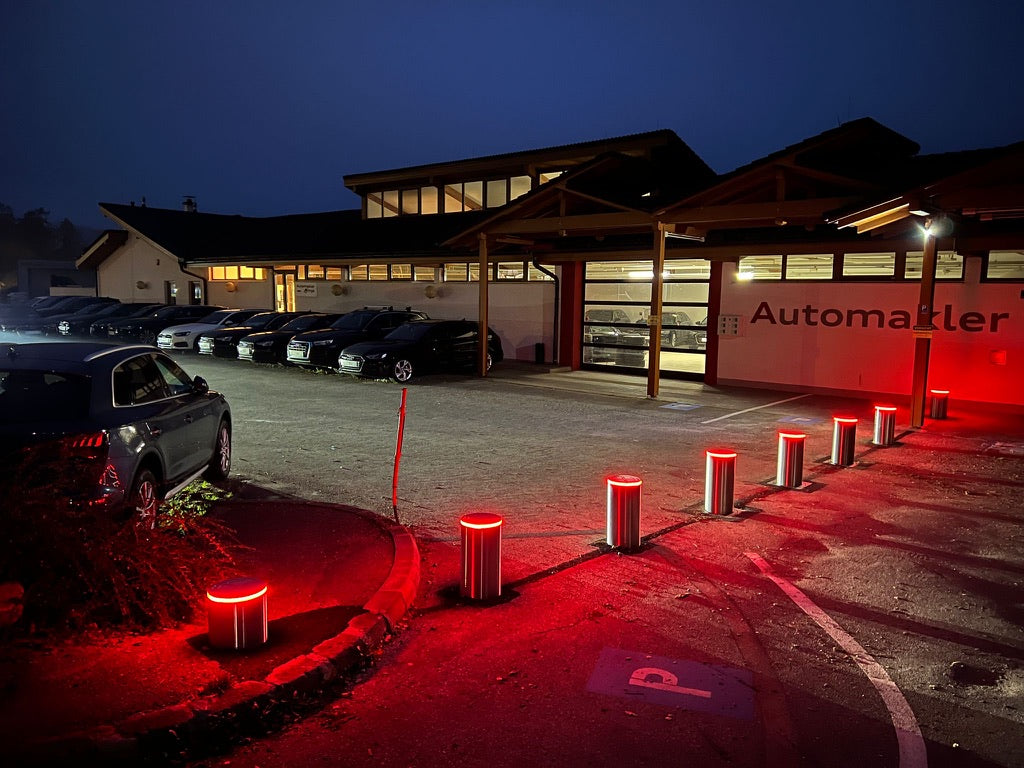
Below the lid plate, the red LED ring runs around the bollard head – the barrier cannot be missed in darkness and fog. The model designation EH60 is on the base frame.
The Sansibar logo from our own CNC milling machine
The real eye-catcher is the lid plate. It bears the two crossed sabres, the emblem of the Sansibar known far beyond Sylt. We milled them on our own CNC machine in Seevetal, directly into the V4A lid plate – no sticker, no engraving film, but metal that lasts as long as the bollard itself. The plate is bolted on and can be removed if necessary. This way the brand shows its colours at the car park before the guest has even seen the restaurant.
We do the same for coats of arms, company logos or lettering – as with the Hamburg coat of arms on the bollards at City Hall. A drawing or a vector logo is all we need.

The lid plate from above: the crossed sabres, milled into the stainless steel on our CNC milling machine.
What restaurateurs and beach operators can take away from this
Three decisions from this project suit almost any access where many people are on foot and only a few vehicles are authorised. First: a single bollard between two fixed elements – boulders here, planters or walls elsewhere – keeps vehicles out without obstructing pedestrians. Second: plan several ways of opening so that suppliers, taxis and your own vehicles do not have to wait for a member of staff. Third: on the coast or on salted roads, do not put technology in the ground that does not belong there.
We have summarised how to keep illegal parkers off private land without locking out guests on the page Unauthorised parking; the basics for businesses and hotels are covered in the topic page Access management for businesses. Which drive type suits which location is explained in our drive comparison of compressed air, hydraulics and electric spindle.
Do you want to secure an access without locking out your guests?
Send us a photo of the access via WhatsApp to +49 172 4544485 or call us on +49 40 226390411. We manufacture the bollards ourselves in Seevetal near Hamburg, mill your logo into the lid plate on request and support the installation. You will find all models in the overview retractable bollards made of stainless steel V4A.