
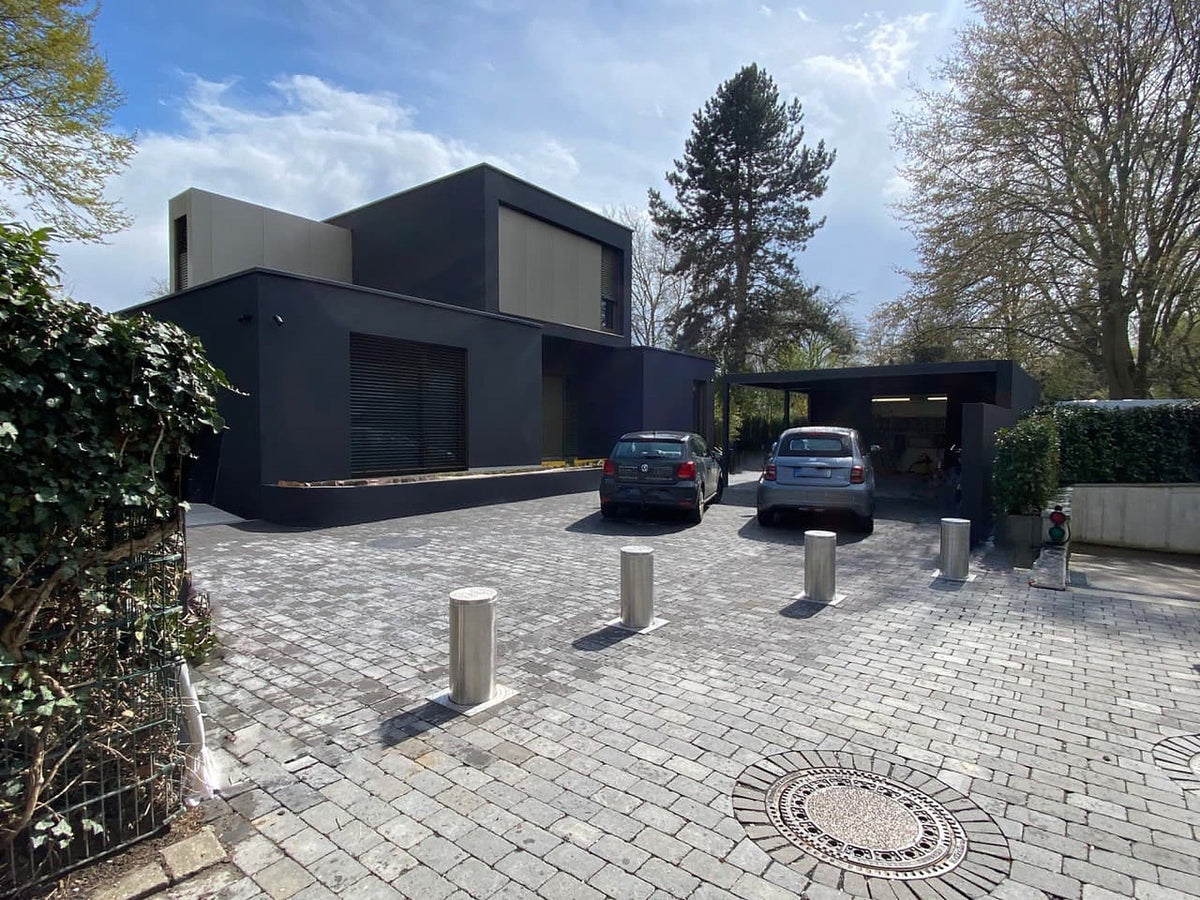
A modern house with a dark façade and flat roof, in front of it a generously paved driveway open to the street, and behind it a carport for two vehicles. It was precisely this openness that was the problem. The driveway practically invited people to drive in: strangers parked their cars in the private spaces, others used the area for turning, and the family's vehicles stood every night just a few metres from the street without any barrier. The owner wanted to change this without putting a gate in front of his house that would not suit the architecture.

Since then, four retractable bollards made of stainless steel V4A (316) have secured the driveway. When raised they completely close off the area in front of the house and carport; when lowered they disappear flush into the paving.
Unauthorised parking, turning manoeuvres, risk of theft – three problems, one cause
Anyone with an open driveway on a residential street knows this: others perceive the area in front of the house as part of the public space. Delivery vehicles turn there, the neighbours' visitors park there “just for a moment”, and your own cars are visible and accessible to everyone. All three annoyances have the same cause – the missing boundary between street and property. So the obvious step was to draw exactly this boundary, but in such a way that it is only there when it is needed.
Why not a gate
A sliding or swing gate across the full width of the driveway would have broken the clean lines of the house. Then there are the practical disadvantages: a gate needs room to open, guide rails in the paving or a track on the ground, it gets damaged when manoeuvring, and anyone who drives in and out several times a day waits each time until the gate leaf is fully open. A barrier arm, on the other hand, looks like a multi-storey car park and does not stop anyone who really wants to get through.
Retractable bollards solve the task more elegantly. They need no space to open, they do not change the look of the driveway, and they are up or down in three seconds. When the family is at home and the bollards are raised, a row of stainless steel stands in front of the driveway that no vehicle can pass. When someone drives off, the bollards lower and the driveway is as free as before.
Four bollards across the driveway
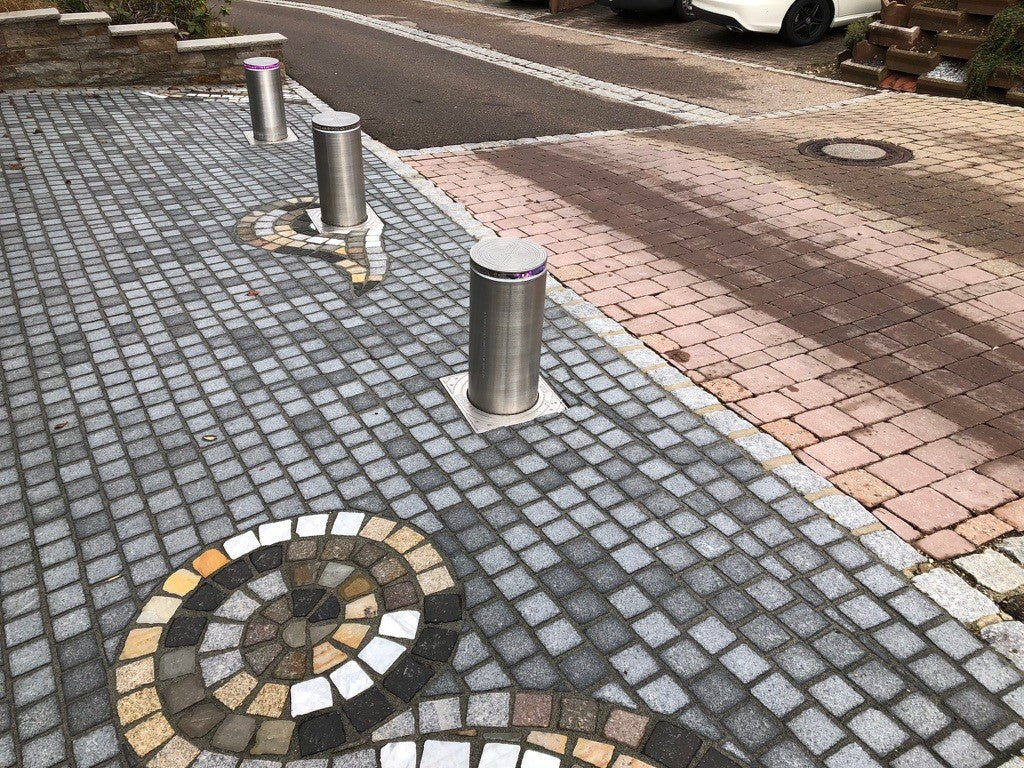
The four bollards stand in a line in front of the house and carport, with gaps that no car can get through. Pedestrians and bicycles pass without any problem. Each bollard sits in its own installation sleeve deep in the ground, surrounded by compacted sand, and the paving was neatly closed around the lids. When lowered, only the stainless steel lids are visible in the paving pattern.

Brushed stainless steel on grey paving: the bollards are understated and suit the house – and yet no vehicle gets past them.
Appearance: stainless steel that suits the house
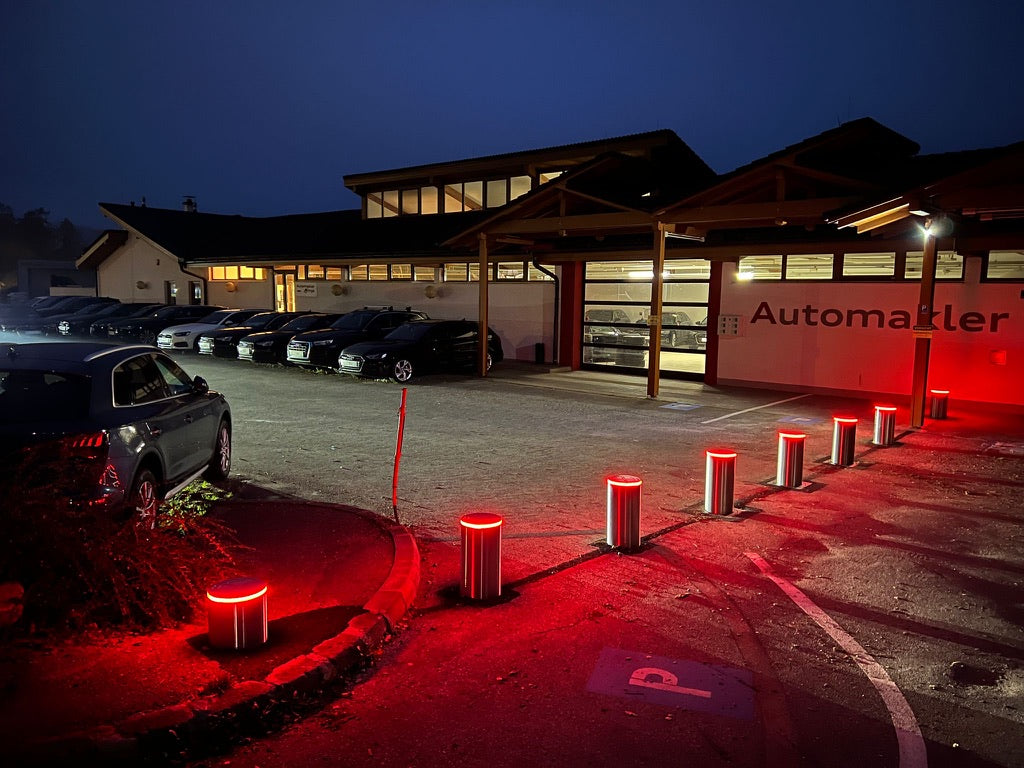
For the owner, appearance was a decisive criterion. A bollard that looked out of place would have been out of the question for this house. Our bollards are made of stainless steel 1.4571 (V4A), brushed on the outside, with no visible screws or attachments. The simple cylinder with a flat lid suits exposed concrete, clinker brick and – as here – dark, minimalist architecture. On request, an LED ring sits below the lid, in a colour of your choice – invisible by day, a discreet marking of the property boundary at night.
Theft protection: the cars stay where they are
The most important reason for the system was the vehicles. Cars are stolen where they stand at night – and that is usually your own driveway. Modern theft methods bypass a vehicle's electronics in minutes; they do not bypass a row of four stainless steel bollards. Anyone who wants to move a car out of this driveway must first lower the bollards, and that is only possible with the owner's authorisation.
To make sure this also applies when someone tries to force the issue, each of our bollards has a mechanical height lock: the raised bollard engages at the top via a locking bolt and can then no longer be pushed down. Even if someone cuts the compressed air lines, only the air escapes – the bolt holds, the bollard stays up. And the system can be set so that the bollards stay raised during a power failure. Cutting the power opens nothing. You can read more about how bollards protect vehicles against theft on our page Vehicle theft protection.
Everyday operation
In everyday use, the family operates the bollards with a hand-held radio transmitter from the car. On arrival, all four bollards lower together, the vehicles roll under the carport, and the bollards rise again. When leaving, the reverse. Nobody gets out, nobody looks for a key. For more convenience, the system can also be controlled via smartphone, voice assistant or the smart home system; the control is a simple switching signal. For visitors, the bollards can be lowered from inside the house without going outside.
The technology: compressed air instead of a motor in the bollard
Installed here is our barrier bollard stainless steel V4A pneumatic in the standard version: around 160 kg, Ø 273 mm, 600 mm stroke, 6 mm wall thickness. It is the bollard we install in the vast majority of driveways. It is driven by compressed air. This means: the bollard itself contains only a stainless steel cylinder with a mechanical lock – no motor, no circuit board, no limit switch, no heater. Everything that needs electricity stands dry in the house: a quiet compressor and the valves, connected by a hose and cable bundle that can be up to 500 metres long.
For the owner this means above all: little maintenance and no nasty surprises. The bollard is sealed to IP69, copes with heavy rain, snow and road salt, and the piston rod with metal scraper and low-temperature seals works down to −35 °C. Should a valve or the compressor need replacing after many years, this is done in the house, on quick-release couplings, without anyone opening the paving. Why we rely on compressed air and how this differs from electric and hydraulic bollards is explained in our comparison of bollard drives.
The result
Since the installation, nobody parks in front of the house without permission any more, nobody turns on the paving, and at night the vehicles stand behind a locked stainless steel barrier. The driveway looks the same as before – except that it now belongs to the family. For data protection reasons, we do not name the customer's location or name.
Do you also have an open driveway?
If strangers use your driveway as a car park or turning area, our page Unauthorised parking shows the options available. How to protect your driveway, vehicles and façade as a whole is summarised in our topic page Driveway and vehicle protection; answers to the most common questions on installation, costs and operation can be found in the FAQ on retractable bollards.
Send us a photo of your driveway via WhatsApp to +49 172 4544485 or call us on +49 40 226390411. We will tell you how many bollards you need, where they should stand and what the system costs. You will find all models and prices in the overview retractable bollards made of stainless steel V4A. Everything is manufactured at our site in Seevetal near Hamburg.