
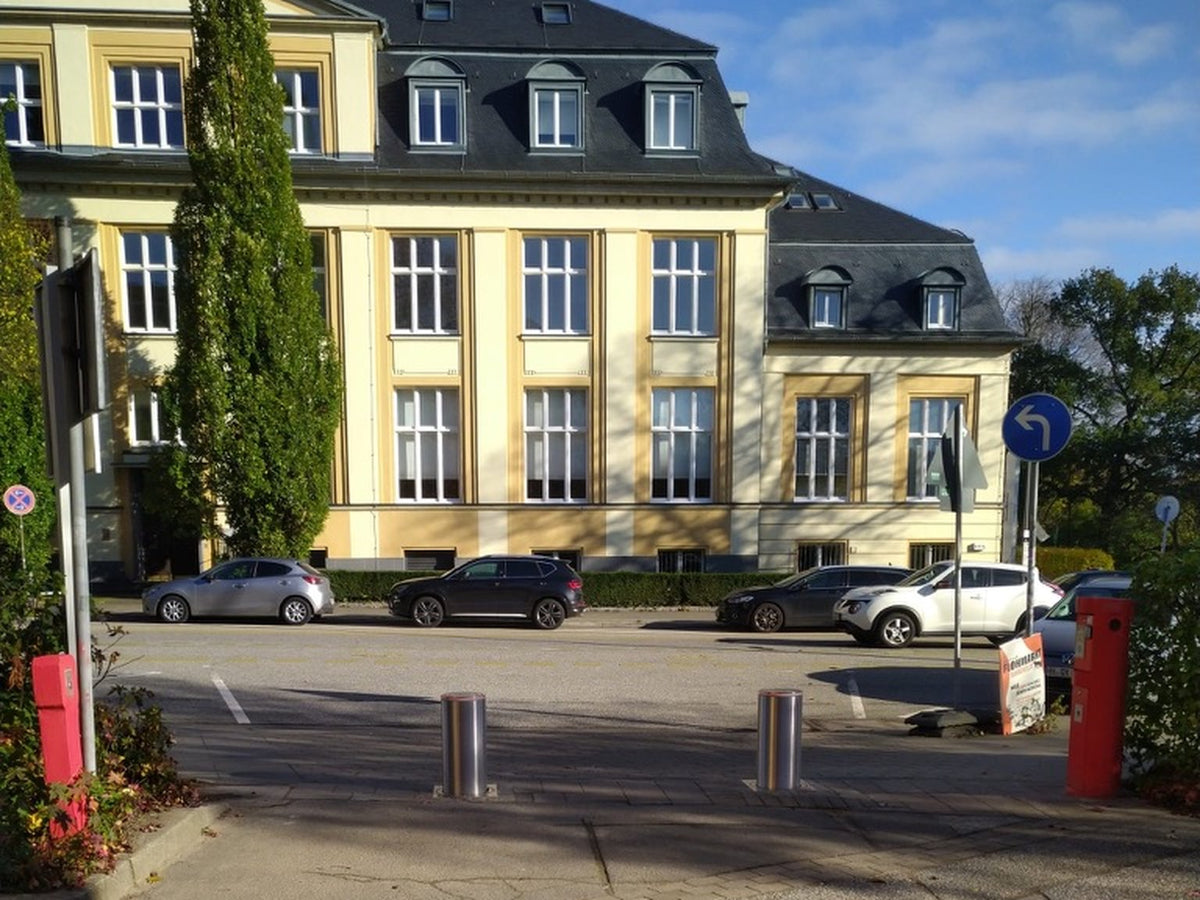
A car park in the middle of the campus, the historic main building behind it, and in front a narrow passage between a hedge and signs: there was traffic here from morning to night. Students, lecturers, suppliers, visitors – plus anyone looking for a shortcut or hoping to find a free space by chance. For the university in northern Germany, the result always looked the same: vehicles manoeuvring in tight spaces, minor dents when pulling out, blocked paths and queues back onto the road. Every accident cost time, nerves and, in the end, money.
The administration's brief was clear: the car park is reserved for those who are allowed to park there. For everyone else the passage should be closed – without a barrier arm, without a gate and without a gatekeeper.

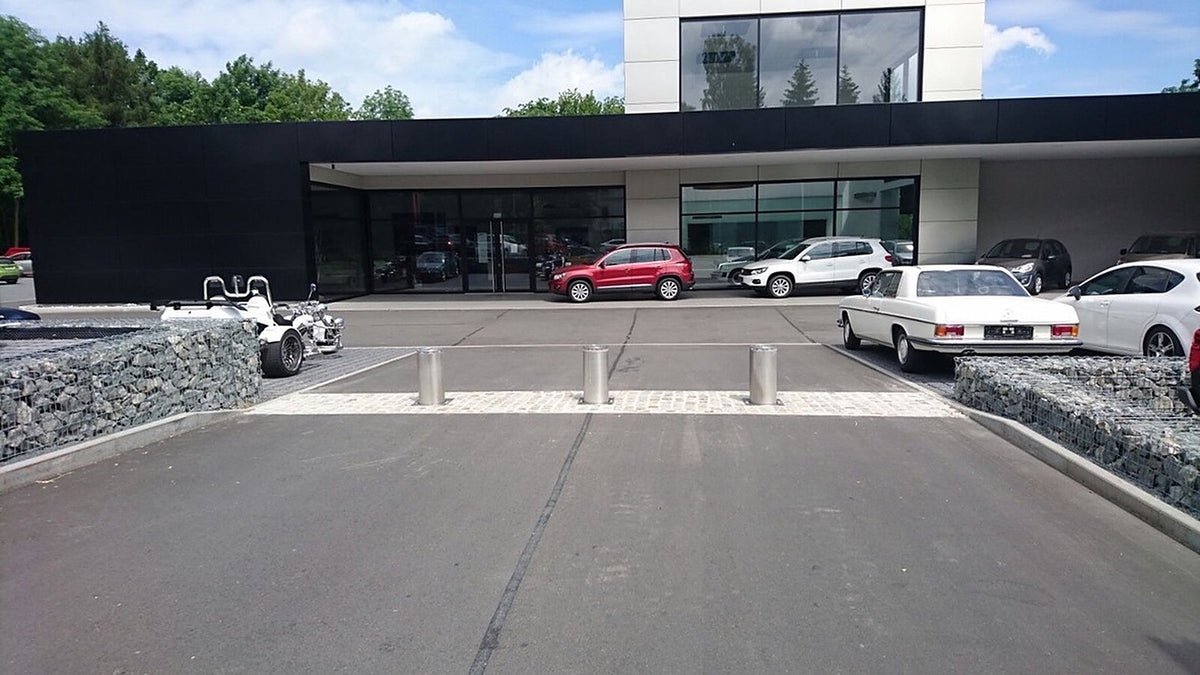
Two raised bollards close the passage to the car park. Pedestrians and cyclists still get through, cars do not.
Why not a barrier arm?
A barrier arm would have been the obvious answer – and the wrong one at this spot. It needs space for the boom and a housing at the side, which simply is not available here. It needs regular maintenance. And on a campus a barrier boom is a popular target: it gets pushed up, driven under or broken off. A gate would have closed the passage to pedestrians and cyclists as well – but they are exactly the people who should still be able to pass. And experience shows that a chain lies permanently on the ground after two weeks.
Two stainless steel bollards, flush with the paving slabs
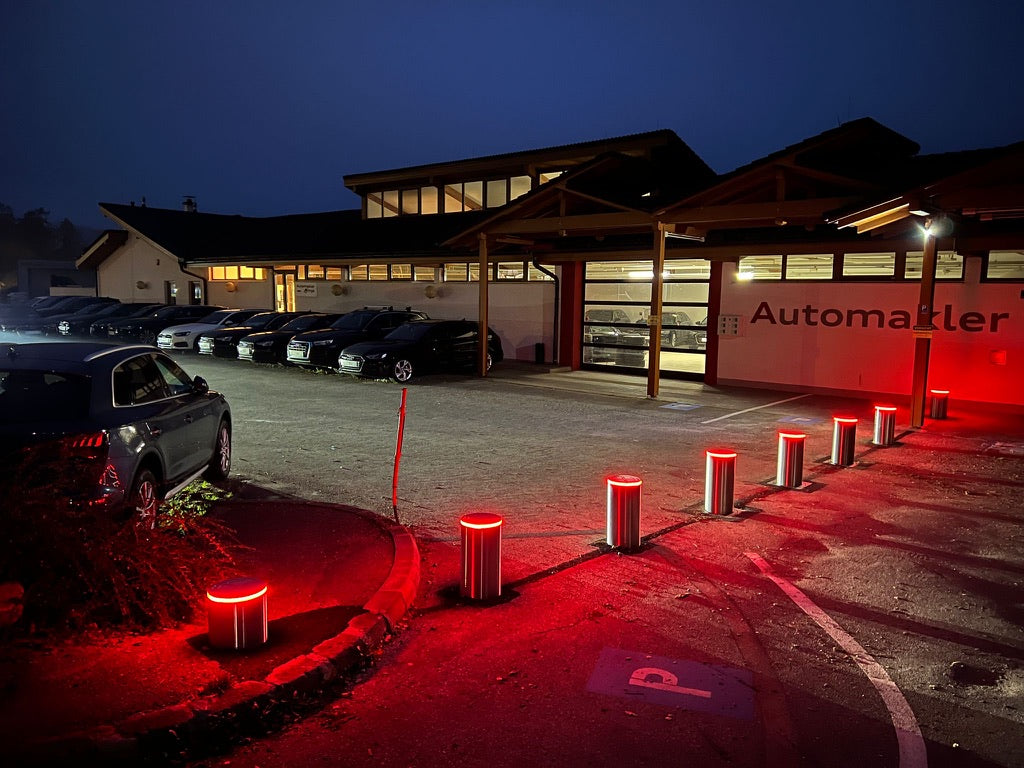
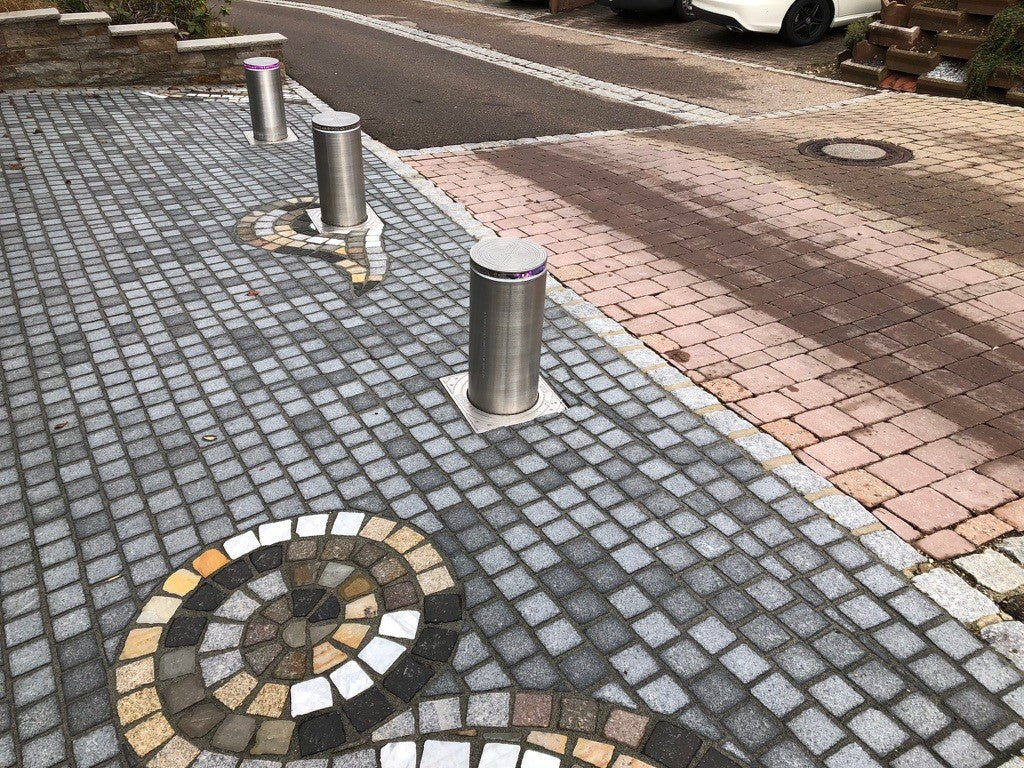
Two retractable barrier bollards made of V4A stainless steel (1.4571) were installed. When raised, they close the passage so tightly that no vehicle can get through. When lowered, only the stainless steel lids remain in the paving, and the area can be driven over freely – by the fire brigade, removal vans or deliveries as well as by authorised users.
The brushed stainless steel suits the building and does not draw attention to itself. Above all, it withstands everyday life in a public place: stickers, marker pen, paint or droppings can be wiped off without leaving any trace on the material. There is no coating that could flake off and no paint that would need touching up.
Operation by radio transmitter and push button
Anyone allowed into the car park has a radio transmitter in the car: press the button on approach, the bollards lower and you roll through without stopping. In addition, the system can be operated on site by push button, for example by the caretaker or from the porter's lodge. If desired, number plate recognition, a timer or a connection to the building management system can be added later – the control unit sits dry inside the building and can be extended at any time.
Why compressed air, especially at a university?
Our bollards work pneumatically. The bollard itself contains only a stainless steel cylinder; the compressor and valves stand in the building. There are no electronics or motor in the ground that could be exposed to rain, road salt or frost. The bollards are sealed to IP69, the seals are designed for temperatures down to −35 °C, and the system needs neither a heater nor a drain.
For a car park in continuous use, something else counts too: the system is designed for several hundred thousand cycles and is very low-maintenance. Should a valve or the compressor need replacing after years, this is done indoors – every component sits on quick-release couplings, and the paving outside stays closed. When raised, the bollard locks mechanically via a bolt; it then cannot be pushed down, not even by force. The material is V4A stainless steel, manufactured in-house at our site in Seevetal near Hamburg.
Car park at a university, public authority or hospital?
The pattern is always the same: many users, a narrow access and too many vehicles that have no business being there. Signs change little; a barrier that creates no work for anyone does. We have described a similar case here: Bollards secure the parking spaces of a residential complex. What else needs to be considered for commercial and public access points is covered in the guide Access management for businesses.
Send us a photo of your access via WhatsApp to +49 172 4544485 or call us on +49 40 226390411. We will tell you how many bollards you need, where they should stand and which control system fits. Universities, public authorities and associations can order from us on account. You will find all models and prices in the overview retractable bollards made of stainless steel V4A; answers to common questions can be found in our FAQ on retractable bollards and in the comparison of bollard drives.