
A hospital forecourt on a grey winter's day. In front of the main entrance stands a group of around 15 people – patients, relatives and staff who have just arrived or are waiting for someone. A few metres in front of them, set in the paving, is a retractable stainless steel security bollard. It has stood there for years, raised, and hardly anyone notices it any more. On this day it earned its place.

The front of the car after the impact: bumper, radiator and front-end carrier are destroyed, oil is leaking. The bollard that caused this stands unchanged in the ground a few metres away.
What happened that day
A woman of around seventy was on her way to the hospital in her Mercedes A-Class when she suffered a stroke at the wheel. The stroke triggered a seizure – and with the seizure she pressed the accelerator to the floor without being able to steer or stop. The car accelerated unbraked onto the forecourt, heading straight for the entrance area where the group of people was standing.
The vehicle hit the security bollard at around 65 km/h. The bollard stopped the car on the spot. The 15 people standing directly behind it in front of the entrance were unhurt. The driver also survived the accident and is well again today. In the end, the damage was limited to property: the 1.5-tonne A-Class was a case for the scrapyard.

Police and ambulance service at the accident site. The oil trail shows the car's path – at the bottom left of the picture is the bollard where it came to a stop.
Without the bollard, the vehicle would have driven into the group of people
This is the sentence that sets this case apart from all the other references on this page. Normally we write here about driveways misused as turning areas or about parking spaces blocked by strangers. Here, lives were at stake. Between the car and the people in front of the entrance there was nothing but this one bollard. No kerb, no planter, no road sign would have stopped a car at 65 km/h – the bollard did.
The bollard does not stand there by chance. In front of hospital entrances, two requirements meet that actually contradict each other: the forecourt must be safe for pedestrians, wheelchairs and beds, and at the same time ambulances, taxis and suppliers must be able to drive up. A retractable bollard solves exactly this – when lowered it clears the access, when raised it separates the pedestrian area from the roadway. And when it matters, it holds.
250 kilojoules: what the bollard absorbed at that moment
We recorded the figures for this accident afterwards, because they show what we are actually talking about when we say “impact protection”:
| Vehicle weight | approx. 1.5 t |
| Impact speed | approx. 65 km/h |
| Kinetic energy | approx. 250 kJ |
| Change in gap at the bollard | none |
| Repair to the bollard | wipe off oil |
250 kilojoules is an abstract figure. It becomes clearer like this: it is roughly the energy the same 1.5-tonne car would have if it were dropped from a height of about 17 metres – in other words from the roof of a five-storey building. This energy has to go somewhere within a few centimetres and milliseconds. Part of it deforms the vehicle; the rest goes as an impact into the bollard and via the installation sleeve into the ground.


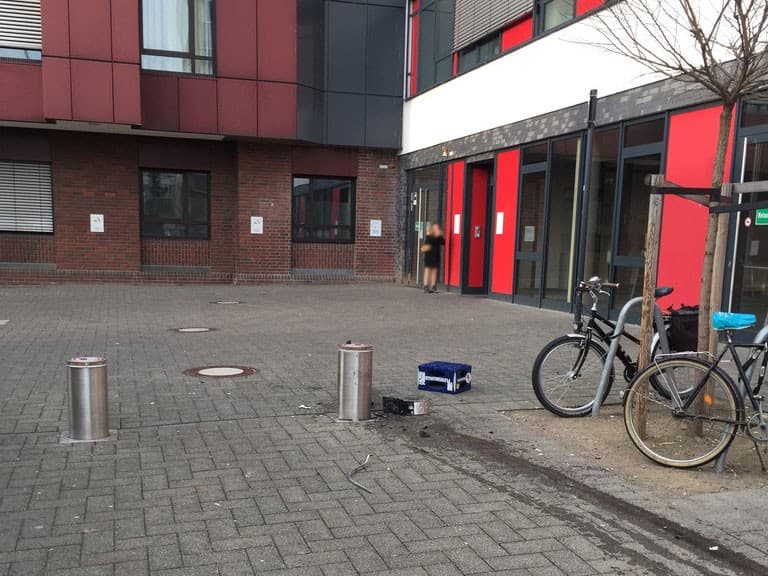
The bollard immediately after the accident: all around lie the number plate, bumper parts and splinters, and on the paving the oil from the engine. The stainless steel cylinder itself has a few smears – nothing more.
The bollard afterwards: no change in gap, just oil wiped off
Anyone looking at the bollard in the photos will see what tells us most about this case technically: after the impact it stands in the ground exactly as before. The gap between the cylinder and the installation sleeve has remained the same all the way round – the bollard has neither tilted nor shifted. No repair was needed, no replacement, no realignment. The oil from the vehicle was wiped off, and then the system kept running as before.
This is down to the design. The bollard consists of a cylinder made of V4A stainless steel (1.4571) with a diameter of 273 mm, which sits in its own stainless steel installation sleeve in the ground. The force does not go into a weld seam or a foundation of thin concrete, but over the entire installation depth into the compacted subsoil. And because our bollards work pneumatically, there is nothing inside the bollard itself that could be damaged by such an impact: no motor, no electronics, no hydraulic pump. The compressor and valves are in the building. An impact like this only hits steel.
This very accident is the reason why we state “1.5 t at 65 km/h without any change in gap” for our standard bollards. It is not a calculated value from a catalogue, but an event that actually happened.
Which bollard for which level of protection?
Most enquiries we receive about security bollards concern vehicles going where they do not belong: onto customer car parks, into pedestrian zones, in front of the entrances of car dealerships, schools, clinics or administrative buildings. We offer three levels for this:
- Standard bollard (6 mm V4A stainless steel, approx. 160 kg) – the version from this article: stops a 1.5 t car at 65 km/h without any change in gap. The right choice for forecourts, driveways and pedestrian areas. To the standard bollard
- Bollard with 12 mm wall thickness – for access roads also used by vans and light lorries. To the 12 mm bollard
- Security bollard with 30 mm wall thickness (approx. 500 kg) – for embassies, the military, car dealerships and any access where a targeted attack or ram raid must be prevented. To the 30 mm security bollard
For high-security applications, we also had our armoured version with a steel core tested in an official crash test: a 12-tonne lorry at 80 km/h head-on into a single bollard. The lorry was stopped and the cab sheared off – the bollard stood.
All three are retractable, work with compressed air and have a mechanical lock at the top: when raised, the bollard engages and can neither be pushed down nor lowered by cutting a hose. What else you should consider when protecting people and buildings can be found on our page Security bollards and in the guides Municipal vehicle access protection and Ramming and burglary protection.
Do you need to secure an entrance, a forecourt or an access road?
Whether clinic, school, town hall, shopping centre or company premises: send us a photo of the situation via WhatsApp to +49 172 4544485 or call us on +49 40 226390411. We will tell you which version you need, how many bollards are required and where they should stand – free of charge and without a sales rep visit. You will find all models and prices in our overview retractable bollards made of stainless steel V4A. Everything is manufactured at our site in Seevetal near Hamburg.