
By day, a pedestrian zone is a place for strolling – and at night, when the shops are closed, an empty, well-built area with smooth paving. That is exactly what became a problem in the centre of a small town in northern Germany: after closing time, drivers used the pedestrian zone as a racetrack. Squealing tyres, revving engines, onlookers – and residents living above the shopping street who could no longer get any rest at night. Signs and a no-entry order had long been in place. They were ignored. The town decided on retractable security bollards made of stainless steel V4A (316) from Braun Antriebe.

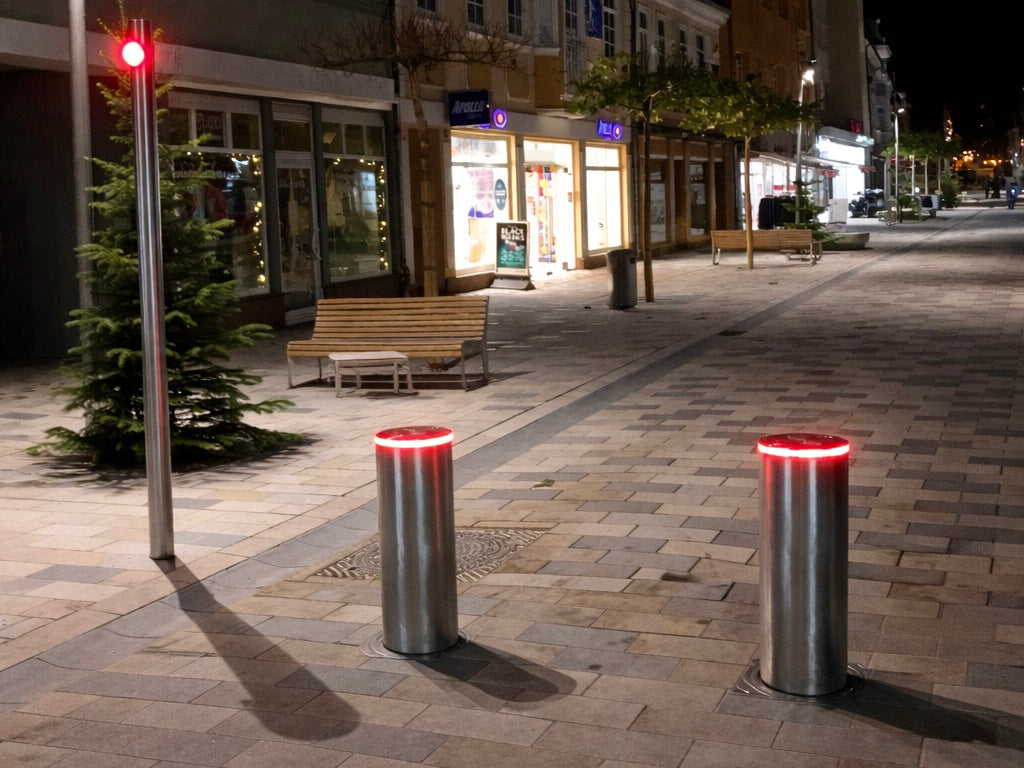
The access to the shopping street in the evening: the bollards are up, the LED ring glows red, and the traffic light next to them also shows red. Anyone wanting to drive in can see from a distance that this is as far as they go.
Why no sign, no chain and no barrier arm?
The problem with a pedestrian zone is that it can never be completely car-free. The shops need deliveries in the morning, parcel services pull up, street cleaning comes, the weekly market sets up, and in an emergency an ambulance or the fire brigade must be able to reach every front door. A fixed barrier is therefore out of the question. A chain or folding hoop that someone opens in the morning and closes in the evening only works in practice as long as someone takes care of it – and stops no one who is determined. A barrier arm looks out of place in a historic shopping street and gets in the way of pedestrians and cyclists.
A retractable bollard solves all three points: when lowered, only a round stainless steel lid lies flush in the paving, and the street is as open as before. When raised, a solid stainless steel tube stands there that no car can get past. Pedestrians, prams and bicycles can pass the bollards at any time.
Authorised journeys in, everyone else out
The town's aim was not to close the pedestrian zone completely but to control through traffic: those who are authorised get through, everyone else stays out. For this purpose the bollards stand at the access to the shopping street, and next to them is a traffic light on a stainless steel mast. It shows red as long as the bollards are up and switches to green when the bollards are lowered and the way is clear. This way, even a supplier unfamiliar with the area knows when he may drive – and nobody accidentally drives onto a bollard that is just rising.
The bollards can be operated in various ways: by radio transmitter for suppliers and emergency services, via a key switch, by time program for morning delivery hours or, on request, via number plate recognition that automatically recognises authorised vehicles. For the town this means: the pedestrian zone is open for delivery traffic during shop opening hours and consistently closed at night – without anyone having to put up a chain in the evening.

Looking down the shopping street: benches, trees, shop windows – and two bollards that blend into the newly laid paving as if they had always been part of it.
Security bollards that are not perceived as security technology
The pedestrian zone had only just been repaved and upgraded with benches, trees and lighting. A clunky bollard with warning stripes would have spoiled the look. Our bollards are made of brushed stainless steel V4A (1.4571) and have a surrounding LED ring at the top. That is the entire look: a simple, round tube that appears neutral in daylight and glows red in the evening. You cannot tell by looking at it that it is a security bollard that stops a vehicle.
The LED ring is more than decoration. In the dark season, a pedestrian zone is unlit for many hours a day, and a bollard that a driver only notices in the headlights is one bollard too many. With the red ring, the barrier is visible from a hundred metres away, and the driver knows what is going on before he is even close.
Why there is compressed air in the ground in this pedestrian zone – and no electronics
A bollard in a pedestrian zone does not have an easy life: in winter it stands in road salt, in summer the street sweeper drives over it, the street cleaners' high-pressure washer goes straight over the lid, and it rises and lowers several times a day. That is why our bollards work pneumatically. The bollard itself contains only a stainless steel cylinder; the compressor, valves and control unit stand dry in a nearby building or in an equipment cabinet. In the ground there is no motor, no circuit board and no limit switch that could get wet, overheat or freeze.
- Sealed to IP69: heavy rain, meltwater and high-pressure cleaners are no issue for the cylinder. The bollard needs no drain and no heater.
- Seals down to −35 °C: the piston rod runs through a metal scraper with grease chamber – designed for northern German winters with frost, snow and salt.
- Quiet: with compressed air, the bollard rises and lowers almost silently. For the residents who had called for a solution because of the noise in the first place, this was an important point.
- Very low-maintenance: if a valve or the compressor needs replacing after years, this is done in the plant room on a quick-release coupling. The paving stays closed, the pedestrian zone stays open.
Why we rely exclusively on compressed air for bollards and where electric spindles and hydraulics in the ground reach their limits is explained in our comparison of bollard drives.
Height lock: anyone trying to push the bollard down at night is out of luck
Anyone securing a pedestrian zone against people who deliberately race there at night must expect someone to try to overcome the barrier. That is why our bollards have a mechanical height lock: as soon as the bollard is raised, a locking bolt engages. The bollard can then not be pushed down – not with body weight, not with a lever, not with a bumper. Even if someone damages the compressed air line, the air escapes, but the bolt holds and the access remains blocked. On the outside of the bollard there is no connection and no hatch that could be used to unlock anything.
The response: peace in the shopping street – and more for the side streets
After the installation, the night-time traffic in the shopping street was over. No car racing past the shop windows with squealing tyres at 2 a.m., no crowds, no complaints. The feedback from residents, retailers and the town was such that the adjacent areas were secured straight away as well: retractable bollards now also stand in the narrow side streets that previously still led into the pedestrian zone. The town centre is now closed at night without anything being in the way during the day.

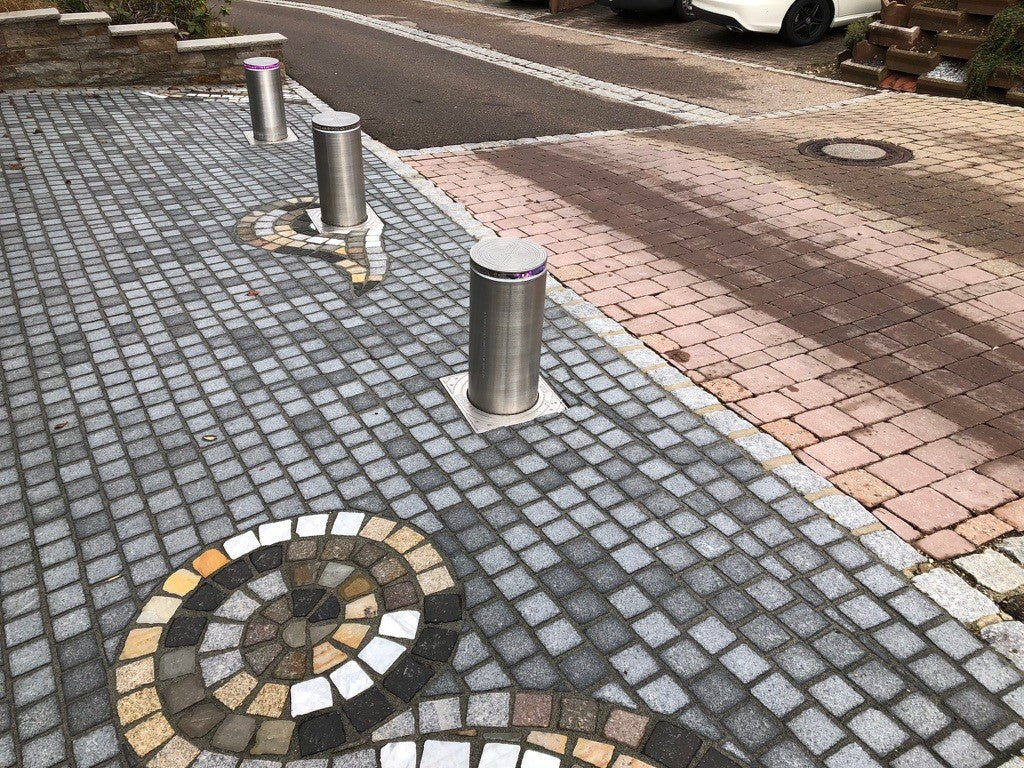
One of the side streets: two bollards in the cobblestones are enough to close the lane to cars – pedestrians still get through, and the Christmas stars hang above as usual.
What other towns and municipalities can take away from this project
Three things have proven themselves here and can be transferred to almost any town centre. First: do not clutter the whole pedestrian zone, but secure the few access points – two bollards per access are usually enough. Second: combine the barrier with a traffic light or clearly visible LEDs so that authorised drivers know when they may drive and nobody drives into a bollard. Third: put the technology in the building, not in the ground – then the system stays inconspicuous, sabotage-proof and easy to service.
How Hamburg uses the same principle is shown in our references Reeperbahn – Große Freiheit and Hamburg City Hall. The basics for local authorities – from delivery times to protecting Christmas markets against attacks – are covered in our topic page Municipal vehicle access protection. If it is not just about noise but about protecting crowds from vehicles, you will find our crash-tested models on the page Anti-terror bollards.
Do you want to secure a pedestrian zone, a market square or a town centre?
Send us a photo of the access via WhatsApp to +49 172 4544485 or call us on +49 40 226390411. We will tell you how many bollards you need, where they should stand and which control system suits delivery traffic, emergency services and market traders. We manufacture the bollards ourselves in Seevetal near Hamburg, provide drawings and data sheets for tenders and support the installation. All models – from the 160 kg standard bollard to the security bollard with 30 mm wall thickness – can be found in the overview retractable bollards made of stainless steel V4A.