

A campsite with a single access, behind it pitches, caravans and seasonal campers – and site rules that clearly state: midday quiet time from 12 noon to 3 p.m., during which no vehicle drives onto or off the site. Clear on paper. In practice it looked different for years. Shortly after twelve someone is still arriving, at half past one someone wants to pop to the shops “just for a moment”, at half past two someone's departure is “already packed”. Each one has a good reason, and each one ends the quiet time for a hundred others.
The real problem was at reception. Anyone who wants to enforce the rule has to explain it again every day – to guests who are on holiday and in no mood for arguments. The team stood at the window at midday instead of taking their break, and in the end someone drove anyway.
Why a sign, a chain and a barrier arm do not work here
The sign “Quiet time 12–3 – no through traffic” had long hung at the access. It was read and ignored. A chain would have to be put up by someone at exactly twelve and taken down at exactly three – precisely when the staff are having their own lunch, and precisely when the site is at its fullest. A barrier arm would have been technically possible but did not fit: a barrier boom over a sandy track, under which caravans with roof boxes and motorhomes with bike racks have to pass, is an obstacle in everyday use and looks like a border crossing. People on holiday do not want to see a boom gate.
What was needed was a barrier that can be seen three hours a day and not for the other 21 – and that closes and opens again without staff.
A single retractable bollard in the access
The access is so narrow that one bollard is enough. A retractable barrier bollard made of V4A stainless steel in the standard version was installed: around 160 kg, 6 mm wall thickness, 27 cm diameter, 60 cm stroke, with an LED light ring in the head – the model we sell for just under 3,000 euros. When raised, it blocks the lane completely; pedestrians, bicycles and children with handcarts pass easily on the left and right. When lowered, only the stainless steel lid lies flush in the track, and site traffic rolls over it as if nothing were there.

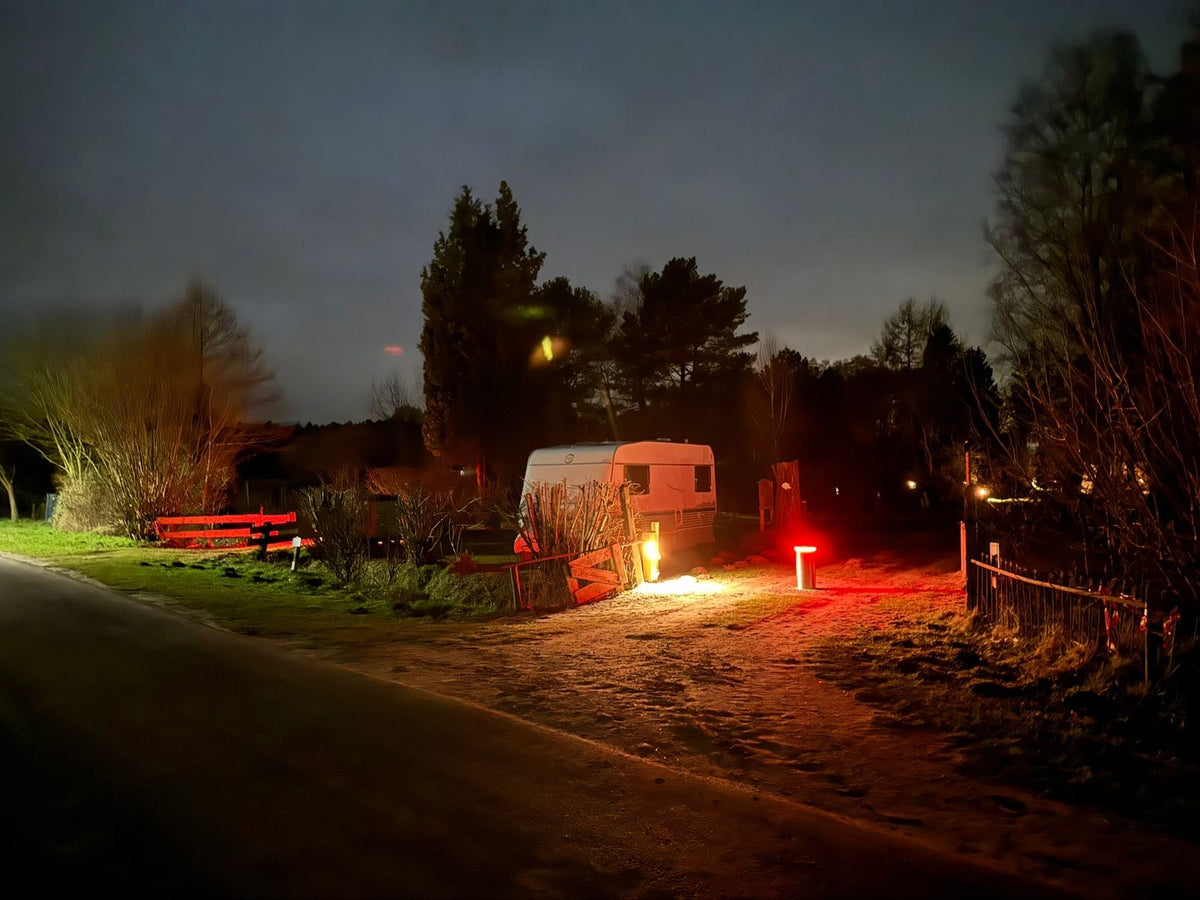
Photo taken in the evening: the bollard stands in the access, and the red LED ring cannot be missed from the road. This is also how a guest arriving after dark sees it.
The control system: Loxone switches the quiet time
The heart of the system is not in the bollard but in the building: our road control system with Loxone technology. A time program is stored in the Loxone Miniserver: at 12:00 the bollard rises, at 15:00 it lowers again. Every day, without anyone thinking about it, without anyone pressing anything. The rule thus enforces itself – when the bollard is up, it is quiet time, and nobody argues with a piece of stainless steel.
Exceptions are still possible. If an ambulance, a guest with a breakdown or an urgent delivery arrives at midday, reception lowers the bollard with a tap in the Loxone app – also from a mobile phone, also from anywhere on the site. After that, the time program takes over again. It is precisely this interplay of fixed automation and manual override that is why we recommended the road control system here rather than the simple radio control.
The site did not need what else the Loxone control can do on day one, but has it in reserve: a night-time quiet period as a second time window, different times at weekends or in the low season, a winter break during which the bollard stays up permanently. And because the control unit sits in the building, the system can be extended later without touching the ground – with an induction loop that automatically raises the bollard again after a vehicle has passed, a traffic light for drivers, radio transmitters for seasonal campers or number plate recognition for regular guests.
Installation in a sandy track – without concrete
The bollard sits in its installation sleeve in a pit around 1.20 m deep, aligned and backfilled with compacted sand. The system does not need a concrete foundation; on a sandy track, sand is the surface that is there anyway. From the bollard, the cable and hose bundle – two compressed air hoses and the cable for the LED light – runs in armoured conduit under the track to the nearest building. There, the compressor, valves and Loxone control stand dry, warm and easily accessible. Apart from the stainless steel cylinder, there is nothing in the ground.
Why compressed air is the right choice at a campsite
A campsite is not a friendly place for technology in the ground: sand that creeps into every crack, rain that stays standing on unpaved tracks, frost in winter and, if worst comes to worst, a site where for months nobody notices when something stops working. Our bollards work pneumatically. The bollard contains a stainless steel cylinder with a piston rod that has a metal scraper and seals rated down to −35 °C – sand is wiped off when the bollard lowers instead of getting into the guide. There is no motor, no hydraulic pump and no circuit board in the ground, and so no heater and no drain that could silt up. The bollard is sealed to IP69.
Two switching cycles a day, around 400 per season: for the pneumatics, that is no significant load. Should a valve or the compressor need replacing after years, this is done in the building on a quick-release coupling – the track stays closed, the bollard stays in the ground. Overall, the system is very low-maintenance. The bollard is made of V4A stainless steel (1.4571) at our site in Seevetal near Hamburg.
What the system costs
For a site with one access like this, the system is made up as follows: the bollard in the standard version at just under 3,000 euros, the road control system with Loxone technology at around 2,150 euros, plus a quiet compressor from 195 euros and the pre-assembled cable and hose bundle depending on length. Together, such a system comes to around 5,500 euros plus groundwork. Many site operators can dig the pit themselves with their own excavator; we support the installation free of charge via WhatsApp photo and video.
Quiet times on your site?
Campsites, holiday parks, motorhome pitches, allotment associations or residential complexes with night-time quiet hours – wherever an access is to be closed at fixed times, the clock is a more reliable control than the person at the window. Send us a photo of your access via WhatsApp to +49 172 4544485 or call us on +49 40 226390411. We will tell you whether one bollard is enough, how the cable bundle gets into the building and whether a time program, a radio transmitter or an induction loop is the right control for your site. You will find all models and prices in the overview retractable bollards made of stainless steel V4A; answers to the most frequent questions on the page FAQ retractable bollards.

Share:
Just driving onto the property? Not any more! – access to a house secured
Distracted at the wheel – delivery van rams a bollard, and the bollard holds