

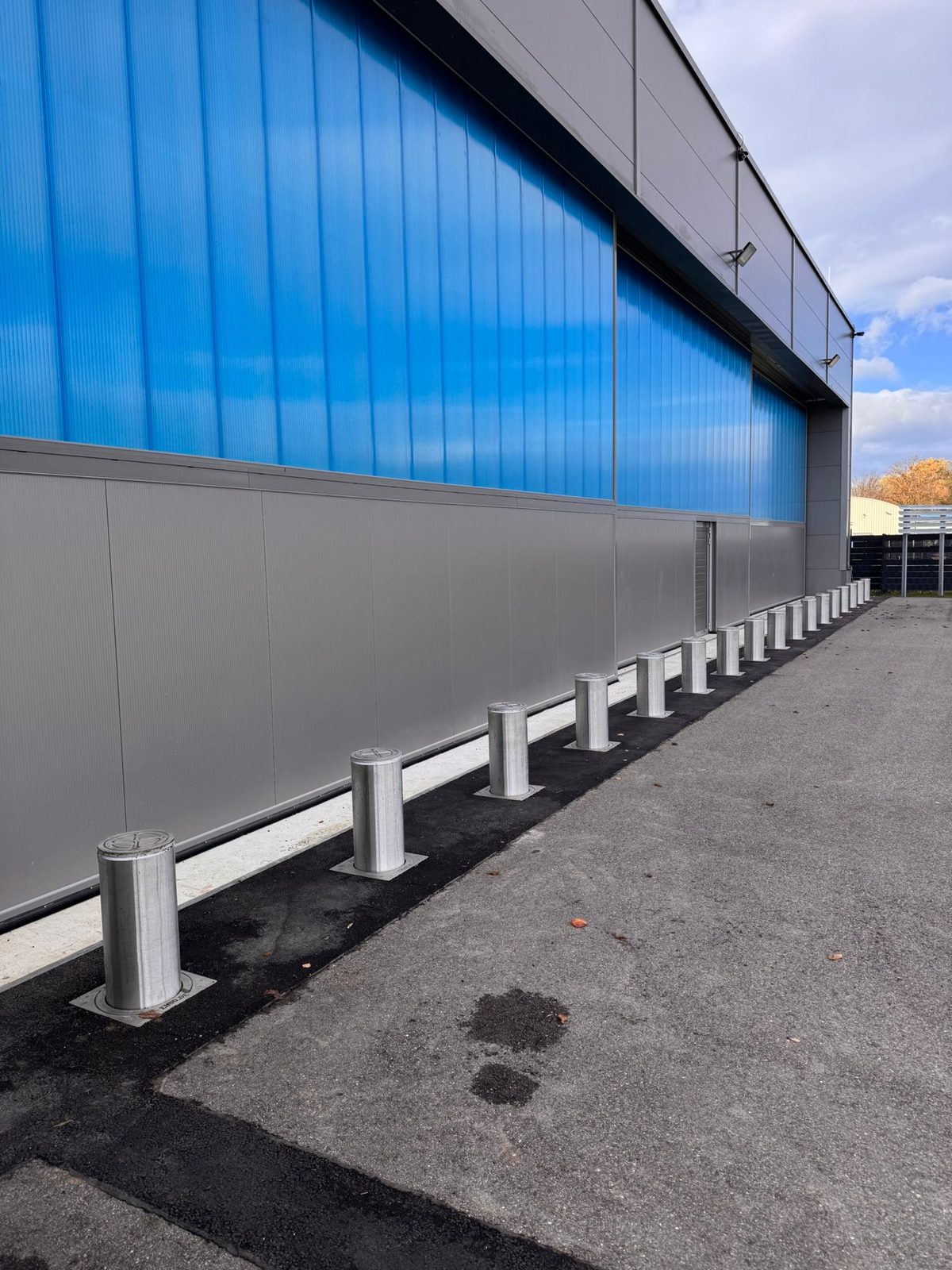
Behind the blue polycarbonate façade stand aircraft, avionics, tools and spare parts worth millions. From the outside, a hangar is nothing more than a large hall with an even larger door – and that is exactly what makes it interesting for professional thieves: anyone who drives a van up to the building at night has already done half the work. Fences and site gates keep pedestrians away, but not a vehicle coming with a run-up. At this airport, 24 retractable security bollards made of stainless steel V4A (316) from Braun Antriebe therefore secure the entire hangar front. For security reasons, we do not name the location.

The entire hangar front in one line: 24 bollards, set so close together that no vehicle fits between them. On the right, the hangar door, which the raised bollards put out of reach of any vehicle.
Why a bollard barrier and not a fence in front of the hangar?
A hangar depends on a clear front. The door must be able to open, and aircraft, tugs and service vehicles must be able to get to the building. A fence or a second gate directly in front of the hall would obstruct operations every day and would only be a sheet-metal obstacle in a ramming attack anyway. The retractable bollard solves both: when lowered, only a stainless steel lid lies flush in the asphalt, and the area in front of the hangar is clear as if the system did not exist. When raised, a row of solid stainless steel stands there on which a van or lorry gets stuck before it reaches the door.
For daytime operations, the whole row lowers within a few seconds, controlled from inside the building. After work, the bollards rise and the hangar is closed to vehicles – without anyone putting up chains or locking a gate.
Height lock: once up, the bollard can no longer be pushed down
At a site with assets worth millions, it is not just about the bollard rising, but about it staying up when someone deliberately attacks it. Our security bollards therefore have a mechanical height lock: as the bollard rises, the piston rod engages via a locking bolt. From that moment on, the bollard is no longer held by the compressed air but by the bolt. Even if a burglar cuts the pneumatic lines and the air escapes, the bollard stays in position. From the outside there is nothing that could be released, levered open or unlocked with a tool.
Then there is the behaviour in the event of a power failure. On our pneumatic systems this can be set, and for theft protection the system is set so that the bollards stay up or rise without power. Anyone who cuts the power supply therefore locks themselves out. A question you should ask every supplier: is there an emergency release connection on the outside of the bollard – and who can get to it?
What is in the ground – and what is not
Each of the 24 bollards contains only a stainless steel cylinder. The compressor, valves and control unit stand protected inside the building; no hatch or equipment cabinet can be seen from outside. At an airport hangar, this is more than a convenience:
- Stainless steel V4A (1.4571): brushed, corrosion-resistant against rain, frost and road salt. No paint that would need touching up.
- Sealed to IP69: heavy rain, snow and high-pressure cleaners are no issue for the cylinder. There are no electronics in the ground that could get damp.
- No heater, no drain, no limit switch: what is not built into the bollard cannot fail or be tampered with there.
- Very low-maintenance: if a part does need replacing after years, it is the compressor or a valve in the plant room – not a bollard in the asphalt in front of the hangar.
Why we rely on compressed air for security bollards and where electric spindles and hydraulics reach their limits is explained in our drive comparison of compressed air, hydraulics and electric spindle.
Installation: 24 sleeves in a line along the front
The construction photo shows how such a system is built: a trench was dug along the hangar front, the 24 installation sleeves were set and aligned in a straight line, and the line bundle was routed into the building. The trench was then compacted layer by layer with a rammer – without concrete reinforcement, as our bollards are designed. Finally the asphalt went back, and today the lids lie flush in the surface. With 24 bollards in a row, the alignment is the real effort; the rest is groundwork that any civil engineering contractor can handle.

During installation: the sleeves stand in a straight line in the trench, the rammer compacts the soil layer by layer, and the mini excavator backfills. Nothing is concreted here.
What operators of airfields, car dealerships and warehouses can take away from this
Three decisions from this project suit almost any building where high-value assets stand behind a large door. First: do not close off the site, but the front of the building – where a vehicle does the damage. Second: the barrier must lock mechanically and stay closed during a power failure, otherwise it is only as good as the cable you cut. Third: put the technology in the building, not in the ground – this keeps the system inconspicuous, sabotage-proof and easy to service.
How car dealerships use the same principle is shown in our reference Mercedes-Benz Center Hamburg. The basics of ramming, burglary and theft protection are covered in our topic page Ramming, burglary and theft protection; specifically for airports and airfields we have put together the page Airport security. Which models are suitable for which level of protection can be found on the page Security bollards.
Do you want to secure a hangar, a hall or a car dealership against theft?
Send us a photo of the front via WhatsApp to +49 172 4544485 or call us on +49 40 226390411. We manufacture the bollards ourselves in Seevetal near Hamburg, provide drawings and data sheets for tenders and support the installation. You will find the security bollard with 30 mm wall thickness and all other models in the overview retractable bollards made of stainless steel V4A.

Share:
Retractable bollards in a Lidl car park – closing off parking spaces, creating a turning area
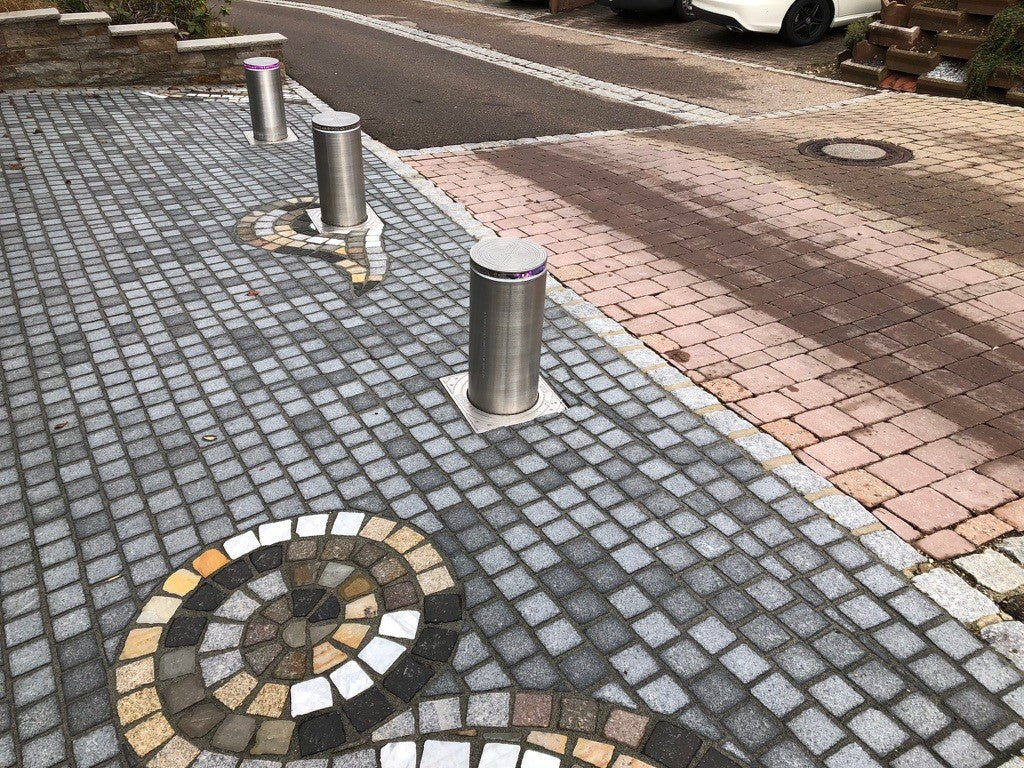
Hillside property secured: two retractable bollards end the delivery turning area in front of the garage