

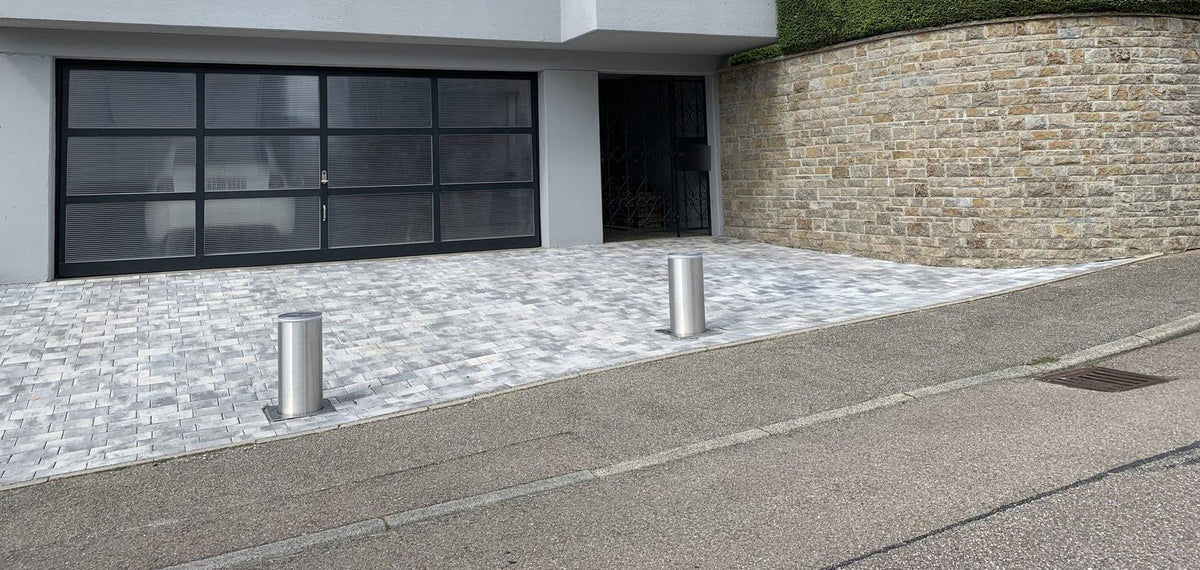
Anyone who lives on a slope rarely has a level area in front of the house. This customer has exactly one: the paved driveway in front of the garage. It lies directly on a road that runs downhill – and was therefore the only place far and wide where a delivery van could turn comfortably. That is exactly what happened every day. Parcel services, couriers and suppliers drove onto the property, manoeuvred in front of the garage and drove off again. Engine noise right by the house, tyre marks on the light-coloured paving, and more than once the natural stone wall was almost clipped when reversing. For the family, their own driveway was no longer a private space but a public turning area.

The driveway today: two retractable V4A bollards stand at the road edge of the paved area. You can clearly see how the road slopes away on the right – the driveway itself is level, and that is exactly what made it a turning area.
Why signs and kind words achieved nothing
The customer first tried the friendly approach: a sign at the driveway, conversations with the drivers who came regularly. Many property owners know the result. A courier under time pressure does not read a private sign, and even those who read it see no reason to take a more awkward route because of it. A sign has no physical effect – it only appeals. As long as the area can be driven on freely, it will be driven on. That only changes when something is in the way.
Gate or chain? Why it became retractable bollards
The house is of modern design: a large garage door with glass panels, light-coloured concrete surfaces, a curved natural stone wall with a hedge above it. A sliding or swing gate would have stood out like a foreign body in front of this façade, and on a slope a gate also needs room to swing open or a track that does not necessarily work on a gradient. A chain or folding hoop looks makeshift, has to be opened by hand every time and is a trip hazard in the dark.
Retractable bollards solve this differently. When lowered, only a stainless steel lid lies flush in the paving – the driveway looks as before, open and tidy. When raised, two brushed stainless steel posts stand at the road edge, suiting the architecture of the house and yet unmistakable: nobody drives in here any more. For the customer, that was the decisive point. He did not want a barrier that changes the house, but one that is only seen when it is needed.
Two bollards at the road edge
The bollards stand right at the front of the paved area, where previously every delivery van swung in. The spacing between them and to the sides is chosen so that no vehicle can get past. The area behind remains completely free: the garage door can be opened, the family's own vehicles have room, and anyone on foot simply walks between the bollards. Because the bollards stand within the surface and not on a raised section, there is no need for a kerb or additional edge – the light-coloured paving continues through, and the bollard collar sits flush in it.
LED lighting: visible when the delivery vans come
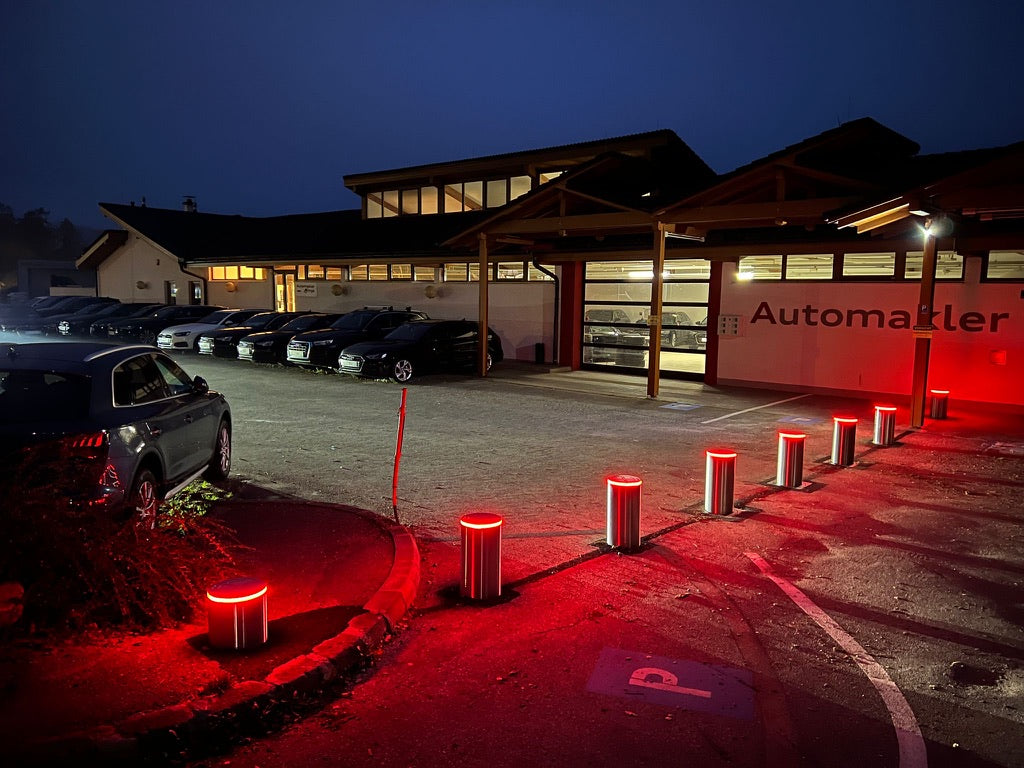
In winter, parcel services often come in the dark. That is why the customer chose bollards with LED lighting in the bollard head. A driver coming down the road in the evening sees two glowing rings at the driveway from a distance and does not even drive in. For the family, the lighting has a second effect: it shows where the bollards are when they manoeuvre themselves, and it signals to the outside that this property is secured. As the customer puts it: at night the bollards also give an added feeling of security.
Compressed air on a slope: the water runs, the bollard stays sealed
A slope has an unpleasant characteristic for a retractable bollard: when it rains, the water runs from above towards the driveway and collects at the lowest point – often exactly where the bollard sits in the ground. For bollards with a motor, circuit board and limit switches in their housing, this is a critical location. Such systems need a drain and often a heater, and both have to work reliably for years.
Our bollards work with compressed air. In the ground there is only a stainless steel cylinder; the compressor, valves and control unit sit protected in the house. The cylinder is sealed to IP69 and can stand completely under water without being damaged – on a slope just as on level ground.
- Stainless steel V4A (1.4571): 6 mm wall thickness, brushed – no rust even after years of rain and road salt.
- No electronics in the ground: nothing that can get wet, overheat or freeze.
- Seals down to −35 °C: piston rod with metal scraper and grease chamber, designed for frost and wet.
- Mechanical height lock: a raised bollard locks with a bolt and cannot be pushed down – not even by the weight of a delivery van.
- Low-maintenance: should a valve or the compressor need replacing after years, this is done in the house on a quick-release coupling. The paving stays closed.
Why we work exclusively with compressed air and what electric spindles and hydraulics in the ground do differently is explained in our comparison of bollard drives.
Operation at the push of a button
The bollards rise out of the ground and lower again at the push of a button – within a few seconds. In everyday life this means: the family comes down the road by car, one press on the radio transmitter on the key ring, the bollards lower, they drive into the garage, and the bollards are up again. The receiver sits in the radio control unit in the house; further transmitters can be paired there at any time, and a push button in the house or a smart home connection is also possible.
What two bollards cost
For orientation: our 160-kilogram standard model costs around 3,000 euros per bollard. With two bollards, the compressor and control unit are only added once, because both are connected to the same control centre. Installation is manageable: the bollards are set plumb in compacted sand, the cable and hose bundle takes a short route into the house, and the paving is closed again around the collar. What this looks like in a driveway with a steep gradient is shown in our reference retractable bollard at a gradient of over 15 %.
Peace and quiet since the installation
The customer's conclusion is short: since the installation, there has been peace and quiet. No delivery van turns in front of the garage any more, no tyre marks on the paving, no worries about the wall. The family uses their driveway again for what it is meant to be – their private space. And because the bollards are practically invisible when lowered, the house looks as before: understated, modern, secure.
We see similar cases quite often: a courtyard entrance in small granite setts whose surface was ruined by constant turning, or a residential complex opposite a supermarket whose parking spaces were constantly occupied by the supermarket's customers. What you should consider when securing your own driveway is summarised in the guide Driveway and vehicle protection.
Is your property being used as a turning area without permission?
Send us a photo of your driveway via WhatsApp to +49 172 4544485 or call us on +49 40 226390411. We will tell you where the bollards should stand, how the cable bundle gets into the house and what the system costs for your driveway – on a slope too. You will find all models in our overview retractable bollards made of stainless steel V4A.

Share:
Airport hangar secured against theft: 24 retractable security bollards along the hangar front
Sports cars protected in the Greater Berlin area – bollards against car theft and parking dents