

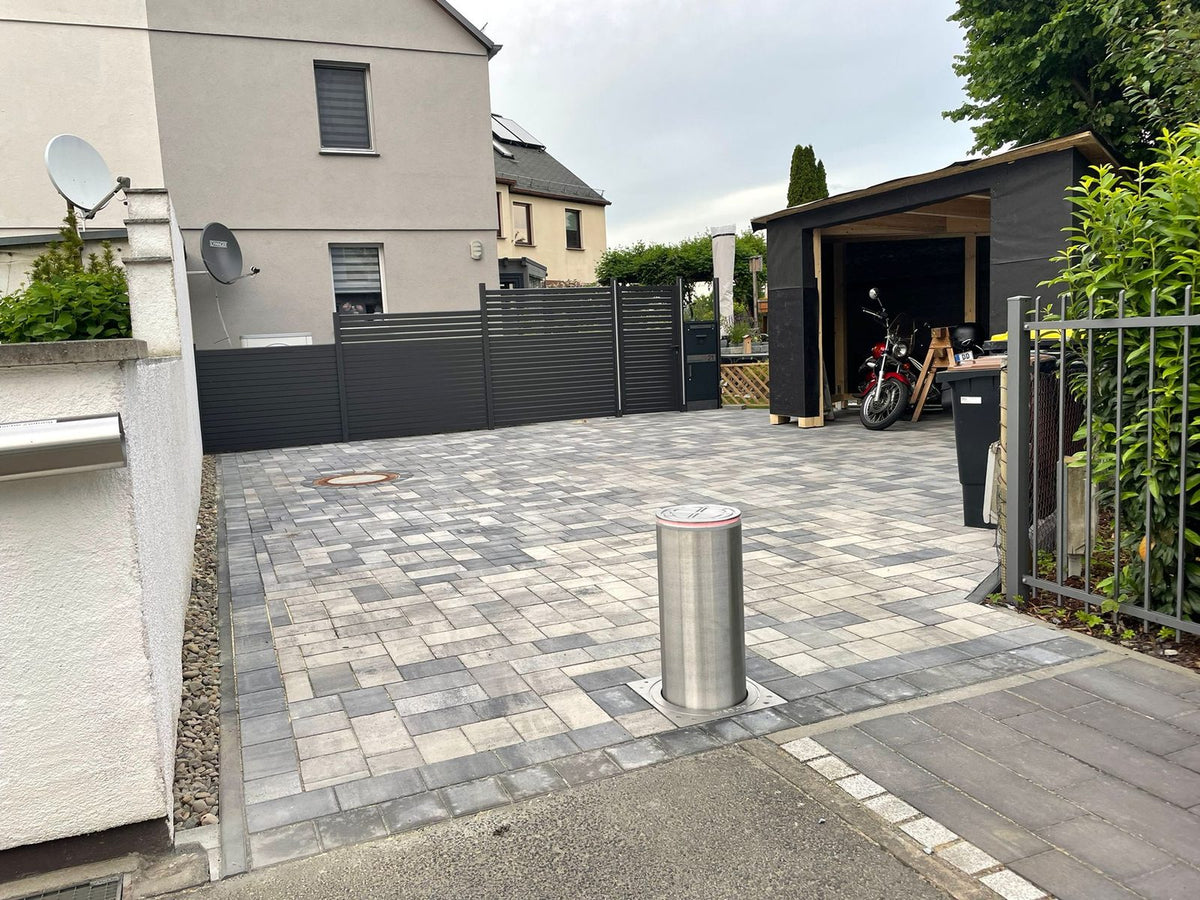
In brief
- A pneumatically retractable V4A stainless-steel bollard from Braun Antriebe costs somewhere between single-digit and low double-digit euros a year to run: the compressor (520 W) runs for around 30 seconds per movement, which works out at under 0.01 kWh per cycle.
- Care instead of a maintenance contract: drain the condensate from the compressor every four to eight weeks (about a minute), keep the bollard head clear of leaves and sand, rinse the stainless steel with clean water. No oil, no heater, no pump.
- The most expensive conceivable repair to the compressed-air system comes to around €240: compressor approx. €180–195, solenoid valve approx. €50, express delivery approx. €10 – swapped via quick-release couplings inside the building, without digging up the bollard.
- For comparison, from our own experience: a repair by a specialist technician costs around €2,500 for an electric spindle bollard and around €3,750 for a hydraulic one, plus roughly €2,500 for an oil and hose change about every four years. Prices incl. VAT, as at September 2026.
Before buying, most people only work out the purchase price: bollard, control unit, groundworks. What comes afterwards is often left to guesswork – and yet that is precisely where it is decided whether an access barrier turns out to be a cheap or an expensive purchase over ten or fifteen years. This article answers the question we hear most often in consultations at Seevetal once the quotation is on the table: what does the bollard actually cost once it is in the ground? We run the numbers for the pneumatic drive using documented figures and explain where hydraulic and electric spindle systems differ. The article belongs to the topic area Protecting your driveway, parking space and vehicle; the purchase costs including groundworks are covered in the article What does a bollard system cost?.
What running costs does a retractable bollard actually incur?
A pneumatically retractable bollard incurs exactly five types of cost in operation: electricity for the compressor, time for draining the condensate and for cleaning, small items such as the battery in the handheld transmitter or a SIM card for the GSM module, a possible repair and – depending on usage – eventually a replacement compressor. There is no prescribed servicing, no maintenance contract and no mandatory replacement of components with compressed-air technology. That is down to the design: all that sits in the ground is a stainless-steel lifting cylinder, moved by compressed air at 8 to 10 bar. Valve, compressor and control unit stand dry inside the building at the end of a cable and hose bundle. Everything that needs care or could ever fail is therefore accessible without excavation.
| Cost type | What it actually involves | Interval | Order of magnitude |
|---|---|---|---|
| Electricity | 520 W compressor, approx. 30 s run-on per movement, then completely off | per movement | under 0.01 kWh per movement |
| Condensate | Open the drain cock on the compressor, catch the water | every 4–8 weeks (roughly quarterly with infrequent use) | approx. 1 minute, €0 |
| Cleaning | Keep the bollard head clear of leaves and sand, rinse the stainless steel with clean water | as required, usually in autumn and after winter | a few minutes, €0 |
| Small items | Battery in the handheld transmitter, SIM tariff for the GSM module | as required or monthly | small amounts, tariff-dependent |
| Repair (worst case) | Compressor approx. €180–195, solenoid valve approx. €50, express delivery approx. €10 | only in the event of a fault | approx. €240 in total, done by the operator via quick-release coupling |
All prices in this article are our list prices incl. VAT as at September 2026; the compressor for one to four bollards is currently listed at €195 in the collection, while the guide figure of €180 comes from our repair costing.
How much electricity does a pneumatic bollard use in a year?
A family home with ten bollard movements a day arrives at a maximum of 36.5 kWh a year on paper – at an assumed electricity price of €0.40/kWh that is around €15, and less in practice. The calculation behind it is simple, because the system has no continuous consumer: the 520 W quiet compressor only starts when the bollard moves, runs on for about 30 seconds and then switches off completely. 520 W over 30 seconds comes to roughly 0.004 kWh; to be on the safe side we calculate with under 0.01 kWh per movement. Ten movements a day make 3,650 movements a year, so 36.5 kWh at most.
A small business with 40 movements a day correspondingly reaches a maximum of 146 kWh or around €58 a year. The compressor has no standby load – after the run-on it is completely off; the solenoid valve works on 12 or 24 V extra-low voltage. Anyone running a Loxone-based traffic control unit or an LED light ring permanently has a small base load for that, as with any smart-home device – we deliberately do not quote specific consumption figures for it, because they depend on the configuration and lighting mode.

What care does the bollard itself need?
The bollard in the ground needs no maintenance in the technical sense, just a visual check: the cover should stay free of leaves, sand and grit so that nothing is pressed into the gap between the bollard head and the sleeve. Rinsing with clean water is all the stainless-steel surface needs; steel wool is off limits because it introduces contact rust. There is nothing else to do on the bollard, because it contains neither motor nor electronics, neither limit switches nor a heater – only the stainless-steel cylinder.
There are three wear parts in the classic sense, and all are designed to last for decades: the stainless-steel piston rod carries a metal scraper that pushes salt, ice and grit off as the bollard retracts. Beneath it sits a grease chamber with pneumatic grease as permanent lubrication, which never needs topping up. The sealing rings are rated down to −35 °C. On the test bench we have run the complete system through more than 500,000 cycles without a fault; the lifting cylinder itself is specified by the supplier at over 80,000 movement cycles with no service interval. To put that in context: a family home with ten movements a day only reaches 80,000 cycles after around 22 years, and the campsite from our reference projects, with two timer-controlled movements a day, would need several decades.
What needs doing on the compressor – and how long does it take?
There is a single regular task on the compressor: draining the condensate that collects in the tank when the air is compressed. To do this you open the cock on the underside, let the tank empty into a cloth or a bowl and close it again – about a minute. We recommend every four to eight weeks as the interval; with infrequent use, experience shows a look once a quarter is enough. Anyone who would rather skip this can retrofit an automatic drain module. The compressor runs oil-free, so there is neither an oil level to check nor an oil change.
The compressor needs a dry, frost-free spot of around 50 × 50 × 15 cm – utility room, garage, cellar or a plant cabinet inside the building. At around 50 dB at a distance of one metre it is as quiet as a fridge; at seven metres that drops to about 35 dB. How many bollards one compressor can supply depends on the number of movements: the €195 model supplies one to four bollards with occasional use; from 20 to 50 movements a day we plan on one to two bollards per compressor, and for continuous operation two compressors or the model for up to 20 bollards (€450). Sizing this correctly is the most important lever for low follow-on costs – a compressor that is too small runs more often and ages faster.
What does winter cost with a retractable bollard?
A pneumatic bollard incurs no additional costs in winter provided three things were done correctly at installation: drainage, siting and choice of material. The compressed-air technology works from −20 °C to +50 °C; there is no heater in the bollard because nothing can freeze – no oil, no condensate, no electronics. The prerequisite is that any water that gets in drains away at the bottom of the sleeve: via a DN 40 sewer pipe laid to a fall or a DN 25 flexible hose into a gravel layer, in each case with filter fleece, never onto a concrete base. Standing water in the sleeve can freeze and jam the mechanism, which is why missing drainage is excluded from the statutory warranty. How the pit is built up is shown in the article Installing a retractable bollard.
Compressor and control unit belong in a frost-free building. In an unheated garden shed the condensate in the tank can freeze – that is the only winter damage we know of from practice, and it is avoidable. For the surface: clear snow with a wooden or plastic shovel rather than scraping a steel shovel over the bollard head, and do not spread de-icing salt directly onto the bollard. The material V4A stainless steel (1.4571) is considerably more resistant to road salt and sea air than V2A, which is why we manufacture exclusively in V4A. Anyone who does not use the driveway in winter can leave the bollard permanently raised using the timer control.

What does a repair cost if something does fail?
The most expensive repair to a pneumatic bollard system costs around €240: a new compressor for around €180–195, a new solenoid valve for around €50 and roughly €10 for express delivery. Both parts sit inside the building and are connected via quick-release couplings, so the operator can swap them in a few minutes – on request we guide you through it over a WhatsApp video call or FaceTime. No technician needs to travel, the bollard stays in the ground, the paving stays closed. We ship accessories such as the compressor and valve from stock within one to two working days.
During the fault the entrance remains secure: a raised bollard locks mechanically at the top and cannot be pushed down without a compressed-air pulse. Anyone with a workshop that has its own compressed-air network can run the bollard from that line at 8 to 10 bar in the meantime. Spare parts, advice and service come directly from the manufacturer in Seevetal; the statutory warranty periods apply. The questions you should put to any supplier about the repair case are collected in our FAQ on retractable bollards.
How do pneumatic, hydraulic and electric spindle drives differ in follow-on costs?
The difference lies not in the purchase but in year five: with a pneumatic system, everything that can age sits in the house and can be replaced for a few hundred euros; with hydraulic and electric spindle systems it sits in the ground and can only be reached with a technician, by opening the bollard and with the corresponding hours of labour. The following figures are our empirical values as a pneumatic manufacturer that regularly replaces defective third-party systems – individual manufacturers differ, so ask specifically.
| Feature | Pneumatic (Braun Antriebe) | Hydraulic | Electric spindle |
|---|---|---|---|
| Technology in the ground | stainless-steel lifting cylinder only | pump, oil, hoses, cylinder | motor, spindle, limit switches, electronics |
| Heater and drainage pump | not required | usually required (condensate) | usually required (condensate) |
| Recurring maintenance | drain condensate, visual check | oil and hose change about every 4 years, approx. €2,500 | no mandatory replacement known |
| Most expensive repair | approx. €240, done by the operator | approx. €3,750 (travel, 2 people × 8 h, pump, overnight stay) | approx. €2,500 by a specialist technician |
| Access to the drive unit | inside the building, quick-release coupling | open or remove the bollard | open or remove the bollard |
| Space required indoors | approx. 50 × 50 × 15 cm for the compressor | none | none |
Hydraulics come with an extra point that rarely appears in a quotation: hydraulic hoses age, and regulations require their replacement after a service life set by the manufacturer – have this period given to you in writing and ask your insurer whether they make the maintenance a condition. With the electric spindle the issue is less mandatory replacement than sensitivity: motor and electronics sit where water, salt and frost reach, and with frequent movements spindle drives tend to overheat. You will find the technical comparison of the three drives, with all the questions to ask a supplier, on the page Bollard drives compared.
What minor items come on top in everyday use?
Three minor items appear in no cost breakdown and are real nonetheless: the battery in the handheld transmitter, the mobile tariff for the GSM module and your own time. The radio handheld transmitter (€29.50) comes with a battery; it lasts a long time in normal use but will need changing at some point – that is an off-the-shelf battery, not a service visit. Anyone who opens the bollard by phone call needs a SIM card with SMS capability in the GSM module (€85); the smallest tariff is sufficient, because the call is not answered and remains free for the caller. The ongoing tariff costs depend on the provider you choose – a data contract is not needed.
Anyone running a traffic control unit with a Loxone Miniserver has an advantage in follow-on costs that is often overlooked: on request we can maintain the control unit remotely, read out faults in real time and change schedules without anyone travelling to site. There is nothing to maintain on the radio control – it consists of a receiver, a power supply and a solenoid valve.

What does operation cost over ten years – two worked examples?
A family home with one bollard and ten movements a day comes to around €150 in electricity over ten years plus the price of a handheld transmitter battery – and, if you factor in the unlikely event of a compressor replacement, a further €240 or so. All told, that is well under €500 in ten years without a single service appointment. A small business with two bollards, 40 movements a day and a GSM module comes to around €600 in electricity, ten years of SIM tariff and one budgeted compressor replacement – here too the total stays below what a single hydraulic service costs according to our experience.
| Item over 10 years | Family home, 1 bollard, 10 movements/day | Small business, 2 bollards, 40 movements/day |
|---|---|---|
| Electricity (assuming €0.40/kWh, 0.01 kWh per movement) | max. 365 kWh ≈ €146 | max. 1,460 kWh ≈ €584 |
| Condensate and cleaning | approx. 10 minutes a quarter, €0 | approx. 10 minutes a month, €0 |
| Small items | 1–2 handheld transmitter batteries | GSM SIM tariff, batteries |
| Budgeted reserve for compressor and valve | approx. €240 | approx. €240 (second compressor €195 for continuous operation) |
| Mandatory servicing | none | none |
The electricity price assumption is an aid to calculation, not a manufacturer's figure – insert your own unit rate. The number of movements, on the other hand, is something you should estimate honestly before buying, because it determines compressor choice, service life and electricity costs all at once.
- Every four to eight weeks: drain the condensate from the compressor (approx. 1 minute) – or retrofit a drain module once and for all
- In autumn: sweep leaves, sand and grit away from the bollard head and gap, and think through the sleeve's drainage (does water run off?)
- Before winter: have a wooden or plastic snow shovel ready, no de-icing salt directly on the bollard, compressor sited frost-free
- After winter: rinse the stainless steel with clean water – rise time (3–10 s) unchanged? Cover flush?
- Once a year: check the handheld transmitter battery, check the SIM credit on the GSM module
- If usage increases: re-estimate movements per day – from 20 to 50 movements, one to two bollards per compressor
- For the event of a fault: do you know where the quick-release couplings are? Our number saved for video guidance?
What do operators report after the first few years?
The courtyard driveway in Upper Bavaria is our textbook case for follow-on costs in winter: six standard bollards weighing around 160 kg each stand there in an arc in granite sett paving, controlled by radio from the car. Snow, meltwater, frost and road salt are part of the yearly cycle, yet there is neither a heater nor a drainage pump – all that sits in the ground for each bollard is the stainless-steel cylinder, while compressor and valves stand in the house. The project is described in the reference Granite paving, no turning area.
The campsite with a midday quiet period shows the other end of the usage scale: a standard bollard rises on a timer at 12 noon every day and retracts at 3 pm – two cycles a day, around 400 per season, regardless of how many vehicles arrive. With this kind of use the electricity consumption is barely measurable, and reception can lower the bollard via the app at any time. Equipment costs according to the reference: bollard just under €3,000, traffic control unit approx. €2,150, compressor from €195 – and after that essentially just the quarterly condensate.
Frequently asked questions about maintenance and running costs of retractable bollards
Does a pneumatic bollard need a maintenance contract?
No. There is no prescribed servicing and no mandatory replacement. The only recurring task is draining the condensate from the compressor every four to eight weeks, plus a visual check and cleaning of the bollard head as required.
How much does a retractable bollard cost in electricity per year?
The compressor (520 W) runs on for around 30 seconds per movement and then switches off; that is under 0.01 kWh per movement. At ten movements a day that comes to a maximum of 36.5 kWh a year, i.e. around €10 to €15 depending on the electricity price.
What does a repair cost in the worst case?
Around €240: compressor approx. €180–195, solenoid valve approx. €50, express delivery approx. €10. Both parts sit inside the building and are swapped by the operator via quick-release couplings; on request we guide you through it by video.
Does the bollard have to be heated in winter?
No. There is neither oil nor electronics in the bollard that could freeze; the compressed-air technology works from −20 °C to +50 °C, and the seals are rated down to −35 °C. The prerequisites are working drainage beneath the sleeve and a frost-free location for the compressor and control unit.
How long does a pneumatically retractable bollard last?
On the test bench we have run the system through more than 500,000 cycles without a fault; the lifting cylinder is specified at over 80,000 cycles with no service interval. A family home with ten movements a day only reaches 80,000 cycles after around 22 years.
What follow-on costs do hydraulic and electric spindle bollards have?
In our experience, a repair to an electric spindle bollard costs around €2,500 by a specialist technician, and a hydraulic one around €3,750 plus an oil and hose change for around €2,500 about every four years. Both usually need a heater and a drainage pump in the bollard.
What guarantee is there on the bollard?
The statutory warranty periods apply. Every bollard is tested on the test bench before dispatch. Missing drainage beneath the sleeve is excluded from the statutory warranty, because standing water can jam the mechanism in winter.
The key points in three sentences
In operation, a pneumatically retractable V4A stainless-steel bollard from Braun Antriebe costs electricity for around 30 seconds of compressor running time per movement (under 0.01 kWh), one minute of condensate draining every four to eight weeks and the occasional sweep of the bollard head – with no maintenance contract, oil change, heater or drainage pump, because all that sits in the ground is a stainless-steel cylinder and everything else stands dry inside the building. The most expensive repair comes to around €240 for compressor and valve, which the operator swaps via quick-release couplings, whereas hydraulic and electric spindle systems, in our experience, run to €3,750 and €2,500 respectively per fault, with hydraulics adding around €2,500 in servicing about every four years. Braun Antriebe manufactures the bollards and the associated compressed-air technology itself in Seevetal near Hamburg, tests every bollard on the test bench before dispatch and ships spare parts from stock within one to two working days; the prices in this article are our list prices from September 2026.
Which control system suits your usage is explained in the article Bollard control: radio, GSM, number-plate recognition or smart home?; the page Bollard costs gives the overview of purchase costs, and you will find all bollards, compressors and control units in the V4A stainless-steel bollard collection.
Would you like to know what your entrance would cost to run? Tell us the number of movements per day and send us a photo of the driveway – we will tell you which compressor fits and what to budget for each year.
Phone 040 226390411 · WhatsApp 0172 4544485
View stainless-steel bollardsRequest advice

Share:
Number Plate Recognition at Entrances: What the GDPR Requires – and How the Number Plate Kit Handles It
Induction loop and traffic light at the bollard: what safety technology does a commercial entrance need?