

In brief
- A commercial bollard system needs three safety functions: a safety loop directly at the bollard that blocks it from rising while a vehicle is standing over it; a control unit that only lets the bollard rise again once the vehicle has passed through completely; and an unambiguous signal to the driver – a traffic light or LED ring.
- An induction loop is a loop of wire in the road surface that detects vehicles by the change in its magnetic field. The Loxone-based traffic control unit from Braun Antriebe (€2,150) includes a loop module with direction detection and 2 × 50 m of loop cable.
- A stainless-steel traffic-light column (€1,350 with red, €1,450 with red and green, 3.00 m long, 2.20 m visible) is essential as soon as there is two-way traffic on a single-lane entrance or restricted visibility of the bollard.
- As a rule of thumb: for up to ten passages a day with regular users, the radio control (€245) without loops is sufficient; above ten passages a day or with changing users, the traffic control unit with loops and traffic light is the right choice. Prices incl. VAT, as at September 2026.
A pneumatically retractable V4A stainless-steel bollard in its standard version weighs around 160 kg, rises in 3 to 10 seconds and pushes upwards with a force of about 450 kg as it does so. At a private driveway with two users that is uncritical – everyone knows when the bollard is moving. At a company entrance with suppliers, visitors and staff travelling in both directions, however, the system itself has to know where a vehicle is at any given moment. This article explains from the manufacturer's perspective which safety technology ensures that a bollard never rises beneath a vehicle, which component does which job and when a traffic light is needed. It belongs to the topic area Access management for businesses and property; how to clarify the operating procedure of your entrance beforehand is described in the article Planning access control for company premises properly.
Why does a commercial bollard system need safety technology at all?
Because at a commercial entrance it is no longer a person but the system that decides when the bollard rises – and to do that it has to know whether the passage is clear. With a radio control, the driver presses the button, the bollard lowers, the driver passes through and presses again, or the bollard rises after a set time. That works as long as the same person controls both ends of the process. As soon as a supplier rolls through behind a member of staff, a visitor stops on the bollard to ask for directions, or two handheld transmitters are pressed at the same time, that control has lost its basis. The traffic control unit catches precisely these operating errors: repeated pressing, unsynchronised remote controls and a premature rise while the passage is still occupied.
Then there is visibility. A lowered bollard sits flush with the paving – that is its advantage over a barrier arm or gate, but also the reason why a driver unfamiliar with the site cannot tell, without a signal, whether the entrance is currently closed or about to close. The reference Delivery van rams bollard shows the case in which a driver with his eyes on his smartphone drove head-on into a raised bollard: bumper off, front end shifted, the bollard without a dent. That case is one of the reasons why, at commercial entrances, we count the LED ring and traffic light as safety technology rather than as optional extras.
How does the system prevent a bollard from rising beneath a vehicle?
By means of a safety loop immediately at the bollard: as long as a vehicle is standing over this induction loop, the control unit does not release the command to rise – regardless of whether a schedule, a handheld transmitter or the number-plate camera triggers it. Only when the loop reports clear again does the traffic control unit switch the traffic light to red and let the bollard rise. In the product logic of our traffic control unit this means: the bollard stays down until the vehicle has passed through completely, and the entire sequence is monitored. The fact that there is no electronics in the bollard itself is not a drawback but by design – the monitoring runs in the control cabinet, while all that sits in the ground is the stainless-steel cylinder, moved by compressed air at 8 to 10 bar.
That is how we solved it in a Berlin residential complex whose passage to the residents' parking spaces was regularly blocked by supermarket customers: two standard bollards of 160 kg each secure the covered passage. Residents open via radio transmitter, and the bollards lower as they approach. From the inside, an exit loop detects every vehicle and lowers the bollards automatically – visitors do not have to operate anything. An additional loop prevents a bollard from rising while a vehicle is standing over it; after the vehicle has passed through, the bollards rise again within a few seconds. The project is described in the reference Supermarket opposite: securing the parking spaces of a residential complex.

Which induction loops are there – and where are they laid?
A bollard system needs two loop functions: the safety loop at the bollard and the exit loop on the inside; with two loops one behind the other, the loop module of the traffic control unit also detects the direction of travel. An induction loop is nothing more than several turns of cable in the road surface through which a weak alternating current flows; when a mass of metal passes over it, the magnetic field changes and the loop module reports "vehicle". Pedestrians, leaves or snow do not trigger it – which sets it apart from a light barrier, which reports every interruption of the beam and therefore trips unnecessarily often at entrances with pedestrian and cycle traffic. That is why our systems work with induction loops; light barriers are not part of our product range.
| Loop | Position | Task | What happens when it is occupied |
|---|---|---|---|
| Safety loop | immediately at the bollard, in the passage area | detect a vehicle over the bollard | rising is blocked until the loop is clear |
| Exit loop | inside, ahead of the bollard in the direction of travel | detect an exiting vehicle | bollard lowers automatically, no operation needed |
| Two loops one behind the other | inside and outside | determine the direction of travel | control unit distinguishes entry from exit, e.g. for the traffic-light logic |
The loops are best laid before paving, together with the bollard's cable and hose bundle; cutting them into asphalt or concrete afterwards is possible but more involved. Practical values from our installations: the loop lies about half a metre in front of the bollard, the feeder cable is twisted at around 20 turns per metre, the standard length to the control cabinet is 15 m, and beyond that we use outdoor network cable up to a maximum of 50 m. The loop module with 2 × 50 m of loop cable is included with the traffic control unit; that is why there is no separate loop item in the shop. How the trench and pit are prepared is covered in the article Installing a retractable bollard.
When is a traffic-light column needed – and what does it show?
A traffic light is needed as soon as vehicles can meet on a single-lane entrance or the driver cannot see the bollard in time – behind a bend, a gateway or in low sun, for instance. It answers the one question for the driver that the flush-retracted bollard cannot: may I drive now? Green means the bollard is down and the passage is clear; red means closed or about to close – after the vehicle has passed through, the traffic control unit switches to red first and only then lets the bollard rise.
Our stainless-steel traffic-light column is 3.00 m long, of which 2.20 m stands visible above ground and about 80 cm sits in the foundation. It is made of 3 mm satin-finish stainless steel and carries either two red LEDs (€1,350) or two red and two green LEDs (€1,450), each rated at 15 W. The four-LED version is intended for opposing-signal control: the column is visible from both directions and shows entering and exiting vehicles their own phase. It is driven by the traffic control unit, or on request via GSM, induction loop or radio. We define the specific phase durations for each system; there is no amber phase as in road traffic, because the bollard does not start moving while the safety loop is occupied.
What do the LED ring and flashing light add?
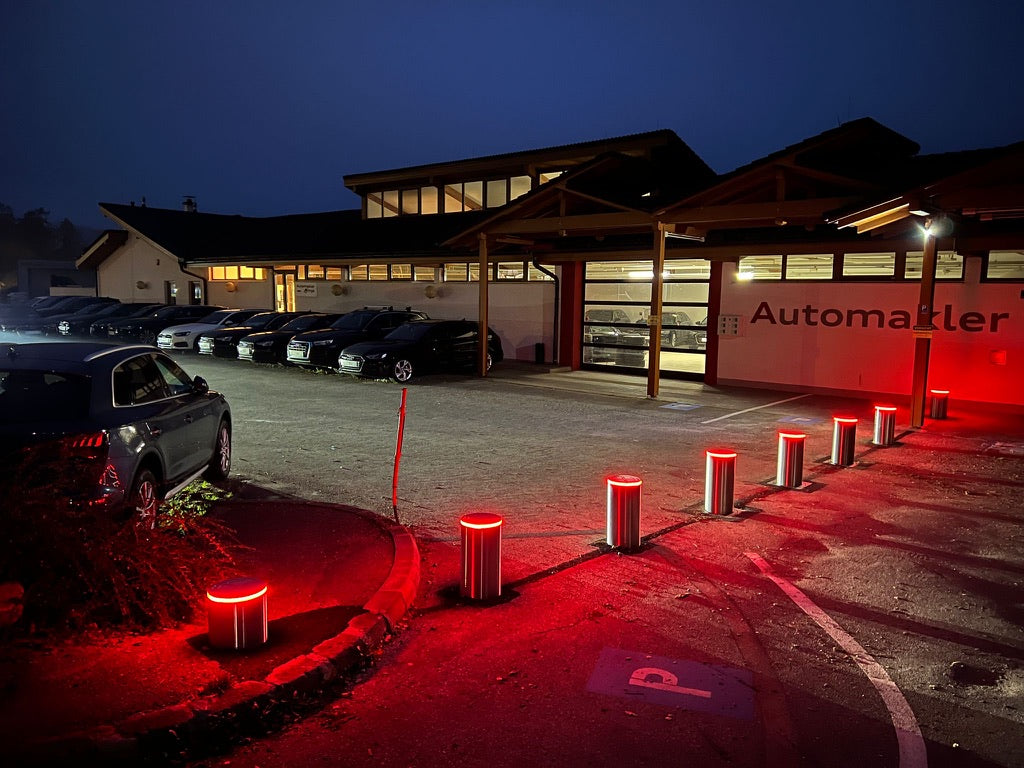
The LED light ring in the bollard head turns the bollard itself into a signal: it runs on 12 V, lights up in any colour you choose and can be switched between steady light, rotating light, running light and flashing light via a Bluetooth app. Red for closed and green for clear is the usual choice, and at night the red ring is visible from a long way off. It does not replace the traffic light, because it is only clearly visible once the bollard is already up – but it is included with every standard bollard and, for entrances without oncoming traffic, is often the only signal that is needed. The traffic control unit additionally has its own outputs for a flashing light, LED warning lights, sounders and the 12 V lighting control for the bollard illumination, so that a flashing light can be switched on during the movement, for example.
In our reference project at a Lidl car park, three retrofitted bollards in front of the sliding gate are fitted with all-round LED lighting so that customers can make them out at dusk; the bollards rise before deliveries, creating a turning area for the lorry, and then retract flush again afterwards.
Which control unit links loops, traffic light and bollards?
The traffic control unit with Loxone Miniserver for €2,150 is the hub where all the safety components come together – a radio control for €245 cannot do this; it is expressly not designed for induction loops or radar sensors. The DIN-rail housing of the traffic control unit contains a pre-configured Loxone Miniserver Gen 2, the loop module with direction detection and 2 × 50 m of loop cable, connections for a traffic light (red/green), LED warning lights, flashing light, sounder, switches and push-buttons, fingerprint reader, number-plate recognition and a fire-brigade signal, plus an 868 MHz radio receiver with external aerial and 5 m of cable for a range of up to 100 m. It is powered from 230 V, with the 12 V and 24 V power supplies integrated; the housing measures about 30 × 35 × 15 cm and weighs around 5 kg.
| Component | Role in the safety chain | Price incl. VAT (as at 09/2026) | Worthwhile from |
|---|---|---|---|
| Traffic control unit with Loxone Miniserver | Monitors the sequence, keeps the bollard down until the vehicle has passed through completely, switches traffic light and lighting | €2,150 | more than 10 passages/day or changing users |
| Loop module with 2 × 50 m of cable | Safety loop, exit loop, direction detection | included with the traffic control unit | every system with automatic rising |
| Stainless-steel traffic-light column | Unambiguous drive signal, coordinating two-way traffic | €1,350 (red) / €1,450 (red + green) | single-lane entrance, restricted visibility |
| LED light ring in the bollard head | Makes the bollard visible in the dark, shows its status | included with the standard bollard | every entrance |
| Number-plate recognition | Checks authorisation without a handheld transmitter, signals the traffic control unit | €1,950 | many changing but registered vehicles |
| Compact radio control | Opening by handheld transmitter, without loops | €245 (handheld transmitter €29.50) | up to 10 passages/day with regular users |
The traffic control unit communicates with existing building technology and control rooms via LAN, KNX, web and app; by remote access we can read out faults in real time, change schedules and install updates without travelling to site. A complete overview of the operating methods is given in the article Bollard control: radio, GSM, number-plate recognition or smart home?; what needs to be observed under data-protection law for number-plate recognition is explained in the article Number-plate recognition at the entrance and the GDPR. For the installation of the traffic control unit, loops, traffic light and camera we allow one working day plus the network connection; the 230 V connection is a job for a qualified electrician.

How does a secured passage work step by step?
A passage through a system with traffic control unit, loops and traffic light runs in six steps, of which the driver notices only two: the opening and the green signal.
- Idle state: the bollard is raised, the traffic light shows red, the LED ring lights up red.
- Trigger: a handheld transmitter, a call to the GSM module, a match from the number-plate camera, a schedule or – on exit – the exit loop sends the command to the traffic control unit.
- Lowering: the bollard travels down in the set rise time of 3 to 10 seconds; as soon as it is down, the traffic light switches to green.
- Passage: the vehicle rolls over the safety loop. As long as it is occupied, no command can make the bollard rise – not a second handheld transmitter and not an expiring schedule either.
- Release: the loop reports clear and the control unit switches the traffic light to red.
- Rising: the bollard rises and locks mechanically at the top; the compressor runs on for about 30 seconds and switches off.
With two-way traffic, direction detection comes into play: if the loop module detects an exiting vehicle, the control unit can hold the traffic light on the entry side at red until the passage is clear again. The exit needs no authorisation – whoever is inside may leave, so the loop alone is sufficient here.
What happens in a power cut, a compressor failure or a fire-brigade call-out?
The operator sets the behaviour in a power cut in advance at the valve: either the bollard lowers and opens the entrance, or it stays up and keeps it closed. Which setting is right depends on what is being protected – a fire-brigade access route is usually set to "open", theft protection to "closed". A bollard locked in the raised position cannot be pushed down and stays up even if the air line is severed; it is unlocked with a short burst of compressed air and can be raised at any time as soon as voltage is present at the valve and 8 to 10 bar is available. Because there is no electronics, no battery and no limit switch in the bollard, nothing needs to be re-taught after an outage.
If the compressor fails, a raised bollard with height lock stays locked in the up position; the compressor is swapped via quick-release coupling in a few minutes, a replacement costs around €180 to €195 and arrives by express delivery. For entrances that must never stand still we recommend two to three compressors in synchronised operation, and anyone with a workshop with a compressed-air network can supply the bollard from it in the meantime. For the emergency services, the traffic control unit has its own connection for a fire-brigade signal and can be linked to control rooms – at the Große Freiheit in Hamburg's St. Pauli district, the Davidwache police station controls six bollards together or individually so that emergency vehicles can always get through. More on failure strategies can be found in the FAQ on retractable bollards.
What does this look like at real entrances?
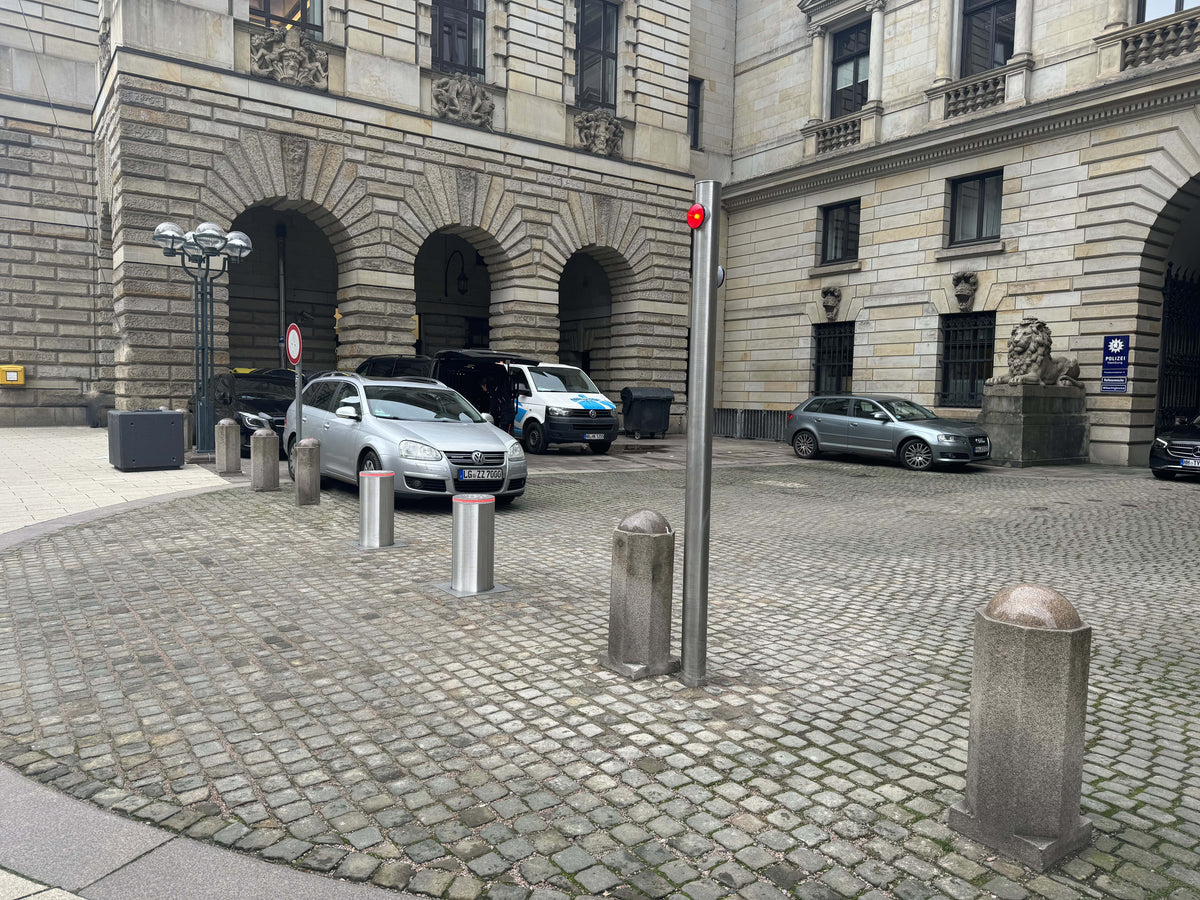
Three of our projects show three levels of safety technology. The Berlin residential complex works with radio for entry, an exit loop and a safety loop – without a traffic light, because the passage is easy to oversee. At Hamburg City Hall, a Loxone Miniserver handles the control and monitoring of the pneumatic bollards, which are lowered at the push of a button; the bollard head bears the milled Hamburg coat of arms, and the V4A material withstands road salt and graffiti. At the Große Freiheit, six bollards protect the nightlife strip every day from 8 pm to 6 am, while during the day they are lowered for deliveries and tradespeople; every rise locks mechanically, and the lock is only released by a controlled lowering from the control room.

- Passages per day estimated? More than ten or changing users → traffic control unit instead of radio
- Safety loop planned directly at the bollard so that nothing rises while a vehicle is standing over it?
- Exit loop provided on the inside so that exiting works without any operation?
- Single lane with two-way traffic or poor visibility of the bollard? → Traffic-light column with red and green (€1,450)
- LED ring in the bollard head configured for red/green, flashing light during movement wanted?
- Loops laid before paving, cable up to 15 m as standard, beyond that outdoor network cable up to 50 m?
- Behaviour in a power cut defined: open (fire brigade) or closed (theft protection)?
- Fire-brigade signal, control room or KNX/LAN link to the traffic control unit taken into account?
- Second compressor for systems that must never stand still?
- Signage and data protection clarified if number-plate recognition is added?
Frequently asked questions about induction loops, traffic lights and safety at the bollard system
Can a bollard rise beneath a stationary vehicle?
Not with a system that has a safety loop: as long as a vehicle is standing over the induction loop at the bollard, the traffic control unit does not release the command to rise – not even from a schedule, handheld transmitter or number-plate camera. Only when the loop reports clear does the traffic light switch to red and the bollard rise.
What is an induction loop and how does it detect a vehicle?
A loop of wire in the road surface that detects a vehicle by the change in its magnetic field. It responds to masses of metal, not to pedestrians, leaves or snow. The loop module with 2 × 50 m of cable is included with the traffic control unit from Braun Antriebe.
Do I need a traffic light at my bollard system?
Yes, if vehicles can meet on a single-lane entrance or the bollard cannot be seen in time. The stainless-steel traffic-light column costs €1,350 with red and €1,450 with red and green, is 3.00 m long and stands 2.20 m visible above ground.
Is the radio control enough for company premises?
Only up to about ten passages a day with regular users. The radio control (€245) is not designed for induction loops or radar sensors; with more traffic or changing users, the traffic control unit (€2,150) with loops and traffic light is the right choice.
How quickly does the bollard rise again after a vehicle has passed?
Within a few seconds of the safety loop reporting clear and the traffic light switching to red. The rise time itself is adjustable between 3 and 10 seconds.
What happens to the safety technology in a power cut?
The bollard behaves as set at the valve: it either lowers and opens the entrance or stays locked in the raised position. There is no electronics in the bollard, so nothing needs to be re-taught after the outage.
Can loops be retrofitted?
Yes. The simplest way is to lay them before paving, together with the cable and hose bundle; retrofitted loops are cut into asphalt or concrete, which is more involved.
The key points in three sentences
A commercial bollard system is safe when an induction loop directly at the bollard blocks it from rising while a vehicle is standing over it, an exit loop opens the exit without any operation, and the traffic control unit only lets the bollard rise again once the vehicle has passed through completely and the traffic light has switched to red – all monitored in the control cabinet, while all that sits in the ground is the stainless-steel cylinder of the pneumatically retractable V4A stainless-steel bollard. The traffic control unit with Loxone Miniserver from Braun Antriebe costs €2,150 including a loop module with 2 × 50 m of cable, the stainless-steel traffic-light column €1,350 with red or €1,450 with red and green, and they are the right choice from more than ten passages a day or with changing users, whereas for up to ten passages with regular users the radio control for €245 is sufficient. Braun Antriebe manufactures bollards and control technology in Seevetal near Hamburg, has equipped entrances at a Berlin residential complex, Hamburg City Hall and the Große Freiheit with precisely this safety chain and supports the traffic control unit by remote access on request; the prices in this article are our list prices from September 2026.
You will find all bollards, control units, traffic-light columns and compressors in the V4A stainless-steel bollard collection; which bollard withstands which impact is explained on the page Security bollards.
Planning an entrance with deliveries, visitors and two-way traffic? Send us a sketch or a photo with the estimated number of passages – we will tell you where the loops and traffic light need to go and whether the traffic control unit is the right choice.
Phone 040 226390411 · WhatsApp 0172 4544485
View stainless-steel bollardsRequest advice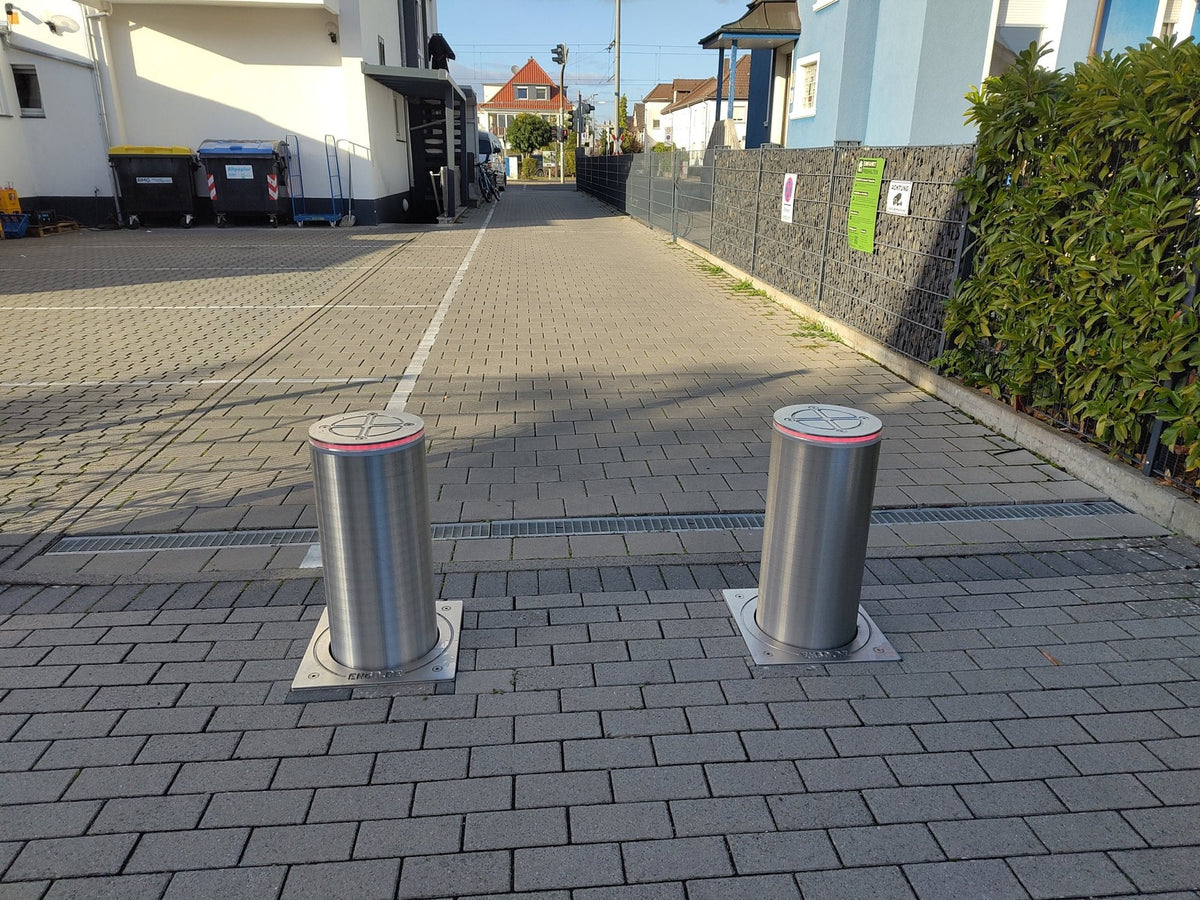

Share:
Bollard running costs: what does a retractable bollard cost in day-to-day operation?
Bollards in a power cut: does the access route stay open for the fire brigade?