

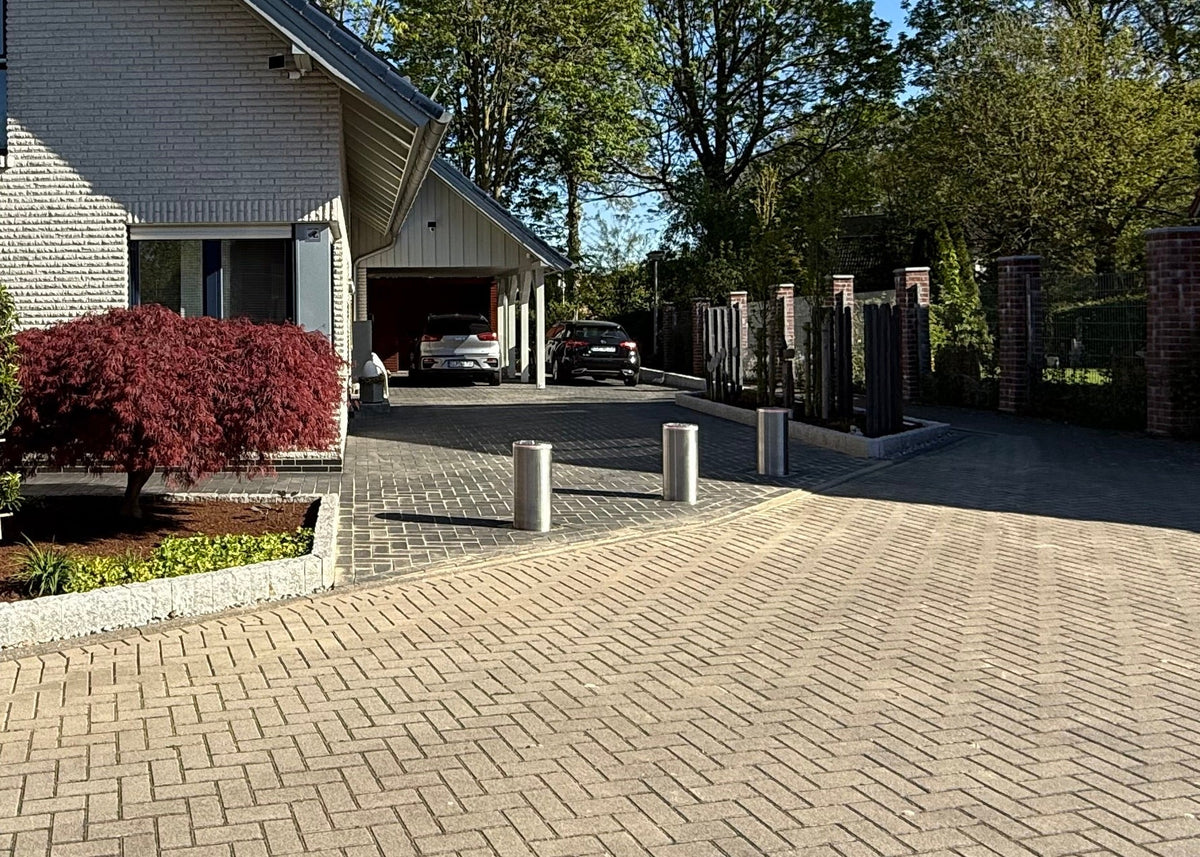
In brief
- A pneumatically retractable bollard made of V4A stainless steel from Braun Antriebe initially stays exactly where it is during a power cut – there is no motor, no electronics and no battery in the bollard that could fail.
- What happens next is set at the solenoid valve inside the building: ‘access open’ (the bollard lowers without power) or ‘access closed’ (the bollard stays up, mechanically locked if fitted with a mechanical top lock).
- Fire brigade access routes are usually set to ‘access open’ plus a way of operating the system without a key: a phone call via the GSM module (€85, up to 200 phone numbers) or app and timer programme via the road control unit (€2,150). When lowered, the bollard can be driven over by vehicles up to 40 t, and the stroke time is 3 to 10 seconds.
- If only the compressor fails, a raised bollard stays up; the replacement unit (€195) is swapped by the owner using a quick-release coupling. Prices incl. VAT, as of September 2026.
This question reaches us in two forms. The private homeowner asks: ‘If the power goes off overnight, will I still get out of my driveway in the morning?’ The property manager asks: ‘If there is a fire and the system is dead, will the fire brigade still get into the courtyard?’ For a pneumatically retractable bollard made of V4A stainless steel, as we manufacture it in Seevetal near Hamburg, both questions have the same answer: without power, the bollard does exactly what you set beforehand at the valve. This article explains what happens technically during a mains failure, which two basic settings exist, how emergency services get in without a key and what needs to be agreed with the fire safety authority. It belongs to the topic area Protecting your driveway, parking space and vehicle; who has to approve a bollard system and when is covered in the companion article Bollards on private property: when the building authority, fire brigade, owners’ association and neighbours have a say.
What happens to a retractable bollard when the power fails?
With a pneumatically retractable bollard, nothing happens at first: the bollard stays in whichever position the power cut catches it in – raised or lowered. The reason lies in the design: all that sits in the ground is a stainless steel lifting cylinder that is raised and lowered with compressed air at 8 to 10 bar; the compressor, solenoid valve and control unit are kept dry inside the building. The system needs electricity in exactly two places: at the compressor (520 W, which only runs on for around 30 seconds after each movement) and at the solenoid valve, which switches on 12 or 24 V extra-low voltage. If the mains fails, the compressor stops charging and the valve either holds or returns to its de-energised default position – and this default position is the key to everything that follows.
A retractable bollard is therefore not a device that ‘crashes’ in a power cut: no limit switches that forget their position, no circuit board that needs to reboot, no battery in the bollard. Anyone who previously had an electric gate knows the emergency release with a key on the drive; on a compressed-air bollard there are deliberately no locks and no access points on the surface – the behaviour without power is defined inside the building, where nobody can reach it from outside.

Which two default positions are there – and who needs which?
There are exactly two default positions, selected by turning the solenoid valve: in the ‘access open’ position, the air escapes from the cylinder during a power cut, the bollard lowers under its own weight and the access route is open; in the ‘access closed’ position, the bollard stays up or rises using the pressure reserve in the air receiver, and the access route remains closed. The first is the answer for fire brigade access routes and residential complexes where ‘getting out’ matters more than ‘keeping out’. The second is the answer for car dealerships, classic car garages and company yards with a theft risk – because, from a thief’s point of view, a deliberately switched-off supply is nothing other than a power cut.
| Criterion | Valve position ‘access open’ | Valve position ‘access closed’ |
|---|---|---|
| Behaviour without power | Bollard lowers, driveway open | Bollard stays up, mechanically locked if fitted with a mechanical top lock |
| Typical users | Fire brigade access route, residential complex, property manager, apartment building, private driveway without theft risk | Car dealership, classic car garage, company yard, financial services provider, high security |
| Protection if the power is deliberately switched off | none – the barrier drops | remains in place |
| Clearance for emergency services without power | automatic, by lowering | via a UPS for valve and control unit, or a burst of compressed air to the ram |
| What you need to do | Select the valve position at commissioning, no extra cost | Select the valve position; plan for a mechanical top lock and an emergency operating method |
The decision can be changed later, because it is made at the valve inside the building and not in the bollard. We nevertheless ask for it before delivery, because it determines which control unit and which accessories you need.
How does the fire brigade get onto the property during a power cut?
With the valve in the ‘access open’ position, the fire brigade gets onto the property during a power cut without any action at all, because the bollard lowers and, once lowered, can be driven over by vehicles up to 40 t – the fire engine simply rolls over the flush stainless steel cover. For normal operation with power, the fire brigade additionally needs a way of opening the barrier without a key or hand transmitter; there are three options for this: a phone call via the GSM module, where the control room uses one of up to 200 stored phone numbers and the bollard lowers in 3 to 10 seconds; clearance by app or remote switching via the road control unit with Loxone Miniserver, which a security service or property manager can trigger from anywhere; and a fixed push button at the gatehouse or caretaker’s office as an on-site emergency control.
Which of these answers is required is determined by the responsible fire safety authority for the specific property; the areas themselves are described in DIN 14090 ‘Areas for the fire brigade on properties’, and whether your driveway is one of them is stated in the building’s planning permission or in the fire safety concept. We know municipalities for which the ‘open in a power cut’ valve position is sufficient, and others that additionally require an operating method by phone call. Clarify this before ordering – stroke time, drive-over capacity, valve position and operating methods are the four details that are usually asked for.
| What the fire brigade wants to know | Answer for the pneumatic bollard from Braun Antriebe | Cost / component |
|---|---|---|
| Does the access route open without power? | Yes, with the valve in the ‘access open’ position the bollard lowers automatically | included in delivery, setting at the valve |
| How quickly is the access route open? | Stroke time 3 to 10 seconds depending on the setting | no extra cost |
| Can the lowered bollard bear a fire engine? | Yes, when lowered it can be driven over by vehicles up to 40 t | no extra cost |
| How do emergency crews open it without a key? | Phone call from the crew’s mobile (up to 200 phone numbers) or remote clearance via app | GSM module €85 or road control unit €2,150 |
| Is the access route closed unattended at night? | Timer programme keeps the bollard down during set hours, clearance possible at any time | Road control unit €2,150 |
| Is there an on-site control? | Fixed push button at the gatehouse or caretaker’s office | Connection available on the road control unit |

Can a bollard locked in the raised position be lowered without power?
Yes – to lower a bollard locked in the raised position, a short burst of compressed air to the ram is all it takes: the mechanical top lock releases and the bollard can be lowered. The mechanical top lock is a locking pin that mechanically holds the raised bollard up so that nobody can push it down – not even if someone cuts the compressed-air line: the air escapes, the pin holds and the access route stays closed. That is why car dealerships and an airport hangar with 24 security bollards choose this variant: anyone who cuts the lines locks themselves out.
For an emergency, this means: the burst of compressed air comes from the compressor’s air receiver, which is still under pressure after the power cut, or from another compressed-air source at 8 to 10 bar – in a vehicle workshop from the in-house supply, or failing that from a portable unit. Raising, by contrast, always requires voltage at the valve and 8 to 10 bar. Anyone who chooses ‘access closed’ but still wants to be able to open for emergency services during a mains failure needs a small uninterruptible power supply (UPS) for the solenoid valve (12 or 24 V) and the control unit; both need so little energy that a UPS keeps them running for many hours, and clearance by phone call or app works even when the building is dark. Which size is right depends on whether the compressor (520 W) is to be bridged as well – talk to us about it before the electrician installs the 230 V connection.
What happens if it is not the power but the compressor that fails?
If the compressor fails, a raised bollard with a mechanical top lock stays locked in the raised position and a lowered one stays down – and in both cases you replace the unit yourself. The compressor is connected via a quick-release coupling; a new quiet drive compressor for one to four bollards costs €195, is shipped by express and connected in a few minutes, and on request we guide you through it by WhatsApp video. No technician, no call-out, and the bollard stays in the ground.
Until the replacement unit arrives, there are two interim solutions: the compressor’s air receiver holds a reserve of 6 to 20 l, which allows the bollard to be moved a few more times – how often depends on the receiver volume and the stroke (60 or 80 cm). And any compressed-air source at 8 to 10 bar can be connected: the Mercedes-Benz Center Hamburg runs its 19 bollards permanently on the compressed air of its own workshop. Anyone who cannot afford to have the access route fail at all plans for two compressors, as Hamburg City Hall does, where the entire system is installed with full redundancy in the basement.
What other fault scenarios are there – and how does the system behave?
Apart from a mains failure and a compressor fault, there are three further fault scenarios that come up regularly in consultations, and the same logic applies to all of them: the bollard stays in its position until someone moves it with compressed air. The overview is written from the operator’s point of view – what you can do yourself without waiting for a technician.
| Fault scenario | What happens to the bollard | What you do |
|---|---|---|
| Mains failure | Bollard stays where it is or follows the valve position (open / closed) | nothing; with a UPS, continue operating by phone call or app |
| Compressor faulty | Bollard stays in its position, air receiver reserve for a few movements | Swap in the replacement unit (€195) via quick-release coupling, use external compressed air in the meantime |
| Solenoid valve faulty (approx. €50) | Bollard stays in its position | Swap the valve via quick-release coupling, express delivery |
| Compressed-air line cut | With a mechanical top lock, the bollard stays locked in the raised position | Repair the line; lower with a burst of compressed air to the ram |
| Hand transmitter lost or battery flat | no effect on the bollard | Use the second operating method (push button, phone call, app); reorder a transmitter for €29.50 |
All spare parts sit inside the building and are replaced without any excavation; what this costs compared with hydraulic and electric spindle bollards is worked out in the article Bollard running costs.

What should a property manager define for the emergency services and residents?
Before ordering, a property manager should define three things: the valve position (almost always ‘access open’ for residential complexes), at least two mutually independent operating methods and one person who knows what to do in a fault scenario. In a residential complex, nobody can manage the hand transmitters of care services, parcel couriers and ambulances – the operating method has to work without handing out physical items. A proven combination is an induction loop for the exit (every vehicle from inside lowers the bollard automatically) and a GSM module for the entry with up to 200 stored phone numbers: residents, care service, caretaker, emergency service; the call is not answered and is free of charge. Add to this a safety loop that prevents the bollard from rising underneath a stationary vehicle – as at the residential complex in the Greater Berlin area, where two standard bollards close off the passageway to the parking spaces.
For the emergency services, we recommend agreeing the control room’s phone numbers or clearance by app with the fire safety authority and filing the arrangement in the building manual – with a note on where the compressor and valve are located and how the burst of compressed air is applied to the ram. A timer programme can additionally keep the access route open at fixed hours, as the Große Freiheit in St. Pauli has done since 2018: closed at night from 8 pm to 6 am, lowered during the day.
What applies to the private homeowner with a single driveway?
For a private driveway with one or two bollards, the ‘access open’ valve position, one hand transmitter per vehicle and a push button in the house are sufficient in the vast majority of cases – the fire brigade question only arises if the driveway is designated as a fire brigade access route, which is rare for detached houses. Anyone protecting a high-value car in a carport chooses ‘access closed’ with a mechanical top lock and, during a power cut, lowers the bollard using the air receiver reserve or a burst of compressed air; a UPS for the valve turns that into the push of a button. The compact radio control (€245) with 868 MHz rolling code and a 100 m range is the simplest solution for this; which control unit suits which type of use is compared in the article Bollard control: radio, GSM, number plate recognition or smart home?, and the matching system is shown on the page Bollards on private property.
A tip from our consultations: test the behaviour in a power cut once, deliberately – switch off the circuit breaker, watch what the bollard does, switch it back on. Ten minutes that, in an emergency, save you wondering whether the valve really is set the way you remember.

What belongs in an emergency plan for the bollard system?
An emergency plan for a bollard system fits on one page and answers six questions: what does the bollard do without power, who opens the barrier without a key, where is the equipment located, how is the compressor replaced, who is the contact person and when was all this last checked.
- Valve position defined and documented: ‘access open’ (fire brigade, residential complex) or ‘access closed’ (theft protection)
- Driveway checked for fire brigade area status (planning permission, fire safety concept, DIN 14090); fire safety authority has confirmed the solution
- Two independent operating methods: hand transmitter plus push button, phone call (GSM, up to 200 phone numbers) or app via the road control unit
- Phone numbers of the control room, care service, caretaker and emergency service stored
- For ‘access closed’: UPS for valve and control unit in place, or burst of compressed air to the ram described in the building manual
- Location of compressor, valve and control unit (frost-free, approx. 50 × 50 × 15 cm) recorded in the handover report
- Replacement compressor (€195) and valve (approx. €50) known, delivery time 1–2 working days from stock, quick-release couplings shown
- For escape routes or continuous operation: second compressor or existing compressed air (8–10 bar) planned in
- Power cut simulated once a year: circuit breaker off, behaviour observed, date recorded
- Manufacturer contact saved: 040 226390411, WhatsApp 0172 4544485
How do operators solve this in practice?
The financial services provider in the Rhine-Main region opted for ‘access closed’: the bollards on the open forecourt stay raised during a power cut so that nobody can roll up to the main entrance by switching off the power; for the fire brigade and announced deliveries, the building services team lowers the bollards at the push of a button in around three seconds. On the forecourt there is neither a push button nor a key switch nor an emergency release – everything that is operated sits inside the building.
Hamburg City Hall shows the other way: the complete equipment for the six bollards is installed in duplicate in the secured basement – if one part fails, the second takes over, and the access routes at the Bucerius-Passage and the police station remain operable. What both projects have in common is the core of this article: the behaviour in a fault scenario was decided before commissioning and set at the valve.
Frequently asked questions about bollards in a power cut and fire brigade access
Does a retractable bollard lower automatically in a power cut?
Only if the solenoid valve is set to ‘access open’. Then the air escapes and the bollard lowers. If the valve is set to ‘access closed’, the bollard stays up – mechanically locked if fitted with a mechanical top lock. You select the position at commissioning inside the building.
How does the fire brigade get through if nobody is at home?
Via an operating method that needs no key: a phone call from the crew’s mobile via the GSM module (€85, up to 200 phone numbers), clearance by app or remote switching via the road control unit (€2,150), or a timer programme that keeps the access route open at fixed hours. Which solution is required is determined by the fire safety authority.
Can a fire engine drive over the lowered bollard?
Yes. When lowered, the pneumatically retractable bollard made of V4A stainless steel can be driven over by vehicles up to 40 t; all that remains visible is the flush stainless steel cover in the paving.
How do I lower a bollard locked in the raised position without power?
With a short burst of compressed air to the ram – from the compressor’s air receiver reserve or from another compressed-air source at 8 to 10 bar. The mechanical top lock releases and the bollard can be lowered. Raising is only possible again with voltage at the valve and 8 to 10 bar.
What happens if the compressor fails?
The bollard stays in its position; the air receiver reserve (6 to 20 l) is enough for a few movements. The replacement unit for one to four bollards costs €195, is shipped by express and is swapped by the owner via a quick-release coupling. Existing compressed air at 8 to 10 bar, for example from a workshop, can supply the bollard in the meantime.
Do I have to decide on the valve position when ordering?
We ask for it before delivery, because it determines the control unit and accessories. It can be changed later by turning the valve inside the building – without excavation and without touching the bollard.
The essentials in three sentences
A pneumatically retractable bollard made of V4A stainless steel from Braun Antriebe initially stays where it is during a power cut and then follows the setting at the solenoid valve inside the building: ‘access open’ – the bollard lowers and can be driven over by vehicles up to 40 t – or ‘access closed’, in which case a bollard locked in the raised position can only be lowered with a burst of compressed air to the ram. Fire brigade access routes and residential complexes are usually set to ‘access open’ plus an operating method without a key – a phone call via the GSM module with up to 200 phone numbers (€85) or app and timer programme via the road control unit (€2,150) – while car dealerships and properties with a theft risk choose ‘access closed’ with a mechanical top lock and, on request, a UPS for valve and control unit. Braun Antriebe manufactures bollards and compressed-air equipment itself in Seevetal near Hamburg, has installed both variants at, among others, a financial services provider in the Rhine-Main region, Hamburg City Hall and a residential complex in the Greater Berlin area, and supplies compressors and valves from stock within one to two working days; the prices are our list prices from September 2026.
All the answers on mechanical top locks, compressors and valves in detail are in the FAQ on retractable bollards; you will find the bollards, compressors and control units in the V4A stainless steel bollards collection, and the GSM module for clearance by phone call on the product page GSM bollard control.
Fire brigade access, residential complex or theft protection? Tell us what should happen in a fault scenario and send us a photo of the access route – we will tell you the valve position, the control unit and the documents your fire safety authority can obtain from us.
Phone 040 226390411 · WhatsApp 0172 4544485
View stainless steel bollardsRequest advice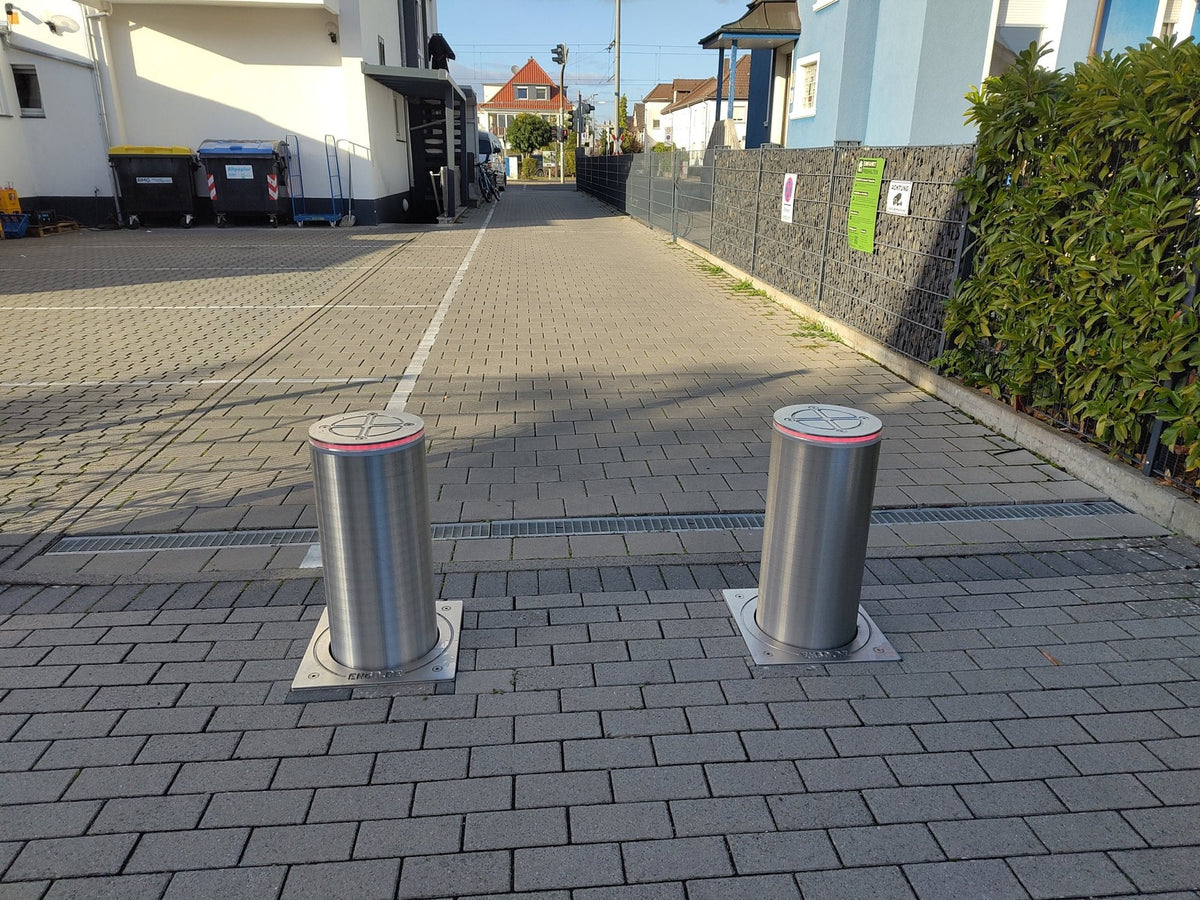
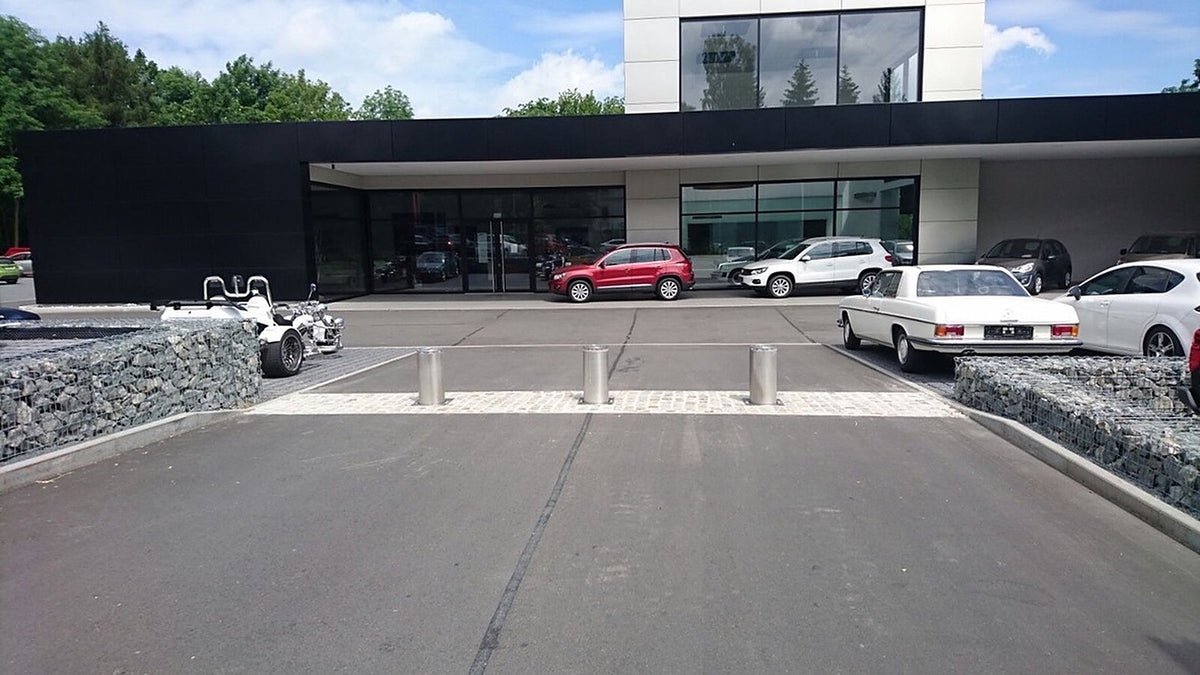
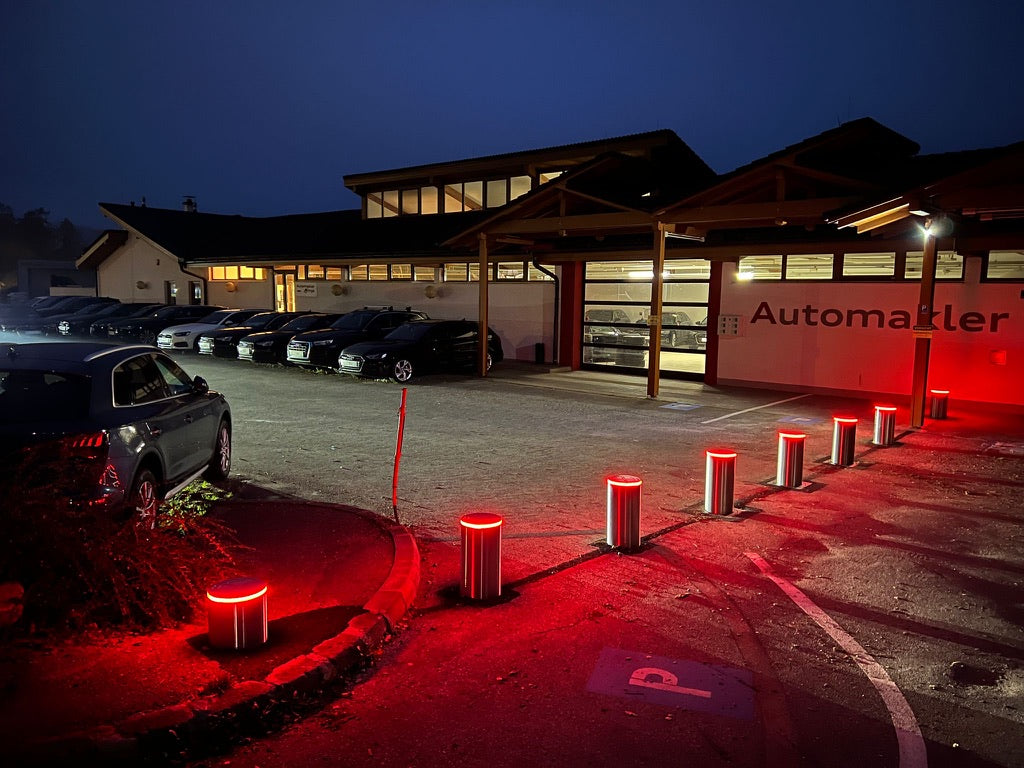

Share:
Induction loop and traffic light at the bollard: what safety technology does a commercial entrance need?
Bollard with Number Plate Recognition: What Makes Up the Complete System – and Where Can You Save?