

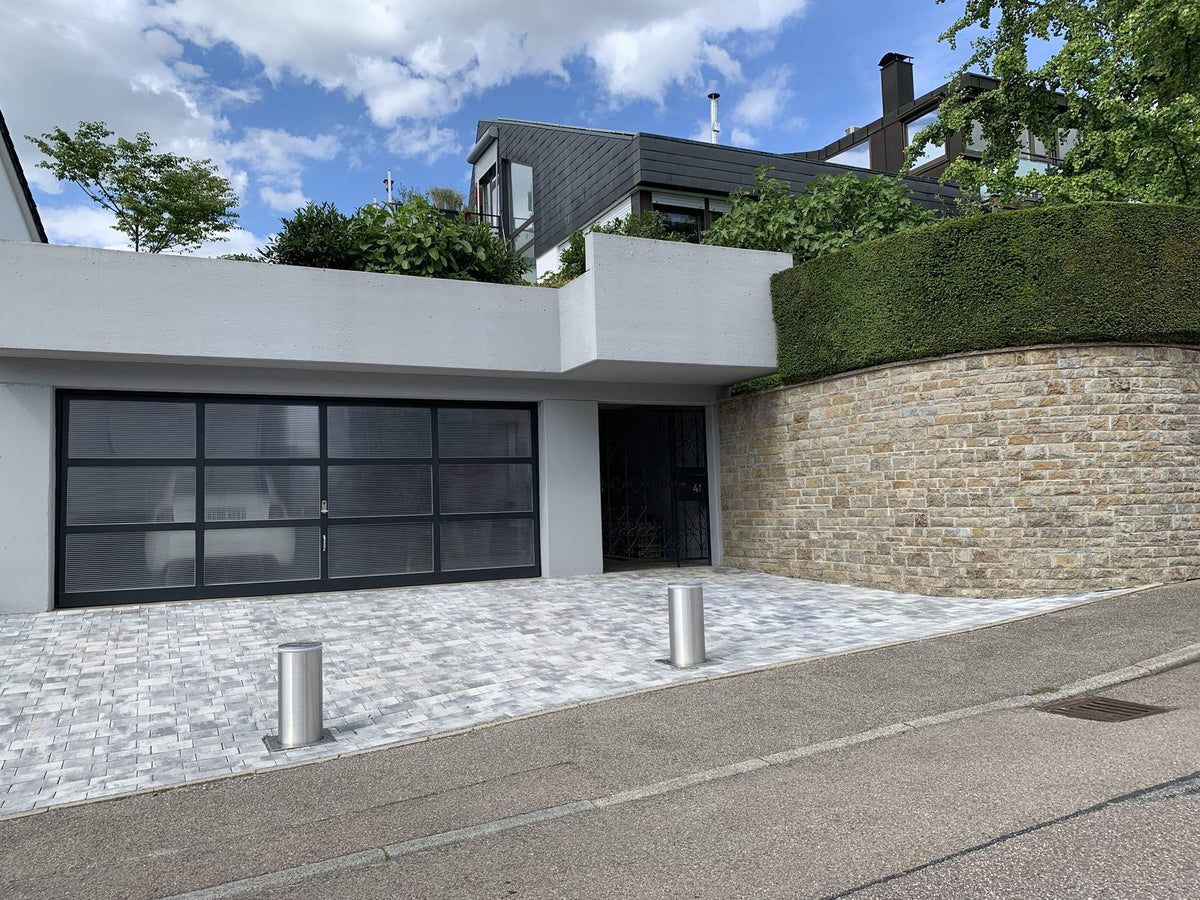
In brief
- A pneumatic retractable V4A stainless steel bollard from Braun Antriebe that stands entirely on your own property behind the boundary with the pavement does not, in most cases, need planning permission – but only your local building authority can give a binding answer on the basis of the applicable state building code (in Germany, the Landesbauordnung).
- Four situations are the exception: the bollard is to stand on or next to public land, the entrance is a designated fire service access route, the property belongs to an owners’ association, or you are a tenant.
- Technically, pneumatics help with all four: stroke time 3 to 10 seconds, behaviour in a power cut adjustable at the valve (entrance open or blocked), operation by radio (€245), phone call (GSM module €85) or induction loop for any number of users.
- For the pit of 80 × 80 cm and 1.0 to 1.2 m deep, the utility companies’ line information belongs before the first spade goes in – that is the permission most often forgotten.
The question comes up almost daily in our telephone advice service in Seevetal, usually in this form: “Am I actually allowed to do this?” What is meant is a retractable bollard in the caller’s own courtyard entrance, and callers have often read contradictory answers beforehand. This article sorts out who really has a say about a bollard on private property – building authority, fire service, owners’ association, landlord, neighbours, utility companies – and who does not. It does not replace legal advice; what applies in an individual case is for your building authority and the building code of your state or region to say. What we as the manufacturer can contribute are the technical answers to the questions these bodies will ask you. The article refers to the legal situation in Germany and belongs to our topic hub Protecting your driveway, parking space and vehicle.
Do I need permission for a bollard on my property?
For a retractable bollard that stands entirely on your own property and only blocks your own entrance, planning permission is generally not required – German state building codes usually classify small structures of this kind as exempt from the permit procedure. “Exempt from the procedure” does not mean “exempt from the rules”, however: even a project without an application must comply with the regulations that apply to the property, such as a development plan, a design statute or heritage protection.
The reason why the question still cannot be answered across the board rarely lies in the bollard itself, but in three things around it: Where exactly does the property boundary run? Who apart from you may or must use the entrance? And who actually owns the property? These three questions determine who is involved, and we go through them one by one in the following sections. For the everyday case – detached house, own driveway, bollard two metres behind the pavement – all that usually remains is a call to the building authority and the utility line information.
A note for context: with a pneumatic retractable bollard, only a stainless steel cylinder in a sleeve sits in the ground; the compressor, valve and control are in the house. This is generally easier for building authorities to assess than a gate with foundations, posts and drive at the boundary, because when lowered nothing protrudes above the surface and the entrance remains clear for pedestrians and emergency services at all times.
Where does my property end – and why does that decide on permission?
Your property ends at the boundary recorded in the land register, not where the paving or the kerb ends; without a special-use permit, a bollard may only stand on your side of this line. The crossing over the pavement – the dropped kerb and the strip up to the boundary – is public road space, even if it serves only you. There, the highway authority, usually the municipality, decides, and a bollard on this land would be a special use that requires approval.
In practice, this means: place the bollard so that the entire sleeve lies on your land – including the 80 × 80 cm pit that installation requires. If you do not know the boundary, obtain an extract from the land register or have a surveyor point out the boundary markers.

Two further points related to the boundary: a property entrance has usually been agreed with the municipality, and a bollard does not change this entrance – it only blocks it temporarily. And if your driveway counts as a required parking space under the building code, the parking space must remain accessible. A retractable bollard meets this requirement because it disappears into the ground in 3 to 10 seconds; a fixed bollard for €1,350 does not.
When should I ask the building authority beforehand?
Ask the building authority before installation if at least one of these four conditions applies: the building or ensemble is listed, there is a development plan or design statute with requirements for boundary features and front gardens, the entrance is designated as a fire service access route, or you are unsure about the property boundary. In most municipalities, a short phone call with a photo of the driveway clears this up without a formal application.
The building codes of Germany’s sixteen states regulate which projects are exempt from the procedure, and they do not regulate it identically. That is why we deliberately do not cite any sections in this article: what applies in Lower Saxony may be worded differently in Bavaria. Your state’s building code is available online, and the building authority is the body that interprets it for your property.
What the building authority usually wants to know, we can supply from our documentation: dimensions of the bollard (Ø 27 cm, travel 60 or 80 cm), installation depth (1.0 to 1.2 m), weight (approx. 80 kg for the entry-level model, approx. 160 kg for the standard bollard), behaviour in a power cut and the installation instructions with pit drawing. This information is on every product page in our V4A stainless steel bollards collection and available as a PDF download.
What applies if my driveway is a fire service access route?
If your driveway is designated as an area for the fire service – for example as access to a building at the rear or a set-up area for the turntable ladder – a bollard must not block it permanently, and the fire safety authority must approve the solution. Such areas are described in the state building codes and in DIN 14090 “Areas for the fire brigade on premises”; whether your driveway is one of them is stated in the building permit for the house or in the fire safety concept, and for residential complexes the property management will know.
On the technical side, a pneumatic retractable bollard offers three answers that fire safety authorities usually want to hear – and which we can document:
| Fire service requirement | Technical solution with the Braun Antriebe pneumatic bollard | What you set or order for it |
|---|---|---|
| Entrance must become clear without power | Behaviour in a power cut is set by turning the valve: bollard lowers, entrance open | Valve position “lower in a power cut”, included |
| Entrance must be cleared quickly | Stroke time 3 to 10 seconds depending on setting; can be driven over by 40 t when lowered | No additional cost |
| Emergency services must be able to open it without a key | GSM module: opening via a call from up to 200 stored phone numbers; alternatively a time programme or lowering via the app through the street control | GSM module €85 or street control €2,150 |
| Entrance must not be blocked unattended at night | Time control keeps the bollard down during set hours; release possible at any time by mobile phone | Street control with Loxone Miniserver |
Prices incl. German VAT, as of September 2026. Which of these answers is required for your entrance is decided by the fire safety authority; some municipalities accept release by phone call, others insist on the valve position “open in a power cut”. We recommend clarifying this question before ordering, because it influences the choice of control. What happens technically in a power cut is explained in detail in our FAQ on retractable bollards.
Important for theft protection: the valve position “open in a power cut” means that the barrier drops when the power is switched off. If you also want to secure vehicles, this calls for a trade-off – or an uninterruptible power supply for the compressor, which keeps fire service release by phone call or app possible even during a mains failure.
How is the decision made in an owners’ association?
In a homeowners’ association, the entrance is almost always common property, and a bollard in it is a structural alteration on which the owners’ meeting must decide – an individual owner may not install one on their own initiative. How the resolution is passed and who bears the costs is governed by the German Condominium Act (WEG); the property management knows the formalities, and if anything is unclear, a lawyer specialising in condominium law is the right contact, not the bollard manufacturer.
What we can say from experience: the resolution is easier to pass if three questions have been answered beforehand. First, how all owners can operate the entrance without getting out – with two to four parties, handheld remotes at €29.50 each are sufficient; with more parties or changing tenants, the GSM module (call from a mobile) or the street control with induction loop is the better solution, because no remotes have to be handed out and collected again. Second, how visitors, care services, parcel services and refuse collection get in. Third, what the complete system costs, including groundwork; the calculation is in the article How much does a bollard system cost?.

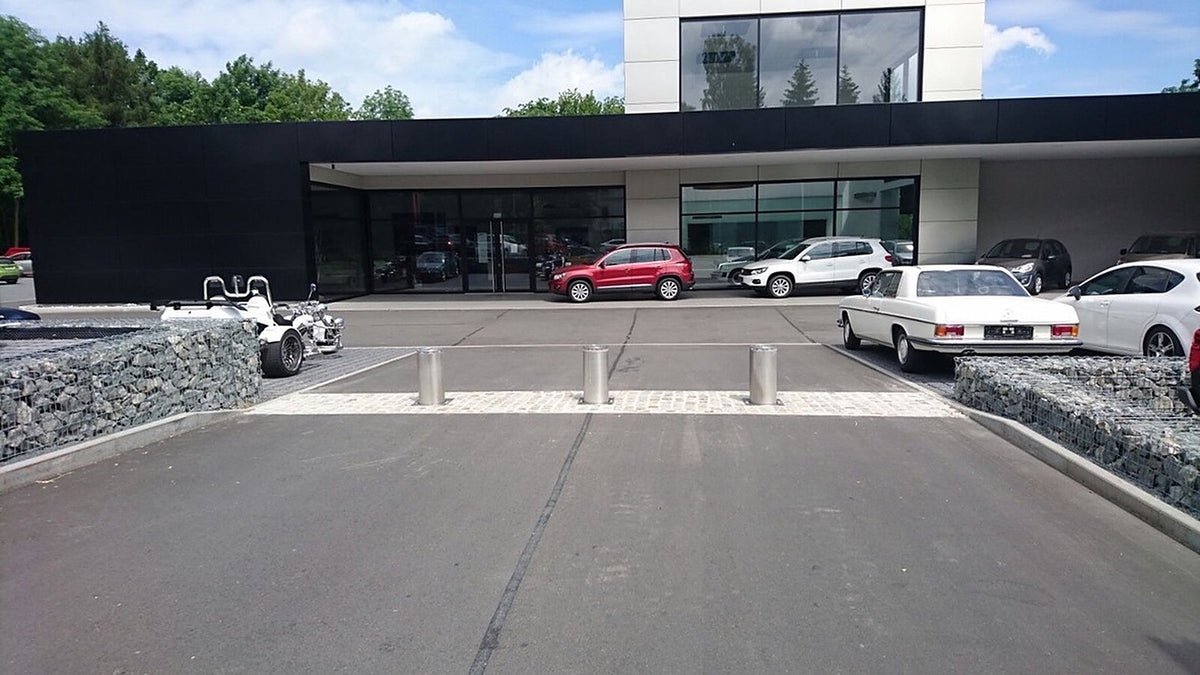
The residential complex in Berlin opposite a supermarket is a typical example: supermarket customers parked in the open passage, signs and towing did not help, a sliding gate was structurally impossible, and a barrier would have obstructed the footpath. Today, two standard bollards of around 160 kg each block the passage; residents drive in using a radio remote, the exit is opened automatically by an induction loop, and a safety loop prevents a bollard from rising under a stationary vehicle. Nobody has to get out, and nobody has to manage keys.
Can I install a retractable bollard as a tenant?
As a tenant, you may only install a retractable bollard with the landlord’s written consent, because the pit of 80 × 80 cm and 1.0 to 1.2 m deep is an intervention in the fabric of the property; the same applies to commercial tenants whose yard is part of the rented property. Clarify three points in the agreement: whether the bollard must be removed when you move out or remains in the property against a transfer payment, who re-paves the area after removal and who takes over the compressor, valve and control.
For tenants, pneumatics are an advantage that helps in these negotiations: the compressor, valve and control are connected with quick couplings and can be taken along when moving out; the stainless steel cylinder remains in the ground and can continue to be used by a subsequent tenant or the owner. Nobody simply takes a gate with a drive at the boundary with them.
What rights do neighbours have over my driveway?
Neighbours have a say if they are entitled to use your driveway – through a registered right of way (easement in the land register), a shared entrance across two properties or a contractual agreement. A bollard must not override such a right of way; the neighbour must still be able to use the entrance, so they need a handheld remote, a phone number in the GSM module or a loop. Without a right of way, there is no right to a say; it is still a good idea to inform the neighbours, if only because of the building site with digger and trench.
A case we come across quite often: two terraced houses share the entrance to two garages, and only one of the two wants to secure it. Then the bollard is either placed where only their own garage lies behind it – or both parties operate it, which is solved with two handheld remotes at €29.50 each. A boundary distance like that for walls or hedges is not usually provided for in German neighbour law for a bollard that disappears into the ground; to be on the safe side, ask the building authority here too.

Which utility lines run through my driveway – and who can tell me?
Before the pit is dug, you must obtain line information from the utility companies – electricity, gas, water, sewage and telecommunications – because service connections almost always run through the driveway, and a digger hitting a gas pipe costs more than any permit. With most network operators, this information is free of charge and can be requested online; it shows the routes on the site plan, but does not replace careful hand digging near the marked lines.
The figures for planning: the pit measures approx. 80 × 80 cm and is 1.0 to 1.2 m deep depending on travel; under the bollard there is no concrete, but a gravel and drainage layer so that rainwater can drain away. From the bollard to the house runs a trench about 30 cm deep for the cable and hose bundle, which we make up in lengths from 1 m to over 100 m, and it enters the building through a 25 mm hole. The 230 V connection of compressor and control is a job for a qualified electrician; the groundwork can be done by groundworks contractors, landscapers or experienced DIYers. Step by step, it is all in the article Installing a retractable bollard.

What must be clarified before installation?
Before you order, the boundary, ownership, rights of use, fire safety and utility lines should be settled – in that order, because each answer affects the next. The following list is the one we go through on the phone before giving an installation recommendation.
- Property boundary with the pavement known from the land register; bollard and pit lie entirely on your own land
- Development plan, design statute or heritage protection checked; if in doubt, building authority asked with a photo
- Entrance is not a fire service access route – or the fire safety authority has confirmed the valve position and release method
- Ownership clarified: sole ownership, owners’ association resolution in place or landlord’s written consent obtained
- Third-party rights of way checked in the land register; neighbours who share use have an operating method (handheld remote, GSM, loop)
- Required parking space remains accessible (retractable, not fixed)
- Line information obtained from all utility companies, routes marked on the site plan
- Space for the pit 80 × 80 cm, 1.0–1.2 m deep, with drainage instead of concrete
- Route for the cable and hose bundle to the house, location for compressor (approx. 50 × 50 × 15 cm) and control frost-free in the building
- Operation defined for all authorised users: radio €245 plus handheld remote €29.50, GSM module €85 or street control €2,150
- Photos of the driveway sent to us – we check position and number free of charge via WhatsApp
One sentence on insurance that we always add: whether a bollard affects your buildings or motor insurance is decided by the insurer; ask before you order. Our page Bollards on private property leads directly to the right system once the questions above have been answered.
What does this look like in practice?
In Upper Bavaria, an owner wanted to keep his open courtyard – without gate, fence or chain – and still prevent strangers’ vehicles from turning on his hand-laid small granite setts. Today, six standard bollards follow the curve of the courtyard edge so closely that no car fits between them, while pedestrians and pushchairs can pass through. The bollards stand entirely on the property and the pavement remains untouched; they are operated by radio remote from the car, and when lowered only the stainless steel lid is visible in the paving. Precisely this arrangement – behind the boundary, without encroaching on public space – is why such projects generally manage without a permit procedure.
The residential complex in Berlin shows the other case: several owners, a shared passage, many users. There, the work lay not with the building authority but in reaching agreement within the association and in choosing an operating method that works for everyone without getting out of the car.
Frequently asked questions about permission for bollards on private property
Do I need planning permission for a retractable bollard in my driveway?
In most cases not, if the bollard stands entirely on your property and only blocks your own entrance. The building authority will give you a binding answer on the basis of the state building code – especially in the case of heritage protection, a development plan, a design statute or a fire service access route.
May the bollard stand on the pavement or the dropped kerb?
No, not without a special-use permit from the municipality. The pavement and crossing are public road space. Place the bollard and pit entirely behind the property boundary recorded in the land register.
What happens with a fire service access route?
Then the fire safety authority must approve the solution. The Braun Antriebe pneumatic bollard can be set at the valve so that it lowers in a power cut and clears the entrance; in addition, a GSM module (phone call) or the street control (app, time programme) opens the entrance in 3 to 10 seconds.
Can I decide on my own as a flat owner?
No. The entrance is usually common property, and a bollard is a structural alteration on which the owners’ meeting decides. The property management knows the procedure under the German Condominium Act.
May I install a bollard as a tenant?
Only with the landlord’s written consent, because the pit is an intervention in the property. Thanks to quick couplings, you can take the compressor, valve and control with you when you move out; the cylinder stays in the ground.
Do I have to ask the neighbours?
Only if they have a right of way over your driveway or share the entrance – then they need an operating method such as a handheld remote. Otherwise, informing them is courteous but not obligatory.
Which utility lines do I need to check before digging?
Electricity, gas, water, sewage and telecommunications – via the network operators’ line information. The pit is 80 × 80 cm and 1.0 to 1.2 m deep, the cable trench to the house about 30 cm.
The key points in three sentences
A pneumatic retractable V4A stainless steel bollard from Braun Antriebe that stands entirely behind the property boundary and only blocks your own entrance does not, in most cases, need planning permission; the building authority decides bindingly on the basis of the state building code, and the exceptions are heritage protection, design statutes, fire service access routes, common property and tenancies. For each of these bodies, pneumatics provide a technical answer – valve position in a power cut, stroke time of 3 to 10 seconds, operation by radio, phone call or loop for any number of authorised users – and for the 80 × 80 cm pit, the utility companies’ line information belongs before the first spade goes in. Braun Antriebe manufactures the bollards itself in Seevetal near Hamburg, has installed them in courtyard entrances in Upper Bavaria, residential complexes in Berlin and at public authority entrances, and delivers them direct from the factory; the prices in this article are our list prices from September 2026.
Which solution suits which driveway is described in the article Retractable bollards for your driveway; how to combine radio, GSM and smart home is explained in Bollard control: radio, GSM, number plate recognition or smart home?.
Not sure where the bollard may stand? Send us a photo of your driveway looking towards the street – we will tell you which position, number and control are right and which documents the building authority or fire service can get from us.
Phone +49 40 226390411 · WhatsApp +49 172 4544485
View stainless steel bollardsRequest advice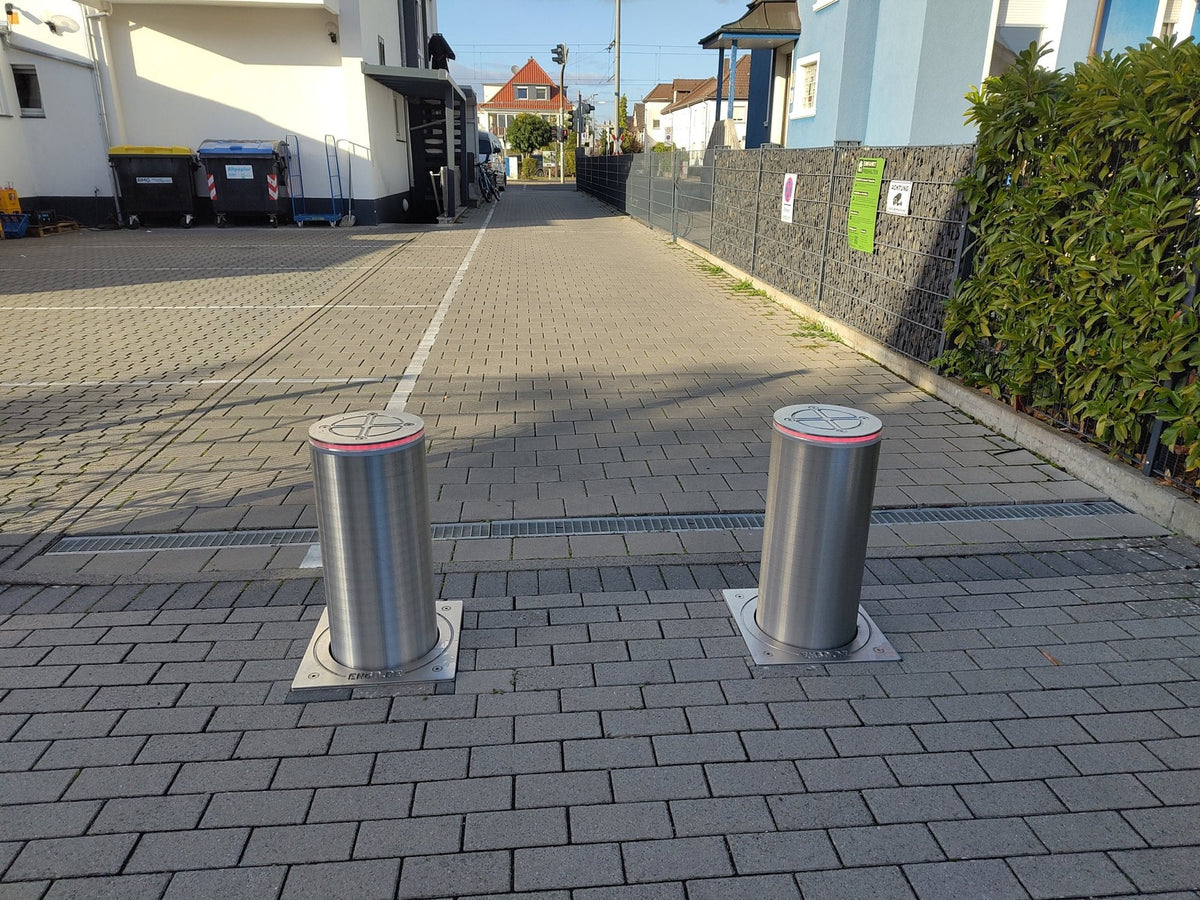

Share:
Preventing Car Theft with Bollards: What an Access Barrier Can Do – and What It Can’t
Number Plate Recognition at Entrances: What the GDPR Requires – and How the Number Plate Kit Handles It