

In brief
- A vehicle number plate is personal data within the meaning of the GDPR because it can be linked to a person via a vehicle keeper enquiry – number plate recognition at an entrance is therefore data processing that requires a purpose, a legal basis, a notice sign and a defined retention period.
- Braun Antriebe’s number plate recognition (€1,950, add-on to the street control for €2,150) works locally: camera via PoE in your own network, whitelist in the web interface, no cloud, no subscription – the data does not leave the property.
- Four principles are enough in practice: store as little as possible, keep only the registered number plates, inform data subjects with a sign at the entrance and set deletion periods; for staff entrances, involve the works council.
- If you do not want to process number plates, you can control the pneumatic retractable V4A stainless steel bollard by radio (€245), phone call (GSM module €85) or induction loop instead – without any personal data. Prices incl. German VAT, as of September 2026.
Number plate recognition is the most convenient way to open an entrance: the vehicle approaches, the camera reads the number plate, the bollard lowers, and nobody presses a button. It is also the only control in our range for which we regularly have to talk about data protection during consultations – a handheld remote does not know who is pressing it, but a camera does. This article explains what the General Data Protection Regulation (GDPR) requires for number plate recognition at an entrance, how our number plate kit handles this technically and which decisions you have to make yourself as the operator. It is not legal advice; binding information for your site is provided by the competent data protection authority or your data protection officer. The article refers to the legal situation in Germany and belongs to our topic hub Access management for businesses and properties.
Is a vehicle number plate personal data?
Yes. A number plate can be linked to a specific person through a vehicle keeper enquiry at the German Federal Motor Transport Authority, and it is precisely this – the ability to link it to an identifiable person – that makes data personal data under Art. 4 GDPR. The fact that you as the operator of the entrance cannot make the keeper enquiry yourself changes nothing; it is enough that the link is possible in principle.
The consequence is straightforward: as soon as a camera reads number plates and compares them with a list, you are processing personal data, and the principles of Art. 5 GDPR apply – purpose limitation, data minimisation, storage limitation, transparency. This is no obstacle to number plate recognition, but it requires you to answer four questions before the camera goes live: What for? On what basis? Who is informed, and how? And how long is what stored?
By way of distinction: an induction loop in the ground only detects that a vehicle is present, not which one. A handheld remote sends a code that is not linked to any person. A call to the GSM module does process a phone number, but only that of the registered authorised users, who trigger the call themselves. These three methods are considerably simpler in data protection terms – which is why, in consultations, we always ask first whether it really has to be the camera.
How does Braun Antriebe’s number plate recognition work technically?
The camera reads the number plate of the approaching vehicle, compares it with the whitelist in the web interface and, if there is a match, sends the signal to the street control, which lowers the pneumatic retractable V4A stainless steel bollard and raises it again after the vehicle has passed. The camera costs €1,950 and supplements the street control with Loxone Miniserver (€2,150); it is powered via PoE over the network cable, connected to the local network or company intranet and set up on a PC via a web interface – without cloud, without subscription.
For data protection, this architecture is the decisive point: the number plates are stored on a device in your building, not on a provider’s server. There is no service provider reading along, and therefore no processor with whom you would have to conclude a contract under Art. 28 GDPR. You yourself are the controller, you maintain the list, and you decide what is logged.
| Feature | Braun Antriebe number plate recognition | Significance for data protection |
|---|---|---|
| Data storage | Locally in your own network, configuration via web interface on a PC | No processor, no transfer to third countries |
| Connection | PoE – one network cable for power and data; no cloud, no subscription | No ongoing transmission to the outside |
| Authorisations | Whitelist of registered number plates, can be changed at any time | Data minimisation: only authorised users are stored |
| Trigger | Match in the list → bollard lowers; street control raises it again | Purpose limitation: recognition serves access only |
| Price | €1,950 camera, €2,150 street control; fixed bollard with integrated camera €3,450 | incl. German VAT, as of September 2026 |
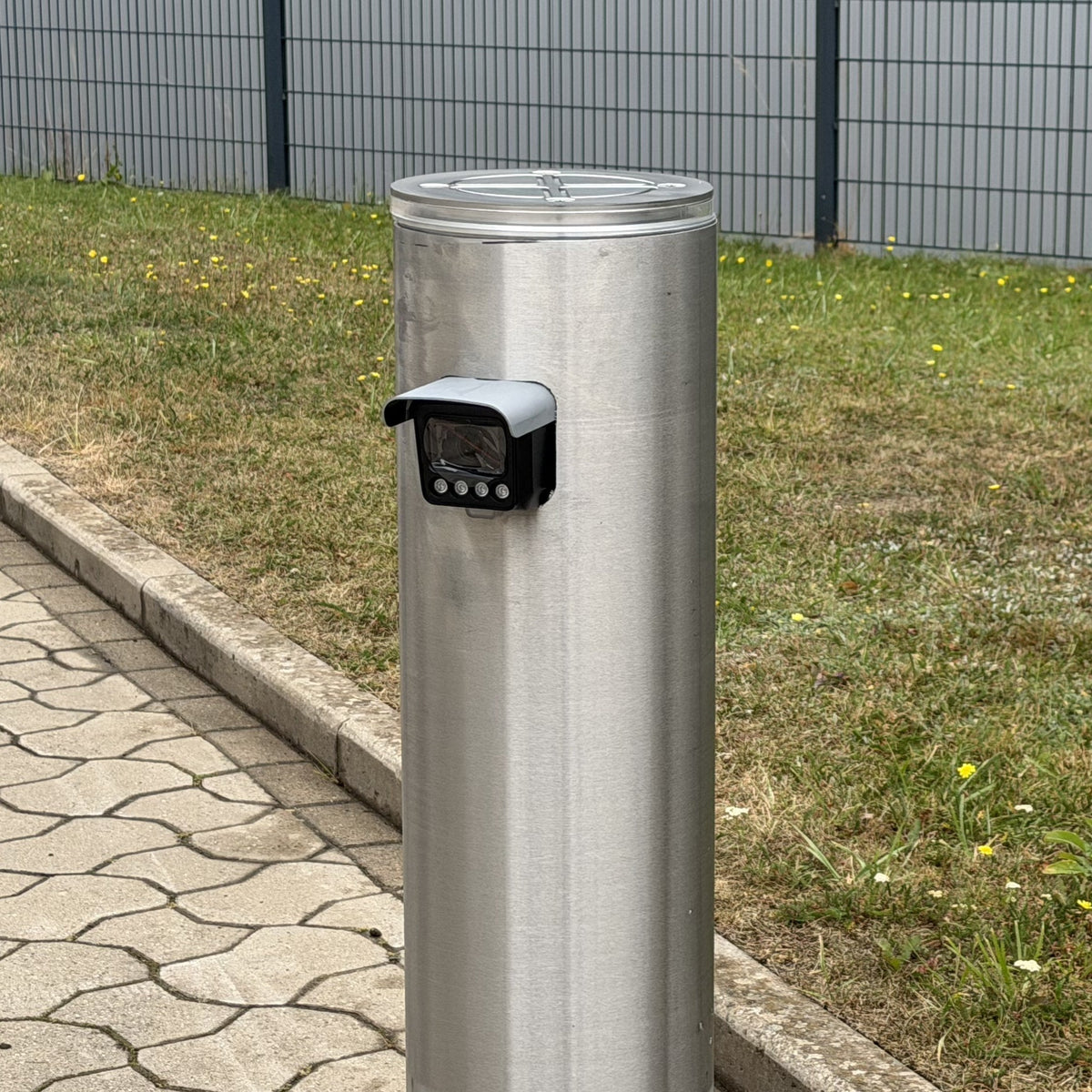
If you do not want to see the camera on a pole, you can have it as a fixed stainless steel bollard with integrated number plate recognition (Ø 27 cm, approx. 100 cm high, 6 mm wall thickness, €3,450): the camera opening is CNC-milled and the technology sits inside the bollard body. All the facts about the camera are on the product page Automatic number plate recognition.

On what legal basis may I capture number plates at the entrance?
In most cases on the basis of legitimate interests under Art. 6(1)(f) GDPR – the interest in securing the property and allowing authorised vehicles access – and, for staff, tenants or hotel guests, often also on the basis of the contract under Art. 6(1)(b); consent (point (a)) is the third option, but the most laborious, because it can be withdrawn at any time. Which basis fits depends on whose number plates you capture and why – and you should record this in writing before the system goes live.
Legitimate interests require a balancing test: your interest in security against the data subjects’ interest in not being captured. This balance is easier to strike the less the system captures. A camera that only recognises registered vehicles and simply does nothing for all others is less intrusive than one that logs every passing vehicle. That is why this question is always followed by the next: what happens to number plates that are not on the list?
Three typical constellations from our consultations:
- Company car park, staff vehicles only: contract (employment relationship) or legitimate interests; under Section 87(1) no. 6 of the German Works Constitution Act (BetrVG), the works council has a right of co-determination for technical equipment capable of monitoring behaviour or performance – so involve it beforehand.
- Residential complex, residents and visitors: legitimate interests of the owners’ association; resolution of the owners, information to all residents, visitors come in by another method (phone call, loop, reception).
- Entrance on a public road where the camera also captures passers-by and through traffic: here the balancing test becomes difficult, because uninvolved persons may be captured. Choose the camera position and capture area so that only the area immediately in front of the bollard is in the picture; if in doubt, consult the data protection authority.
Do I need to put up a notice sign at the entrance?
Yes. Art. 13 GDPR obliges you to inform data subjects at the time of collection – at an entrance, this is done with a notice sign that is clearly visible before the camera’s capture area and states at least the controller, the purpose, the legal basis and a reference to the full information (e.g. via a notice or link). The sign is the transparency the GDPR means: anyone approaching the entrance should know that their number plate will be read before it is read.
For the registered authorised users – staff, residents, regular suppliers – the sign alone is not enough. When they are added to the whitelist, they should receive a short information sheet: what data is stored (number plate, possibly name and assignment), for what purpose, for how long, and that they can request access and deletion. In a residential complex, this is a circular from the property management; in a company, a paragraph in the works agreement.

How long may number plates be stored?
For as long as the purpose requires, and not a day longer – this is the principle of storage limitation under Art. 5(1)(e) GDPR, and for an entrance it means two things: the whitelist remains in place for as long as the authorisation exists, and a number plate is deleted as soon as the employee leaves, the tenant moves out or the supplier changes. Logs of individual passages – if you keep them at all – need a short, fixed period that you can justify.
With our number plate kit, you set both yourself, because management runs locally in the web interface: you add and remove number plates, and during setup you decide whether and for how long events are recorded. Our recommendation from practice: only keep a log if you have a specific reason for it (such as billing for parking spaces or investigating damage), then set a period of a few days to a few weeks, and document the decision. A system that only executes “match in the list → bollard lowers” and keeps nothing else is the most data-efficient option.
In addition to the whitelist and log, there is a third type of data that is often overlooked: the camera image itself. Number plate recognition is a camera, and if it stores images, the rules for video surveillance also apply. Set up the system so that it analyses number plates rather than collecting footage.
Do I need a data protection impact assessment or an entry in the record of processing?
For companies, number plate recognition generally belongs in the record of processing activities under Art. 30 GDPR – a short entry with purpose, data categories, data subjects, deletion period and technical measures is sufficient. A data protection impact assessment under Art. 35 GDPR, on the other hand, is only necessary where there is likely to be a high risk, for example if the camera systematically monitors a publicly accessible area; for an entrance that only recognises registered vehicles of a closed user group, this is usually not the case – whether it applies in your case is for your data protection officer to check.
For private properties, the situation is different: number plate recognition at your own driveway that only recognises the family’s vehicles and captures exclusively the area in front of the bollard on your own land is moving towards personal use, for which the GDPR provides exemptions. As soon as the camera captures the pavement or the street, however, this exemption is no longer certain – and then the rules in this article also apply to private individuals.
Which decisions do I have to make as the operator?
Five decisions that no manufacturer can make for you: purpose, legal basis, capture area, retention periods and information for data subjects. The following list is the one we go through when commissioning number plate recognition – it is the practical core of the GDPR for an entrance.
- Purpose defined in writing (checking access authorisation – not monitoring attendance)
- Legal basis determined and justified: legitimate interests, contract or consent
- Camera capture area limited to the area immediately in front of the bollard; pavement, street and neighbouring property not in the picture
- Whitelist kept minimal: only number plates of authorised users, linked to persons only where necessary
- Passages logged only for a specific reason, with a fixed deletion period
- No storage of camera images, only analysis of number plates
- Notice sign before the capture area stating the controller, purpose, legal basis and a reference to further information
- Authorised users informed when added to the list (information sheet, circular, works agreement)
- Works council involved if staff vehicles are captured
- Entry in the record of processing activities; check whether an impact assessment is necessary
- Access to the web interface restricted to a few people, password set, device in a protected network
- Process for leavers: number plate deleted on the day of departure
The penultimate point is technical, but just as important as the legal ones: a locally managed list is only more secure than a cloud if access to it is protected. The camera is connected to your network – treat it like any other computer on it.
When is a control system without number plates the better choice?
Whenever the convenience gained from the camera is small and the user group can be served just as well by radio, phone call or loop – then all the data protection work disappears, because no personal data is generated. For a private driveway with two vehicles, the handheld remote for €29.50 is the right solution, not the camera; for a residential complex with twenty households, the GSM module, with which each authorised user opens the entrance via a free call, is often sufficient; for exits, the induction loop detects every vehicle from inside without knowing which one it is.
Number plate recognition comes into its own where many changing but known vehicles are to enter without remotes and without stopping: company car parks with fleets, supplier entrances with regular suppliers, hotels with long-stay guests, city-centre entrances where residents and delivery traffic may pass and nobody else. In all other cases, our consultation rule applies: the simplest control that fulfils the purpose. Which one that is is explained in the comparison article Bollard control: radio, GSM, number plate recognition or smart home?.

What does this look like in practice?
At Hamburg City Hall, retractable stainless steel bollards with the Hamburg coat of arms milled into them secure the surrounding area; control runs via a Loxone Miniserver, and the bollards lower into the ground on release and clear the way only for authorised users. The project shows the logic that also applies to number plate recognition: the decision about who may pass lies with the operator, and the technology implements it – whether by release from inside the building, by time programme or by camera.
How little data an entrance needs is shown by the residential complex in Berlin: residents drive in using a radio remote, an induction loop opens the exit, and a safety loop prevents the bollard from rising under a vehicle – no camera, no list, no sign. And at a campsite, a time programme governs the midday quiet period from 12 noon to 3 pm; number plate recognition for regular guests is planned there as a future extension – and, when it comes, it will be set up with a sign, a list and a deletion period.
Frequently asked questions about number plate recognition and data protection at entrances
Is a vehicle number plate really personal data?
Yes. It can be linked to a person via a vehicle keeper enquiry; that is sufficient under Art. 4 GDPR. Number plate recognition at an entrance is therefore processing of personal data.
Does Braun Antriebe’s number plate recognition store data in a cloud?
No. The camera is connected via PoE to the local network, and the whitelist is maintained in the web interface on a PC. There is no cloud and no subscription; the data stays with the operator.
What legal basis do I need?
Usually legitimate interests (Art. 6(1)(f) GDPR) in securing the entrance, and for staff or tenants often the contract (point (b)). The basis should be recorded in writing; your data protection officer can give binding advice.
Do I need a notice sign?
Yes. Under Art. 13 GDPR, data subjects must be informed – with a sign before the capture area stating the controller, purpose, legal basis and a reference to further information.
How long may I store number plates?
For as long as the authorisation exists; passage logs only with a specific reason and a short, fixed deletion period. With the Braun Antriebe number plate kit, you set the list and logging yourself, locally.
Does the works council have to agree?
If staff vehicles are captured, the works council has a right of co-determination under Section 87(1) no. 6 of the German Works Constitution Act (BetrVG) for technical equipment that enables monitoring. Involve it before setting up the system.
Is access control possible without number plates at all?
Yes. Radio control (€245, handheld remote €29.50), GSM module (€85, opening by phone call) and induction loops via the street control open the bollard without any personal data.
The key points in three sentences
Number plate recognition at an entrance processes personal data, because a vehicle number plate can be linked to a person; it therefore needs a defined purpose, a legal basis – usually the legitimate interest in securing the property –, a notice sign before the capture area, a minimal whitelist and fixed deletion periods, and for staff entrances also the involvement of the works council. The Braun Antriebe number plate kit (€1,950, add-on to the street control with Loxone Miniserver for €2,150) makes this easier, because the camera and whitelist run locally via PoE in the operator’s network – without cloud, subscription or processor – and if you do not want to process number plates, you can open the pneumatic retractable V4A stainless steel bollard by radio, phone call or induction loop without any personal data at all. Braun Antriebe manufactures bollards and controls itself in Seevetal near Hamburg, has equipped entrances at Hamburg City Hall, in residential complexes and in city centres, and delivers direct from the factory; the prices in this article are our list prices from September 2026, and the data protection officer or the data protection authority is responsible for the legal assessment of your site.
How a commercial entrance is planned as a whole is described in the article Planning access control for business premises properly; you will find all bollards, controls and number plate recognition in our V4A stainless steel bollards collection.
Planning an entrance with number plate recognition? Send us a photo of the entrance and tell us who should be able to get through – we will tell you whether the camera is the right control and how to set the capture area.
Phone +49 40 226390411 · WhatsApp +49 172 4544485
View stainless steel bollardsRequest advice

Share:
Bollards on Private Property: When the Building Authority, Fire Service, Owners’ Association and Neighbours Have a Say
Bollard running costs: what does a retractable bollard cost in day-to-day operation?