

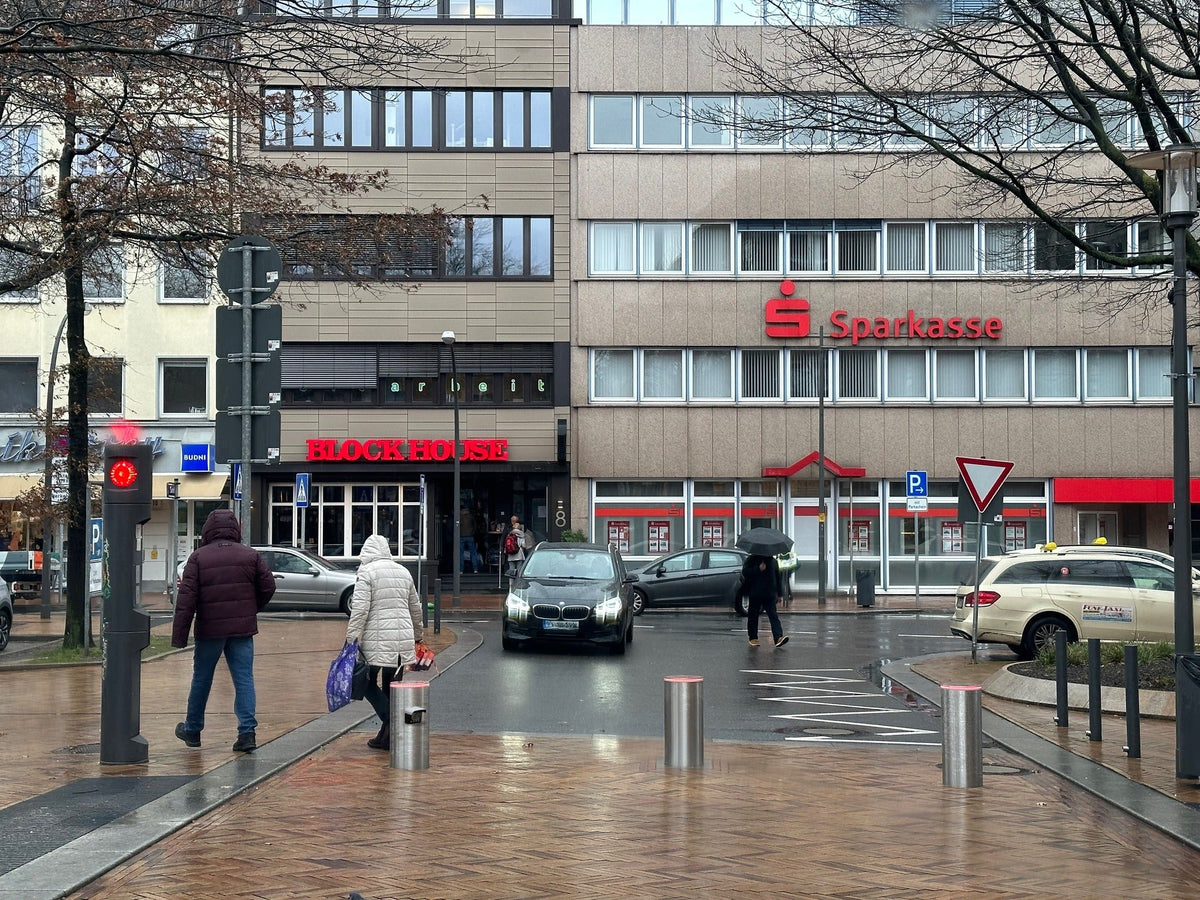
In brief
- A retractable bollard with number plate recognition consists of four building blocks: the pneumatically retractable bollard made of V4A stainless steel (from €1,450, standard model €2,950), the road control unit with Loxone Miniserver (€2,150), the number plate recognition camera (€1,950) and a compressor (from €195).
- A complete entrance with one standard bollard therefore costs €7,245 in technology, or €5,745 with the entry-level bollard – excluding groundworks, excluding the electrician and with no ongoing fees, because the camera works on your own network without a cloud and without a subscription.
- Three ways to save that we recommend as the manufacturer: the entry-level bollard with a 60 cm stroke where no impact protection is required (saves €1,500), existing compressed air at 8 to 10 bar instead of a dedicated compressor (saves €195), and radio instead of a camera where fewer than ten vehicles use the entrance (system from €1,890).
- Delivery time: bollards 3 to 4 working days, camera and accessories 1 to 2 working days, systems from €4,000 around 12 working days. Prices include VAT, as of September 2026, direct from the manufacturer Braun Antriebe, Seevetal near Hamburg.
Anyone searching for a “bollard with number plate recognition” first finds a price for the camera – and is then surprised by a quotation that comes in three to four times higher. The reason is simple: the camera on its own does not move a bollard. In between sit a control unit that translates the camera's signal into lowering and raising again, a compressor that supplies the compressed air, and of course the bollard itself. This article shows which building blocks a complete system needs, what it actually costs from us in Seevetal near Hamburg, and where you can save without compromising on quality. It belongs to the topic cluster Access management for businesses and properties; what data protection requires when number plates are captured is covered in the separate article Number plate recognition at the entrance: what the GDPR requires, and the costs of groundworks and cable trenches are worked through in How much does a bollard system cost?.
Which building blocks does a retractable bollard with number plate recognition need?
An entrance with number plate recognition needs four building blocks: the bollard, the road control unit, the camera and a source of compressed air – everything else is an accessory that may or may not make sense depending on the entrance. The pneumatically retractable bollard made of V4A stainless steel (1.4571) is the component in the ground; it contains nothing more than a stainless steel cylinder that is raised and lowered with compressed air at 8 to 10 bar. The road control unit is the brain of the system: a pre-programmed Loxone Miniserver in a flush-mounted enclosure with an induction loop module, radio receiver and traffic light connection. The number plate recognition is an IP network camera with software that reads the plate, checks it against your approved list and sends the signal to the road control unit via a switching contact. The compressor supplies the air and, like the control unit and the camera's processing unit, sits dry inside the building.
| Building block | Role in the system | List price incl. VAT | Required or optional |
|---|---|---|---|
| Retractable bollard V4A, 60 cm stroke, approx. 80 kg | Barrier in the ground, entry-level model | €1,450 | Required (one bollard version) |
| Retractable bollard V4A Standard, approx. 160 kg | Barrier in the ground, rated for 1.5 t at 65 km/h | €2,950 | Required (one bollard version) |
| Road control unit with Loxone Miniserver | Translates the camera signal into lowering and automatic raising; loops, time schedules, app | €2,150 | Required |
| Number plate recognition (IP camera, software, switching contact) | Reads number plates, checks them against the approved list | €1,950 | Required |
| Quiet drive compressor for 1–4 bollards | Compressed air 8–10 bar, approx. 50 dB | €195 | Required unless compressed air is already available |
| Compressor for 1–20 bollards | Compressed air for many bollards or continuous operation | €450 | Optional |
| Stainless steel traffic light column | Red/green in front of the bollard line where traffic is heavy | from €1,350 | Optional |
| Rittal equipment cabinet | Houses compressor and control unit where there is no plant room | €165 | Optional |
| Radio remote control, 4 buttons | Second way of operating for visitors whose plates are not on the list | €29.50 | Optional |
Prices are our list prices from September 2026 from the V4A stainless steel bollards collection. Not included are the pit, the cable trench, paving work, the 230 V connection by a qualified electrician and the network cable to the camera – these items depend on the site, not on the product.
What does a complete system with number plate recognition actually cost?
The technology for an entrance with one bollard and number plate recognition costs between €5,745 and €7,245, depending on whether the entry-level bollard or the standard bollard is chosen; a commercial entrance with two standard bollards, traffic light column and equipment cabinet comes to around €11,700. The following table works through three typical enquiries, just as they reach us via WhatsApp.
| Item | Private driveway, entry-level | Private driveway, standard | Commercial entrance, 2 bollards |
|---|---|---|---|
| Bollard | 1 × 60 cm stroke: €1,450 | 1 × Standard 160 kg: €2,950 | 2 × Standard 160 kg: €5,900 |
| Road control unit Loxone | €2,150 | €2,150 | €2,150 |
| Number plate recognition | €1,950 | €1,950 | €1,950 |
| Compressor | €195 | €195 | €195 |
| Traffic light column / equipment cabinet | – | – | €1,350 / €165 |
| Technology total | €5,745 | €7,245 | €11,710 |
| Ongoing fees for camera software | €0 | €0 | €0 |
| Delivery time | approx. 12 working days (from €4,000) | approx. 12 working days (from €4,000) | approx. 12 working days (from €4,000) |
Two bollards do not need two cameras or two control units: one road control unit serves one entrance with several bollards, and one camera captures one vehicle per passage. The compressor for one to four bollards is sufficient for occasional use; from 20 to 50 passages a day we plan one to two bollards per compressor, or the model for up to 20 bollards. For complete systems we prepare a package quotation direct from the factory, with no intermediaries – a photo of the entrance sent via WhatsApp is all we need to start.

How do the camera, road control unit and bollard work together?
The sequence has four steps and takes about as long as the bollard's stroke time from recognition to a clear path, i.e. 3 to 10 seconds: a vehicle approaches and the camera captures the number plate; if it is on the approved list, the camera closes a switching contact to the road control unit; the control unit switches the solenoid valve, the bollard lowers and the vehicle drives in; an induction loop behind the bollard line registers the passage, and the control unit raises the bollard again. A second loop directly at the bollard prevents it from rising underneath a stationary vehicle.
The camera is powered via PoE (Power over Ethernet) – one network cable is enough, no separate power line is needed. Processing runs on your own network; you enter number plates in the web interface on a PC, laptop or tablet and delete them again when an employee leaves or a tenant moves out. There is no cloud, no subscription and no ongoing fees. We set up the camera by remote access via AnyDesk or TeamViewer, and the road control unit arrives pre-programmed; its installation by a qualified electrician takes about one working day and requires a network connection at the installation site.

Why doesn't number plate recognition work with the simple radio control?
Because the compact radio control (€245) deliberately has no automation: it only knows “button pressed – bollard down” and “button pressed – bollard up”, but has no input for a switching contact, no loop evaluation and no logic that raises the bollard again by itself after the vehicle has passed. These are exactly the three things the camera needs. That is why, with number plate recognition, the road control unit with Loxone Miniserver is not an extra that could be left out but the prerequisite – and it brings with it the extensions that are wanted at a commercial entrance anyway: time schedules, traffic light connection, remote switching via app or by a security service, integration with KNX, Apple Home, HomeLink or a PLC, and remote maintenance by us without a site visit.
If you already have the road control unit, the camera can be retrofitted later – the connection is provided for, and we integrate it by remote access. With a radio system, on the other hand, the route always leads via a change of control unit.
Where can you save on a system with number plate recognition – and where not?
You can save on the bollard, on the compressor and on the groundworks; you should not save on the control unit, on the drainage or on the material. The largest item is the bollard, and here the honest question is what it has to do: if it is meant to keep out unauthorised parkers and through traffic, the entry-level model with a 60 cm stroke and around 80 kg for €1,450 is sufficient. If it has to stop a vehicle on impact or protect against theft at night, the standard bollard with around 160 kg, 6 mm wall thickness and a rating for 1.5 t at 65 km/h is the right choice – €1,500 more that cannot be retrofitted, because it concerns the sleeve in the ground.
| Way to save | Saving | Prerequisite |
|---|---|---|
| Entry-level bollard with 60 cm stroke instead of standard bollard | €1,500 per bollard | No impact or theft protection required, only an access barrier |
| Existing compressed air instead of a dedicated compressor | €195 | Workshop or site network with 8–10 bar near the cable run |
| Groundworks done yourself or by your own landscaping contractor | Groundworks costs, depending on the area | Pit 80 × 80 cm, 1.0–1.2 m deep, gravel instead of concrete; 230 V by a qualified electrician; free construction support via WhatsApp photo |
| Compressor and control unit inside the building instead of an equipment cabinet | €165 | Frost-free space of approx. 50 × 50 × 15 cm in a garage, cellar or utility room |
| One camera, one control unit for several bollards | €1,950 + €2,150 per additional bollard | All bollards at the same entrance, one lane |
| Radio or GSM instead of a camera | €3,855 net (camera €1,950 and road control unit €2,150 are dropped, radio control €245 is added) | Fixed group of users, no automation needed; see next section |
There are three places where you should not save. First, the drainage: there must be no concrete beneath the bollard, water must drain away through gravel – missing drainage is excluded from the warranty. Second, the material: we manufacture exclusively from V4A stainless steel (1.4571), because V2A does not stay permanently rust-free when exposed to road salt and sea air. Third, the control unit, because a bollard that does not rise again automatically after a vehicle has passed does not secure a commercial entrance. The Mercedes-Benz Center Hamburg demonstrates the second way to save in practice: there, 19 retractable bollards run on the compressed air of the dealership's own workshop, and a compressor for the bollard system was never needed.
When are radio or GSM the better choice instead of number plate recognition?
Radio or GSM are the better choice when a fixed, small group of users operates the entrance and nobody needs to be recognised automatically without getting out – that applies to most private driveways and many small yards. The rule of thumb from our consultations: up to around ten passages a day, the radio control (€245) with one hand transmitter per vehicle (€29.50) is sufficient; a complete radio system with entry-level bollard and compressor therefore costs from €1,890. If the users change frequently, for instance in a residential complex with tenants, care services and delivery drivers, the GSM module (€85) is the most economical solution: up to 200 phone numbers, opening via a free call, no transmitters that have to be handed out and collected back.
Number plate recognition pays off where many vehicles are meant to pass regularly and without stopping – company car park, hotel entrance, depot with delivery traffic, residential complex with underground car park. Bear in mind that it processes personal data: a notice sign, an approved list with a deletion period and, for employee vehicles, the involvement of the works council are part of it; the article on the GDPR at the entrance explains what needs to be done. That it also works without a camera is shown by Hamburg City Hall: there, a person in the police station deliberately decides who drives through and lowers the bollards at the two entrances via the Loxone control – the same road control unit, just without a camera.

What does the fixed bollard with built-in camera for €3,450 offer?
The V4A barrier bollard with integrated number plate recognition replaces the camera mast: the camera sits in a fixed stainless steel bollard (Ø 27 cm, approx. 100 cm high, 6 mm wall thickness) behind a CNC-milled opening, and from the outside it looks like our other bollards. It costs €3,450 and includes the camera with rain protection, pre-wired, plus an LED warning light with Bluetooth control; compared with the freely mounted camera (€1,950), you are therefore paying €1,500 for the bollard body, which at the same time serves as a technology hub – radio receiver, cable distribution and control packages fit inside and remain out of sight.
This makes sense when there is no wall and no mast for the camera at the entrance, when the technology needs to be protected from vandalism, or when a row of bollards has to remain visually uniform. For a private driveway with a garage as the camera location, the freely mounted camera is the more economical solution.
How long does it take from order to the first automatic access?
For a complete system from €4,000, allow around 12 working days for delivery; individual bollards ship in 3 to 4 working days, camera and accessories in 1 to 2 working days from stock. The groundworks run in parallel: pit 80 × 80 cm and 1.0 to 1.2 m deep, gravel bed instead of concrete, cable trench about 30 cm deep to the building, 25 mm hole into the plant room. After installation, the qualified electrician makes the 230 V connection for the compressor and control unit, the road control unit is ready for operation after around one working day, and we connect to the camera via AnyDesk or TeamViewer, set up the recognition and enter the first number plates together with you. From then on, authorised vehicles drive through without a transmitter, key or phone.

What information does a package quotation for the complete system need?
A reliable quotation needs five pieces of information: the width of the entrance, the number of vehicles per day, the protection objective, the location for camera and technology, and the distance from the bollard to the building. The following list is what we ask over the phone before we put a system together.
- Usable width of the entrance measured – this determines the number of bollards
- Vehicles per day estimated: fewer than 10 with a fixed group of users → consider radio; changing users → GSM; many passages without stopping → number plate recognition
- Protection objective defined: block the entrance (entry-level bollard €1,450) or impact and theft protection (standard bollard €2,950)
- Camera location chosen: wall or mast (camera €1,950) or fixed camera bollard (€3,450), with a view of the number plate in front of the bollard line
- Network connection for camera (PoE) and road control unit available at the technology location
- Compressed air: dedicated compressor (€195 / €450) or existing network with 8–10 bar
- Technology location frost-free inside the building (approx. 50 × 50 × 15 cm) or equipment cabinet €165
- Distance from bollard to building known for the cable and hose package (1 to over 100 m, made to measure)
- Traffic light column needed? From €1,350 for heavy traffic or an entrance with poor visibility
- Data protection prepared: notice sign, approved list with deletion period, works council involved for employee vehicles
- Photo of the entrance looking towards the road sent via WhatsApp to 0172 4544485
What does the system look like in operation?
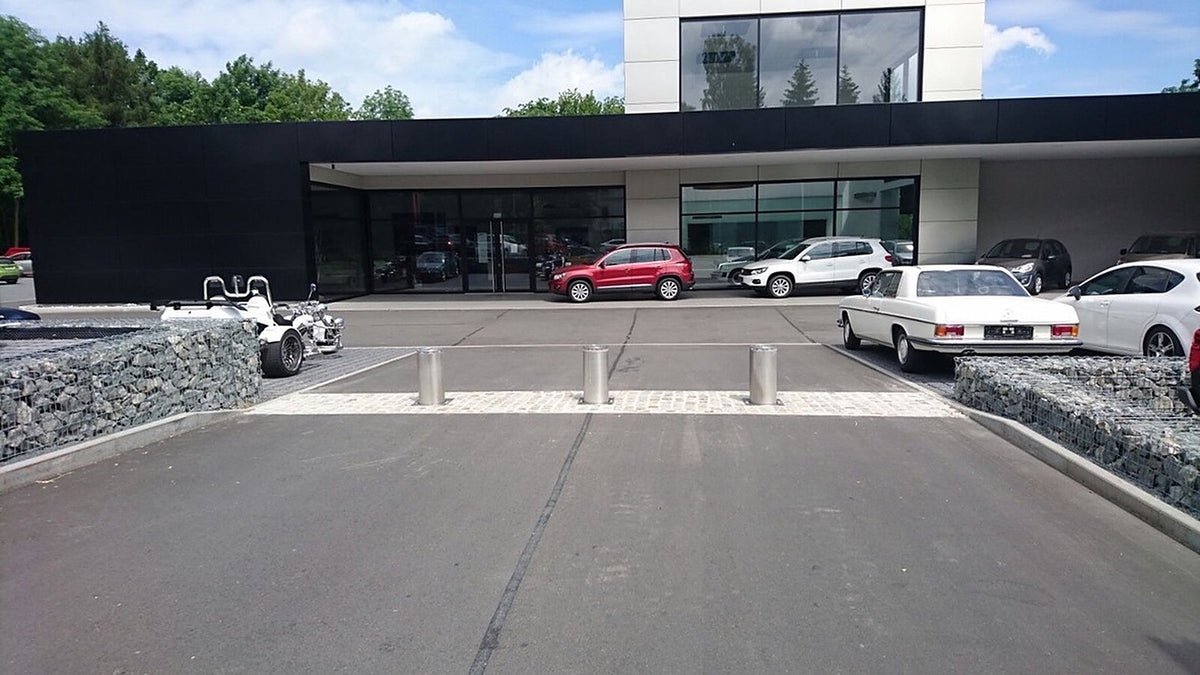
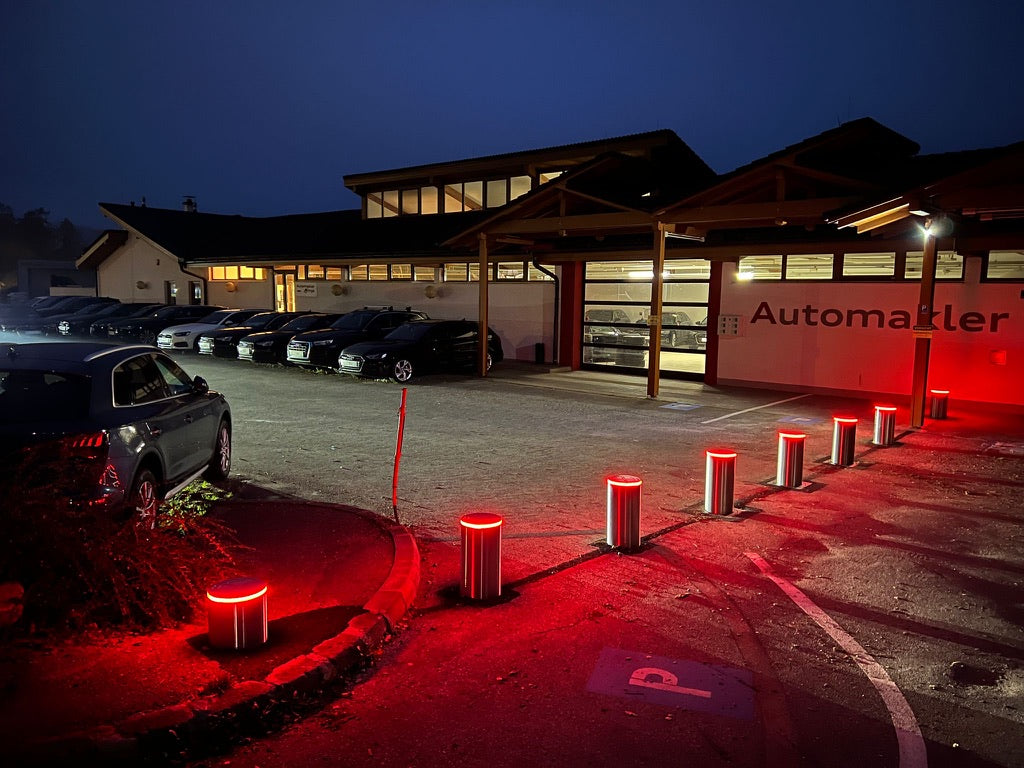
In the car park of a Lidl store, retractable bollards block the parking bays only during deliveries so that the delivery lorry has room to turn; the system has since been extended by three more bollards in front of the sliding gate – a system grows with you without the technology in the ground having to be touched. The campsite with a midday quiet period uses the same road control unit for a time schedule: the bollard rises every day at 12 noon and lowers at 3 pm, and reception can lower it at any time via the app; there, number plate recognition for regular guests is planned as a later extension – exactly the retrofit route the control unit provides for.
Frequently asked questions about bollards with number plate recognition
What does a complete retractable bollard with number plate recognition cost?
The technology for an entrance with one bollard costs €5,745 with the entry-level bollard (60 cm stroke) or €7,245 with the standard bollard (160 kg): bollard, road control unit €2,150, camera €1,950, compressor €195. Groundworks, electrician and network cable are extra. Prices include VAT, as of September 2026.
Is the camera on its own enough to control the bollard?
No. The camera provides a switching contact; the road control unit with Loxone Miniserver turns it into lowering, passage detection via induction loop and automatic raising. The simple radio control does not have this automation.
Are there ongoing fees for the number plate recognition?
No. The camera runs on your own network, and the approved list is maintained in the local web interface. There is no cloud, no subscription and no licence fees.
Do I need two cameras for two bollards?
No. One camera and one road control unit serve one entrance with several bollards. Each additional bollard at the same entrance costs only the price of the bollard.
Where can you save the most on the complete system?
On the bollard: the entry-level model with a 60 cm stroke costs €1,450 instead of €2,950 if no impact or theft protection is required. In addition, existing compressed air instead of a compressor (€195) and doing the groundworks yourself with free construction support via WhatsApp.
Can I retrofit number plate recognition later?
Yes, provided the road control unit is in place. The camera ships from stock in one to two working days and is integrated by us via remote access. With a radio system, a change to the road control unit is needed first.
How long does delivery of a complete system take?
We deliver systems from €4,000 in around 12 working days, individual bollards in 3 to 4 working days, camera and accessories in 1 to 2 working days from stock.
The essentials in three sentences
A retractable bollard with number plate recognition is a system of four building blocks – pneumatically retractable bollard made of V4A stainless steel (€1,450 or €2,950), road control unit with Loxone Miniserver (€2,150), number plate recognition camera (€1,950) and compressor (€195) – which costs €5,745 to €7,245 per entrance as a technology package and runs without a cloud, subscription or licence fees. You can save on the bollard model, on existing compressed air and on doing the groundworks yourself, but not on the control unit, drainage or material; anyone with fewer than ten vehicles a day and a fixed group of users is better off with radio (from €1,890 complete) or GSM (€85), at lower cost and without the data protection effort. Braun Antriebe manufactures the bollards and compressed air technology itself in Seevetal near Hamburg, programs the road control unit in-house, sets up the camera via remote access and delivers complete systems from €4,000 in around 12 working days direct from the factory; all prices are our list prices from September 2026.
The product pages Automatic number plate recognition and Road control unit with Loxone list what is included; which control unit generally suits which entrance is compared in the article Bollard control: radio, GSM, number plate recognition or smart home?, and the overview of purchase costs is given on the page Bollard costs.
Would you like a package quotation for your entrance with number plate recognition? Send us a photo of the driveway and the number of vehicles per day – we will put together bollard, control unit, camera and compressor and tell you where you can save.
Phone 040 226390411 · WhatsApp 0172 4544485
View stainless steel bollardsRequest advice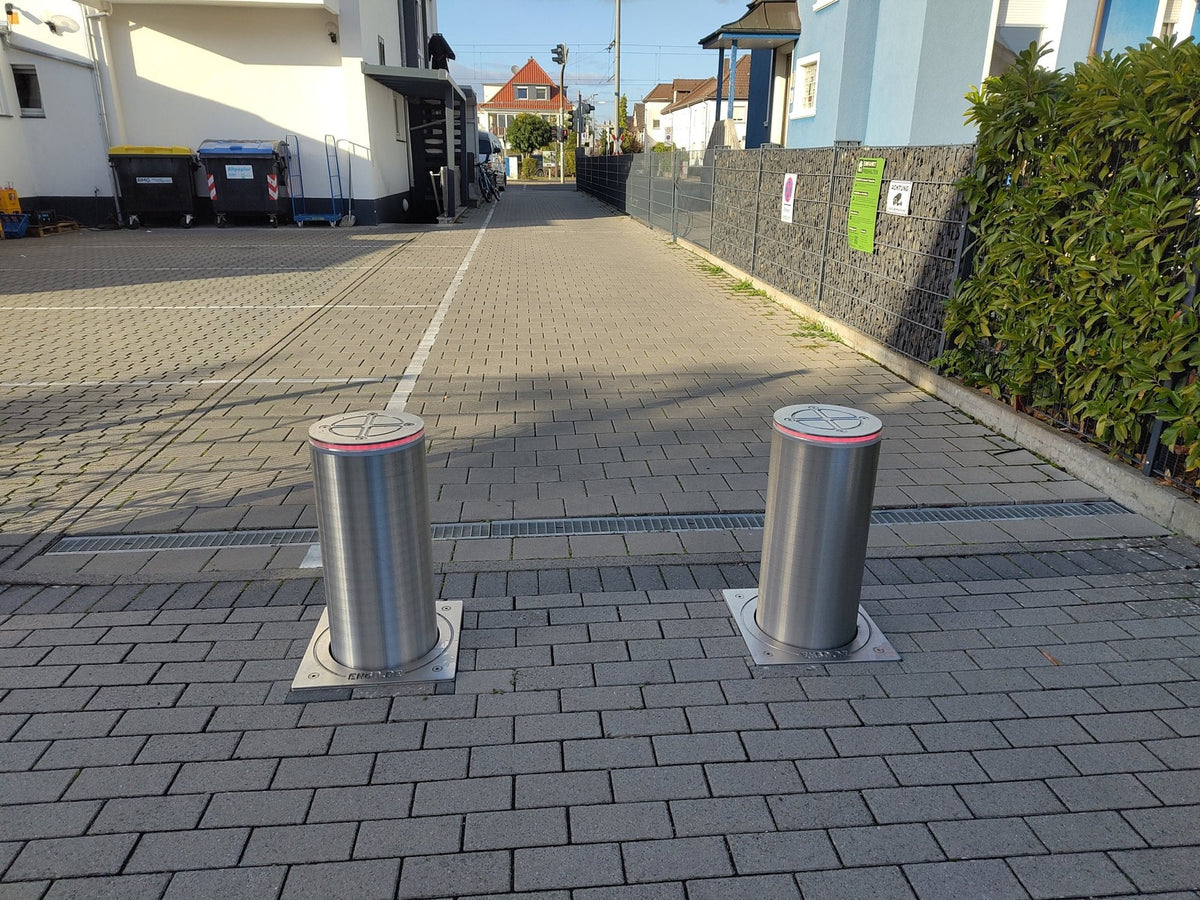

Share:
Bollards in a power cut: does the access route stay open for the fire brigade?
Ram raids by car: how exposed is your shop?