

Guide to bollards, access control and site protection
Bollards can perform very different tasks: they keep unauthorised vehicles out of private driveways, control access to business premises, secure public areas or add to protection against vehicle theft and ram-raid attacks. The right solution therefore always depends on the location, the type of use and the required level of security.
In our guide you will find fundamentals, comparisons and planning aids on bollards and access solutions. It offers orientation for private property owners as well as for companies, property operators, local authorities and those responsible for particularly vulnerable sites.
How does the Braun Antriebe guide help?
Our guide answers questions on choosing and planning bollards, securing driveways and vehicles, access control, and installation, control, costs and maintenance. You will also find information on increased security requirements, ram-raid and burglary protection, and vehicle security barriers. This allows you to assess your own requirements first and then go straight to the relevant topic.
What information does this guide contain?
A private driveway places different demands on an access barrier than a depot with regular delivery traffic. Different standards again apply to a pedestrian zone, a Christmas market or a particularly vulnerable area that needs to be protected against deliberate vehicle attacks.
That is why our guide is structured not by individual products but by application and protection requirement. You will learn, for example, which options exist for private driveways, how access to company premises can be automated and which questions need to be clarified for municipal protection concepts. We also cover topics such as installation, control, costs, operational availability and different security levels.
This helps you get to the question that really matters for your project more quickly.
Protecting driveways and vehicles on private property
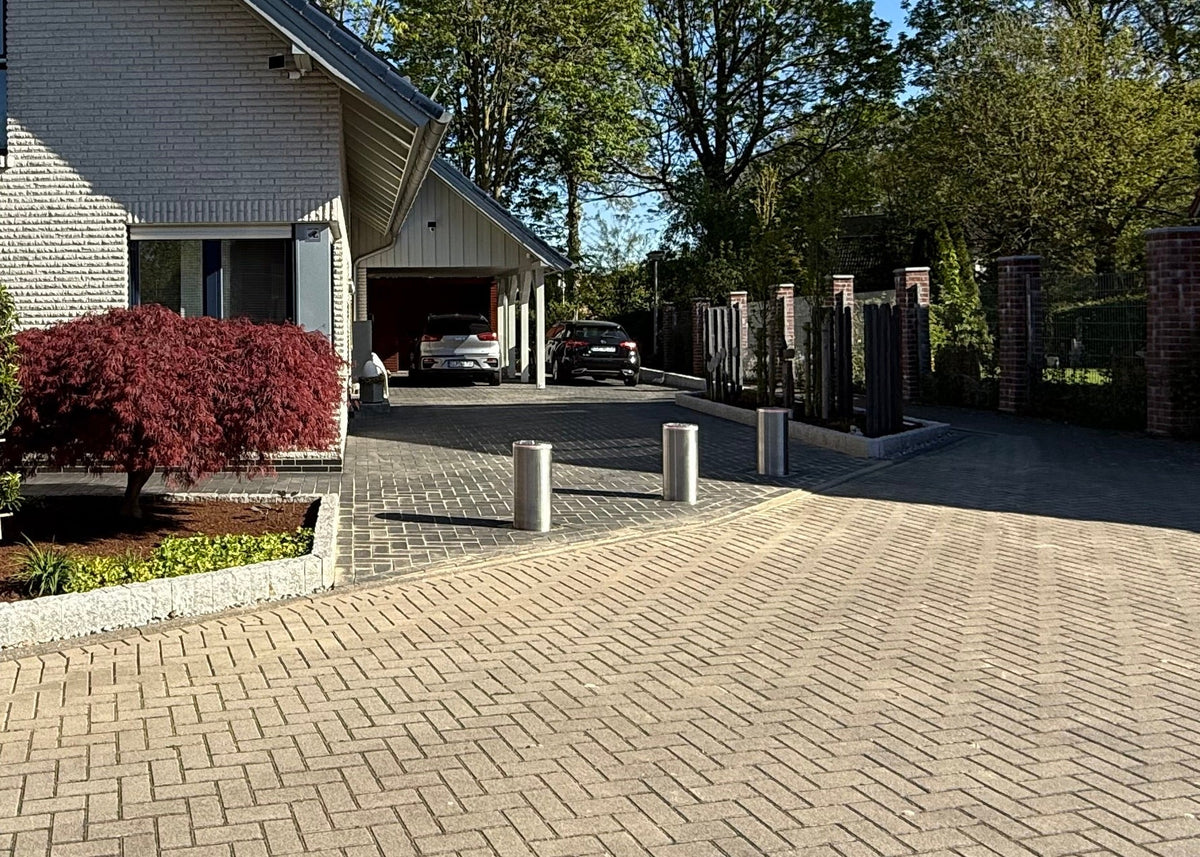
An openly accessible driveway can quickly become a nuisance: strangers park in your space, vehicles turn on your property or a carport can be reached freely from the street. Owners of high-value vehicles often also want to physically secure the normal exit from the property.
Bollards can be a flexible solution in such situations. Retractable models in particular allow the driveway to be opened when needed and closed again afterwards. Depending on the property, such systems can also be retrofitted to existing driveways.
In the Driveway & vehicle protection section you will learn which systems are generally suitable, what to consider during installation and how convenient operation can be achieved.
Further guides:
- Protecting driveways, parking spaces and vehicles: a guide for private properties
- Retrofitting bollards: securing driveways and entrances reliably
Controlling access to company premises and properties
For companies, depots and larger properties it is often not enough simply to open or close an entrance. Employees need to pass through regularly, visitors need temporary access, suppliers must reach certain areas and unauthorised parkers should stay out. At the same time, it must be clear how emergency services or other authorised vehicles gain access when needed.
Well-designed access control therefore combines security, authorisation management and traffic flow. Automatic bollards, barriers or gates can be combined with radio control, number plate recognition, sensors, traffic lights or higher-level control systems.
Which technology makes sense depends on factors such as user groups, operating hours, the number of vehicle movements and the required level of security.
Further guide:
Protecting public spaces and events against vehicle attacks
Market squares, pedestrian zones, shopping streets and event areas should remain as open and accessible to people as possible. At the same time, certain access routes may need to be controlled or areas protected against dangerous vehicle movements.
Municipal access protection therefore does not begin with choosing a particular bollard. First, threats, access routes, weak points and protection objectives have to be assessed. Delivery traffic, emergency and rescue vehicles, accessibility, urban design and subsequent operation also play a role.
Where security requirements are higher, a clear distinction must also be made between an ordinary access barrier and a tested vehicle security barrier.
Further guide:
Protection against smash-and-grab burglary, ram raids and vehicle theft
Car dealerships, jewellers and other businesses with high-value vehicles or stock may need additional mechanical protection. One possible scenario is the use of a vehicle as a means of attack, for example to force through a glass frontage or an entrance.
Bollards and other barriers can be part of a more comprehensive security concept. What matters, however, is the specific protective effect required. A simple access restriction, a reinforced bollard and a vehicle security barrier tested under defined conditions are not equivalent.
For sensitive sites of this kind, mechanical and electronic security measures should therefore be considered together and the required resistance clearly defined in advance.
Further guide:
Which bollard solution suits which application?
The following overview is intended as initial guidance. The final choice always depends on the specific requirements on site.
| Application | Typical requirement | Possible solution | Typical control |
|---|---|---|---|
| Private driveway | Block access | Retractable bollard | Radio / GSM |
| Parking space with high-value vehicle | Make vehicle theft more difficult | Reinforced retractable bollard | Radio / GSM |
| Company premises | Automate authorised access | Bollard system | Number plate recognition / access control system |
| Depot | Manage delivery and staff traffic | Automatic bollard system | Traffic lights / sensors / control unit |
| Pedestrian zone | Admit vehicles in a controlled way | Retractable security bollards | Central control |
| Event area | Prevent vehicle attacks | Tested vehicle security barrier | Depending on the security concept |
| Car dealership | Make theft and ram raids more difficult | Reinforced or tested bollards | Automatic or manual control |
| Jeweller / high-end retail | Prevent smash-and-grab burglary | High-security bollards | Depending on the site |
What should be clarified before planning a bollard system?
What is the protection objective?
First, it should be clear which problem needs to be solved. Is it about unauthorised parkers, regulated access, additional vehicle protection or protection against a defined vehicle attack?
Who needs to use the entrance?
Residents, employees, customers, visitors, suppliers or emergency services may have different access requirements. These user groups should already be taken into account at the planning stage.
How often will the bollard be operated?
A private driveway with only a few opening cycles a day places different demands on technology and control than a depot with numerous vehicle movements.
What are the structural conditions?
Subsoil, installation depth, existing utility lines, drainage and road surface have a considerable influence on the installation of a retractable bollard system.
How should access be controlled?
Depending on the application, options include radio control, GSM, number plate recognition, timer control, sensors or integration into existing systems.
What level of security is required?
Not every bollard system performs the same protective function. In particular, a normal access barrier must not automatically be equated with a tested vehicle security barrier.
What types of bollards are there?
Retractable bollards
They are suitable for entrances that are to be opened regularly and then physically closed again. When retracted, the road surface remains largely clear.
Reinforced bollards
Reinforced versions are an option where higher mechanical requirements apply than for a simple access restriction.
High-security bollards
They are intended for more demanding protection concepts and clearly defined security requirements. The decisive factors are the specific technical properties and, where applicable, any tests that have been carried out.
Fixed bollards
Fixed bollards are suitable for areas that are permanently closed to vehicles or as a complement to movable access systems.
How can a bollard system be controlled?
- Radio remote control: A straightforward solution for a manageable number of regularly authorised users.
- GSM: Access can be granted via the mobile network or appropriately configured mobile phones, which also makes it suitable for more flexible user groups.
- Number plate recognition: Registered vehicles can be recognised automatically and admitted if they are authorised.
- Induction loops: They detect vehicles in defined areas and can trigger sequences within an access control system.
- Traffic light control: Traffic lights indicate clearance or waiting phases and can, for example, ensure clearer sequences where there is oncoming traffic.
- Smart home and building automation: Depending on the technical design, bollard systems can be integrated into existing control or building systems.
- Central access control: At larger sites, several entrances and user groups can be managed via shared control logic.
What security effect can a bollard provide?
‘Bollard’ describes a design in the first place, not a uniform security promise. Depending on the version, installation and tested performance, the protective effect can vary considerably.
A distinction should be made in particular between:
- Access restriction – vehicles are not supposed to drive into an area as a matter of course
- Deterrence – a visible physical barrier makes unauthorised use more difficult
- Mechanical vehicle protection – a vehicle should not be easy to move out through the normal entrance
- Burglary or ram-raid protection – higher mechanical resistance is required
- Tested vehicle security barrier – a defined performance has been demonstrated under specified test conditions
Which of these requirements is relevant for a site should be clarified before choosing a product.
Explore the guide by topic
-
Basics · Planning · Comparison · Security · Costs
Everything about private driveways, parking spaces, carports and additional vehicle protection.
-
Planning · Control · Processes · Operation
Information for companies, property operators, facility management and commercial sites.
-
Threats · Planning · Standards · Procurement
Specialist information for public spaces, local authorities, events and planning bodies.
-
Burglary & ram-raid protection
Security · Testing · Planning · Comparison
Information for particularly vulnerable sites, car dealerships and high-end retail.
Bollard and access solutions in practice
Theory is important – but what really counts is how a solution performs under real conditions. That is why Braun Antriebe documents a range of applications from the private, commercial and public sectors.
Examples from our case studies include:
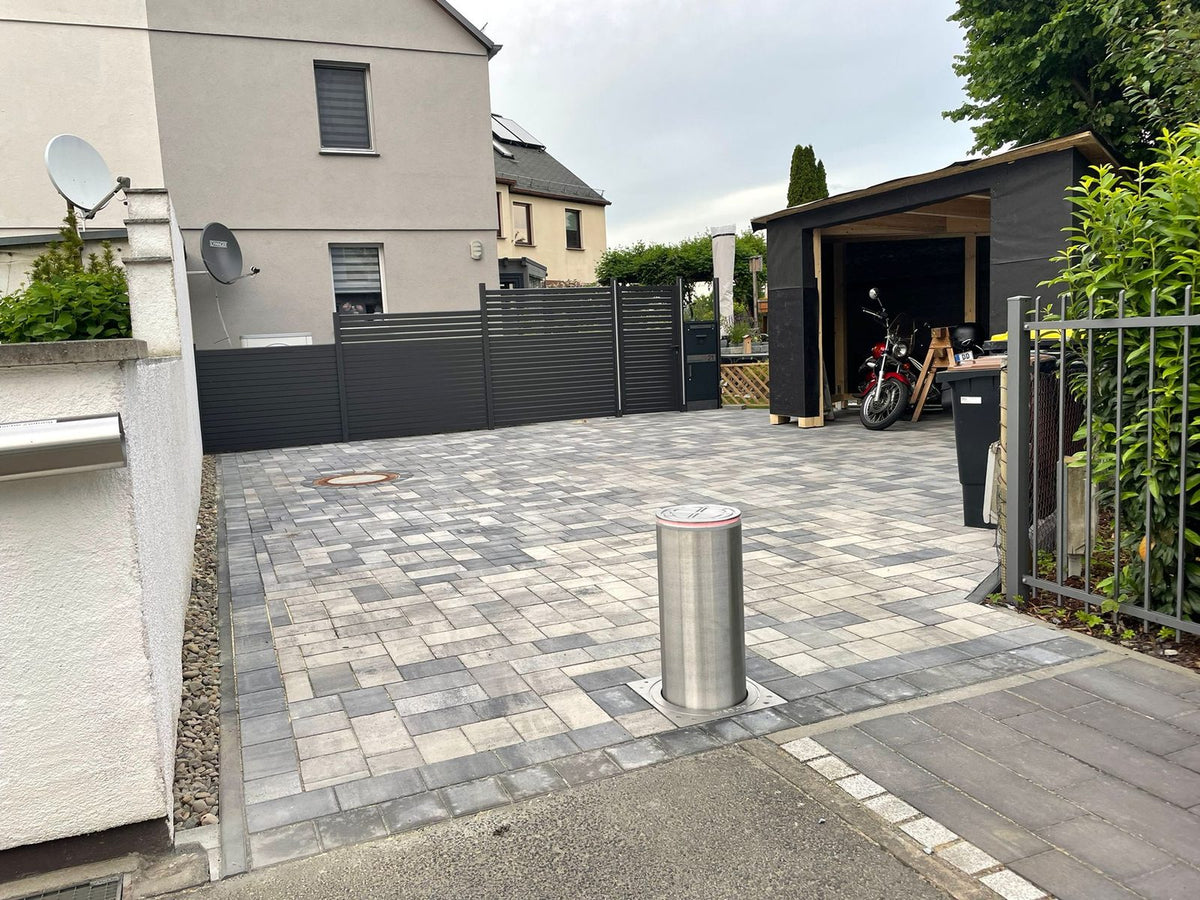
- a secured entrance at a private residence
- an automatic bollard solution at a campsite
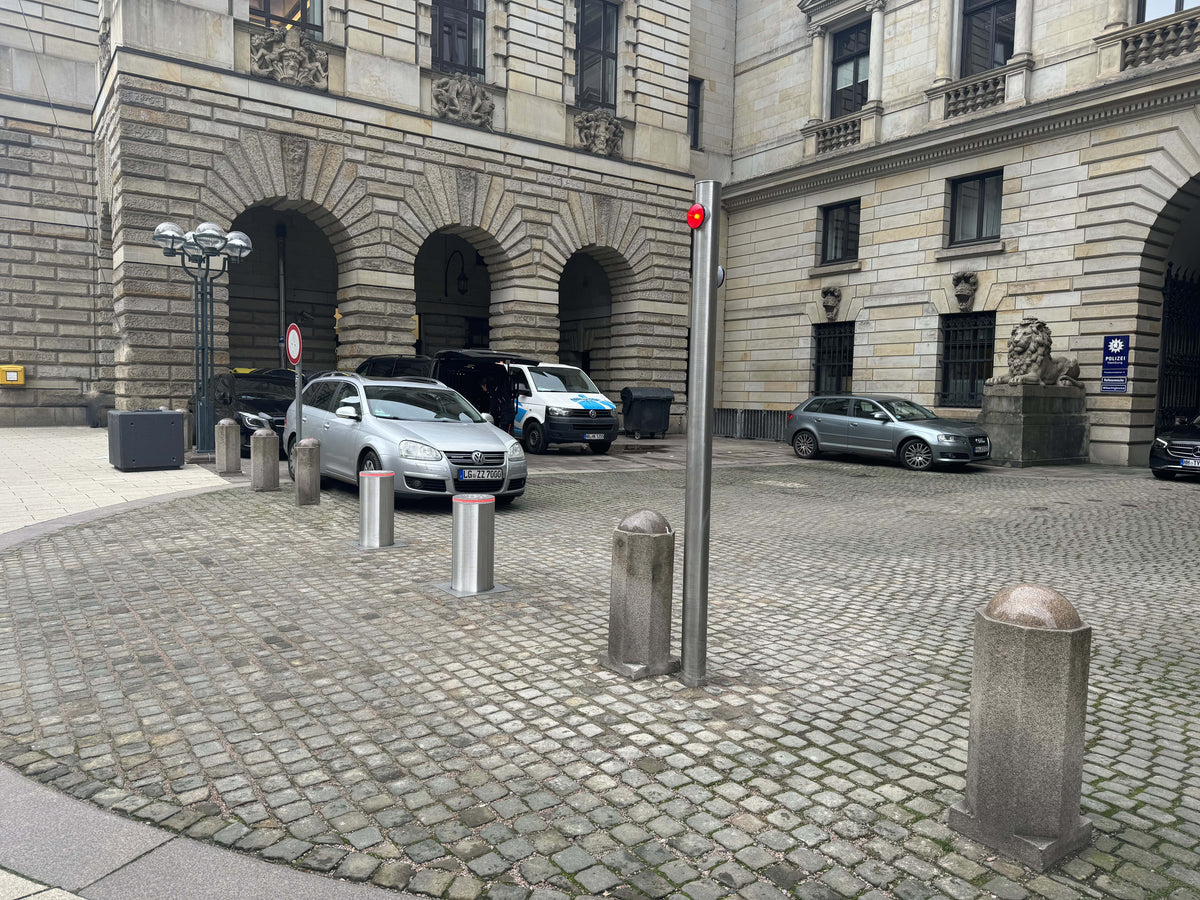
- the protection of Hamburg City Hall and its surrounding grounds
- a bollard that withstood a collision with a delivery van
The full case studies show the initial situation and the solution implemented in each project.
Frequently asked questions about bollards and access control
Which bollard is suitable for a private driveway?
For driveways that are used regularly, retractable bollards are often an option because they can clear the way when needed and then block it again. Which version makes sense depends on factors such as driveway width, use, subsoil, operation and the protection required.
How much does a retractable bollard system cost?
The total cost is not made up of the bollard alone. Depending on the project, it also includes the control system, groundworks, cabling, installation and additional equipment. A reliable total cost can therefore only be determined once the specific installation situation has been assessed.
Can a retractable bollard be retrofitted?
In principle, retrofitting may be possible. Beforehand, however, installation depth, subsoil, existing utility lines and drainage, among other things, must be checked. The width and geometry of the entrance also play a role.
How is an automatic bollard controlled?
Depending on the system, it can be operated by radio remote control, GSM, push button, number plate recognition or a central control system, for example. The number of users and the usage situation are the key factors when choosing.
What happens in the event of a power or system failure?
The behaviour depends on the respective drive and control system. It should therefore be clarified at the planning stage how the entrance can be used or opened in the event of a power, communication or control failure.
What maintenance does a bollard system need?
Maintenance requirements depend on the design, frequency of use, installation situation and technical equipment. Regular inspections can be important, especially for heavily used systems, to keep function, drainage and control working reliably.
Can bollards protect against vehicle theft?
A bollard can create an additional physical obstacle because the vehicle cannot easily be removed via the normal property exit. However, it is no guarantee against vehicle theft and should be combined with other protective measures.
What distinguishes a normal bollard from a high-security bollard?
What matters is not the name alone but the specific construction and, where applicable, proven performance. A bollard used to secure a parking space does not automatically meet the requirements for increased ram-raid or vehicle attack protection.
Planning a bollard or access solution?
Private driveway, company premises, depot or public space: which bollard system makes sense depends on the location, use, structural conditions, control requirements and the desired level of security.
Braun Antriebe helps you assess these requirements and configure a suitable bollard and access solution.
Would you like to know which bollard solution suits your entrance?
View stainless steel bollards Request advice
Guides

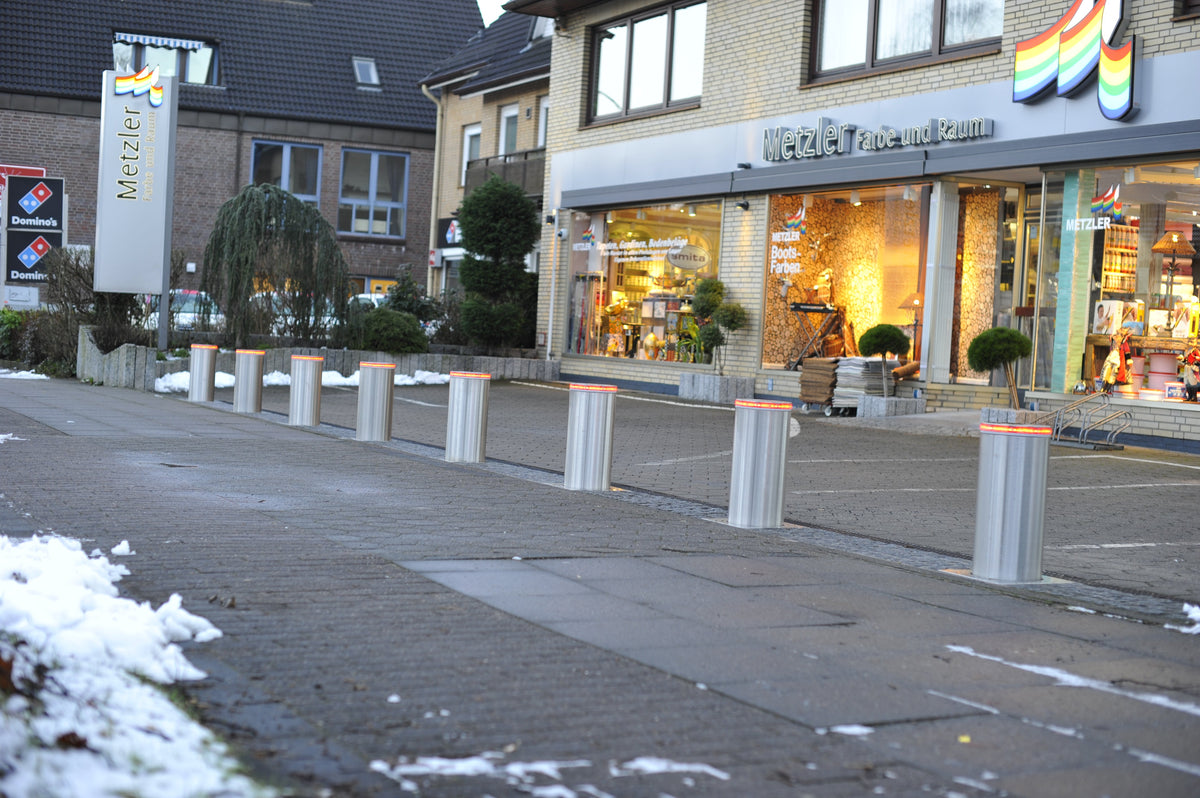
Theft protection for car dealerships: which gap does the forecourt leave open at night?
Where does a car dealership lose its vehicles at night – and how do you close the gap without blocking the forecourt during the day? The six typical weak points of open ground and access, the sabotage check for any bollard system and the solution with compressed air from the dealership’s own workshop, shown at the Mercedes-Benz Center Hamburg with 19 bollards.
Ram raids by car: how exposed is your shop?
How high is the risk of a vehicle being driven through your shop window? A ten-question risk check for owners of small shops, the real case of a facade hit twice, and a comparison of what planters, cycle stands and bollards actually stop – with prices for a row of bollards.

Bollard with Number Plate Recognition: What Makes Up the Complete System – and Where Can You Save?
Bollard, road control unit, camera, compressor: what an entrance with number plate recognition costs in full, with list prices and three fully costed examples. Plus the ways to save that the manufacturer recommends – and when radio or GSM are the better choice.
Bollards in a power cut: does the access route stay open for the fire brigade?
What happens to a retractable bollard when the power fails – and does the fire brigade still get onto the property? The two valve positions of the pneumatic bollard, the ways of operating it without a key, and what homeowners and property managers should agree with the fire safety authority.
Safety loop, exit loop, traffic-light column and traffic control unit: how a commercial bollard system prevents a bollard from rising beneath a vehicle. With prices, dimensions and practical examples from a Berlin residential complex and Hamburg City Hall.
Bollard running costs: what does a retractable bollard cost in day-to-day operation?
Electricity, condensate, cleaning, winter and the repair case: what a pneumatically retractable stainless-steel bollard costs year after year once it is installed – with documented figures and two worked examples. Plus the manufacturer's comparison with hydraulic and electric spindle drives.
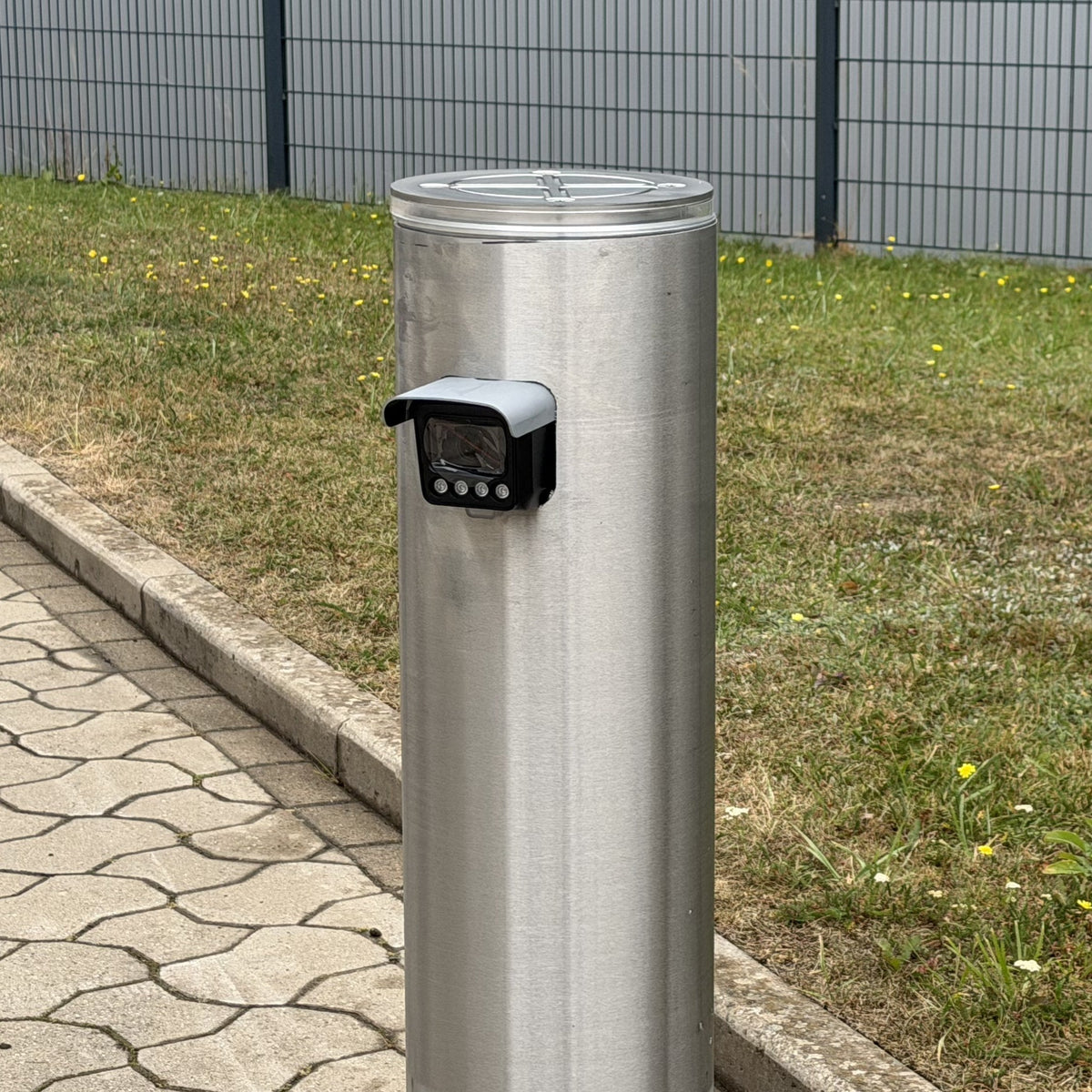
A vehicle number plate is personal data – number plate recognition at an entrance therefore needs a purpose, a legal basis, a notice sign and retention periods. What the GDPR requires, how Braun Antriebe’s locally operating number plate kit handles it and when a control system without number plates is the better choice.
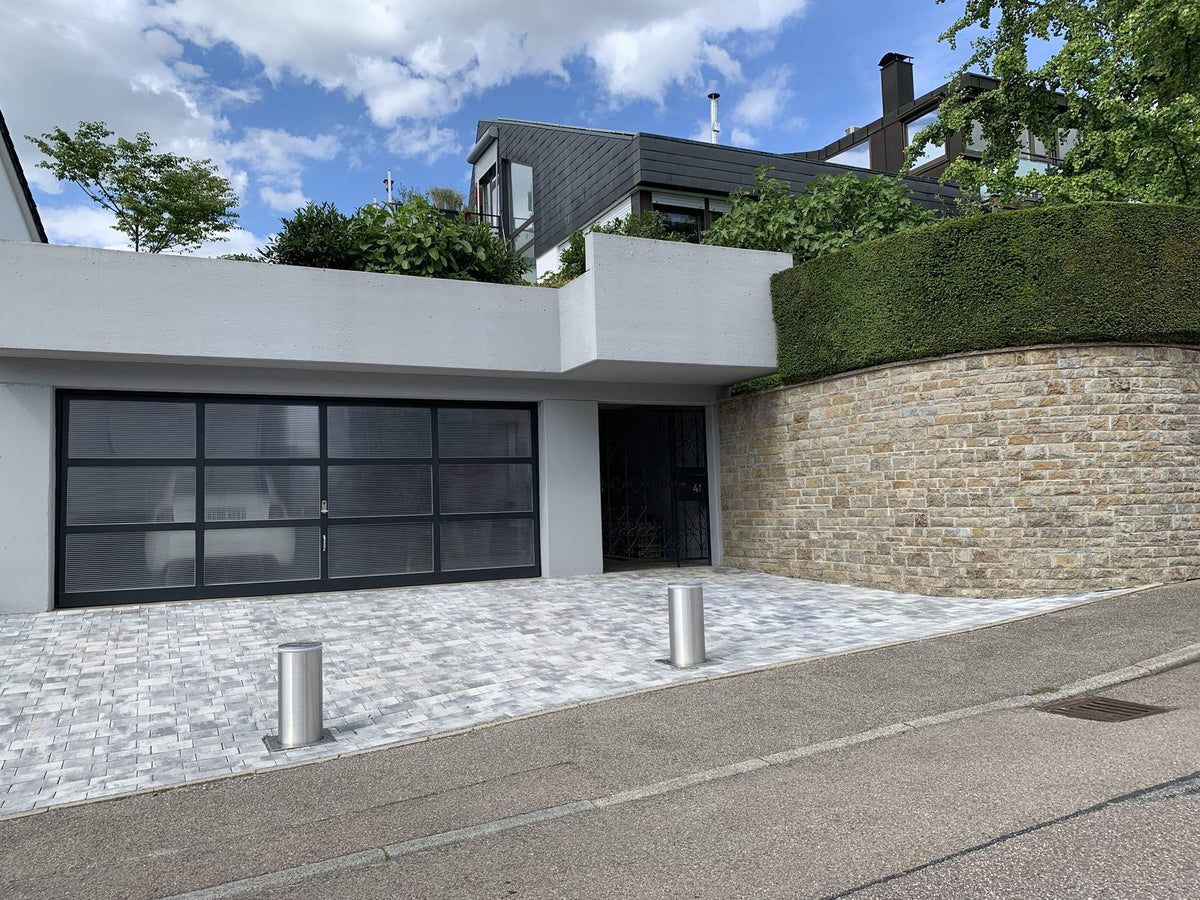
A retractable bollard that stands entirely behind the property boundary usually needs no planning permission – what matters are the boundary, ownership, fire service access and utility lines. Who has a say among the building authority, owners’ association, landlord and neighbours, what technical answers pneumatics provide and what must be clarified before installation.

Preventing Car Theft with Bollards: What an Access Barrier Can Do – and What It Can’t
A bollard does not stop anyone breaking into your car, but it does stop the car rolling off your property: the locking bolt, behaviour in a power cut and four weight classes from 80 to 500 kg determine whether the barrier holds. What an access barrier can do against car theft, where its limits lie and how carports, garages and car dealerships use it.
